Making prayer routine easy for kids: gentle family habits, 4–15
Quick answer
Making prayer routine easy for kids means inviting, not forcing: pray together, tie one prayer to a fixed point in the day, such as Maghrib before homework, keep it short and praise the effort. Protect sleep: 9–12 hours at ages 6–12. Hitting or shaming often makes children avoid prayer. Families follow their own scholars on what to practise, and when.
 By the ParentMind team12 min read
Listen to this article
17 min listen · Read by your device's voice
At a glance
- Who it is for
- Parents of children aged about 4–15 who want prayer to feel like a warm family habit, not a daily fight
- Key takeaways
- Children usually come to prayer by copying the people they love, so praying together often helps more than reminders.
- Fit prayer around school, coaching and sleep; a shared Maghrib before homework is an easy start for many families.
- Praise effort and never shame: hitting or shaming a child to make them pray often makes them avoid it and can harm your bond.
- What to practise, and from what age, is a religious question for your family and its scholars; this page covers routine and feelings.
If you are looking for ways of making prayer routine easy for kids, you may know this evening well: the Maghrib azan sounds, your child is mid-game, and “Come and pray!” turns into a tug of war. Or your child prays only when reminded, quickly, with one eye on the cartoon.
This is very common. Young children can't stand still for long, school children juggle school, coaching and homework, and teens start asking their own questions. A faith routine for children usually grows better through warm, steady habits than through pressure, especially when prayer is done together.
This page covers routine and feelings, age by age, with a 7-day plan. What to practise, and when, is a religious question, and families follow their own scholars on it.
Why can a prayer routine feel hard for children?
A prayer routine asks for skills that grow slowly with age: standing still, remembering words, stopping something fun, and doing a thing because it matters rather than because it's exciting. Making prayer routine easy for kids starts with seeing which of these, or which part of the routine, is getting in the way:
- Timing: being called away mid-game, or asked when tired or hungry.
- Being told, not invited: “Go and pray!” called from another room can make prayer feel like a chore.
- Not understanding: many children enjoy hearing, in simple Bangla, what a short dua means.
| Age | What children can usually manage | What tends to help |
|---|---|---|
| 4–6 years | Copying you for a minute or two, a short dua, standing on a small mat beside you | Let them join when they want and keep it playful; wandering off is fine |
| 7–9 years | Learning the steps from family, joining a prayer with a parent, remembering with a reminder | A fixed time in the day, their own mat, a parent alongside and praise for effort |
| 10–12 years | Keeping a routine with fewer reminders, and asking “why?” | Explain meanings simply, let them lead small parts, and keep reminders private |
| 13–15 years | Making their own choices, wanting privacy, questioning, listening to friends | Your own example, calm talks and an open door; no public correction or pressure |
Making prayer routine easy for kids: 7 steps that often help
These steps are about the routine; what your child practises, and when, is your family's decision with its own scholars.
- Pray where your child can see you. Children copy what they see far more than what they hear.
- Start with one shared time a day, the one that fits your family best; for many school children it is Maghrib, between play and homework.
- Give a warning, not a summons: “Azan in five minutes, finish your level.”
- Make it theirs: their own small prayer mat, a cap or scarf they chose, a corner that is always ready.
- Keep it short and warm for young children, and let little ones wander off without a scolding.
- Praise the effort, specifically: “You stopped your game when you heard the azan. That wasn't easy.”
- Remind once, calmly and privately, never in front of guests or cousins.
What you might say
- The azan is in five minutes. Finish up, and let's pray together.
- Do you want to stand next to me or next to Dadu today?
- You came as soon as I called. I'm really glad.
- You forgot today, and that's okay. Shall I remind you before the azan tomorrow?
- You don't have to be perfect. I'm happy you're trying.
How to fit prayer times into a school day, coaching and sleep
Prayer times move with the sun through the year, while school, coaching and bedtime stay fixed, so plan a prayer routine for children around the day your child actually has. Here is one example for a school child; adjust it to your family's practice and local times:
| Prayer | The day | A gentle way to fit it |
|---|---|---|
| Fajr, before sunrise | Asleep; school starts early | Waking children for Fajr is your family's decision; if you do, an earlier bedtime keeps sleep at 9–12 hours at ages 6–12 |
| Zuhr, midday | At school, or on the way home | Follow the school's arrangements; at home, lunch and a rest first if your child is worn out |
| Asr, afternoon | Coaching, tuition or play | Before play or tuition, rather than stopping in the middle |
| Maghrib, sunset | Play ends, homework begins | In from play, wash, pray together, then homework |
| Isha, night | Dinner, then bed | Before the bedtime routine, so bedtime stays on time |
Sleep is part of the plan: about 10–13 hours in 24 hours at 3–5 years, 9–12 hours at 6–12 and 8–10 hours at 13–18. An early start needs an earlier bedtime, with screens off an hour before bed; a tired child finds every routine harder.
Family prayer habit: praying together at home and at the mosque
A family prayer habit is often the gentlest way in, because children join something they see the adults they love enjoying:
- At home: mats laid out in one corner, where anyone can join. A little one who copies you for a minute is joining too.
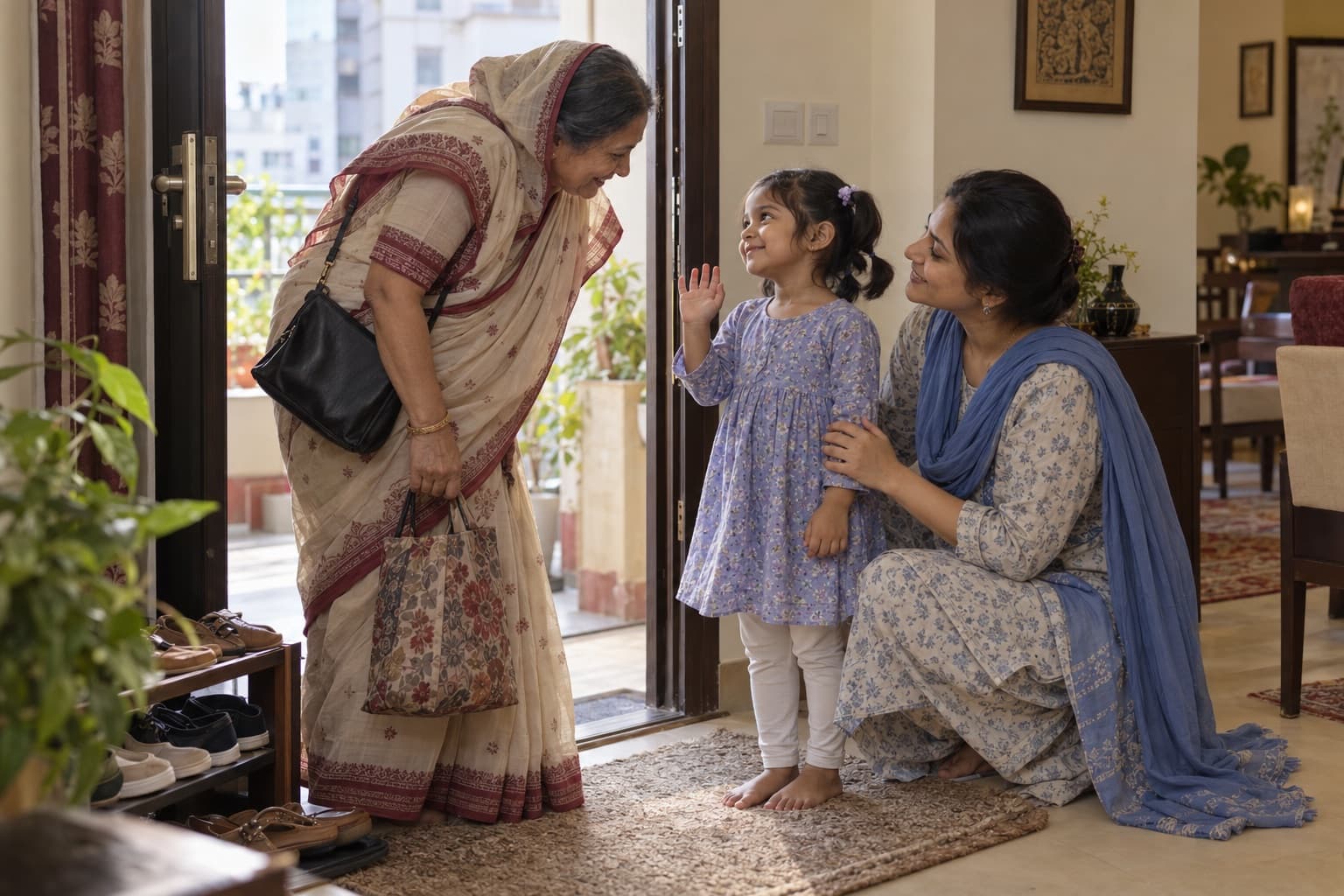
- With grandparents: many love praying with a grandchild or teaching a short dua. It gives them a special role, and the child a special person.
- Both parents: when mothers and fathers both pray at home, or take turns with the children, sons and daughters see it as everyday family life.
- Friday: for families who go to Jumu'ah, the walk to the mosque with a parent and a special lunch afterwards can become a weekly ritual.
- At the mosque: keep a young child beside you the whole time, agree where to meet if you get separated in a Friday or Eid crowd, and hold hands on the busy road. Never send a young child to the mosque, or home from it, alone.
How to make Quran time enjoyable, and a calm bedtime dua
Many families also keep a short Quran time or a dua before meals or sleep; for many, that is their Islamic bedtime routine. The same ideas apply:
- Short and regular: a few minutes most days usually beats a long session once a week.
- Warm: sit close, explain meanings in simple Bangla, and praise effort rather than speed.
- Tied to a moment: a dua said together as part of your children's bedtime routine, between brushing teeth and lights out, is a calm moment for many children.
- Safe teachers: for lessons at home, a mosque or a madrasa, choose someone your family trusts, keep home lessons in a shared room with another adult in the house, and ask your child often how it is going. A teacher who hits, shames or frightens a child is never part of a good habit.
What if your child doesn't want to pray?
Many children go through times of not wanting to pray, often as they grow older. It is usually a phase, or a sign that something about the routine isn't working, not a sign that you have failed.
- Ask, and listen: “What makes it hard?” The answer is often practical, such as boredom, a game, tiredness or a teasing cousin, and so is the fix: a new time, a warning, praying side by side.
- Encourage gently: notice every effort, and keep any rewards small, so prayer doesn't become a deal.
- Never hit or shame. Hitting or shaming a child to make them pray often makes them avoid it, pray only when watched or feel afraid, and it can harm the bond between you. Calm, steady guidance tends to work better over time; see positive discipline without hitting.
- No comparisons: “Your cousin never misses one” tends to bring resentment, not prayer.
- Respect a child who isn't ready: keep praying yourself, keep the door open and keep your relationship warm. With teens, listen to questions calmly; for questions of belief, families turn to their own scholars.
Faith habits in a Bangladeshi home: the azan, relatives and Ramadan
Faith is woven into daily life in many Bangladeshi homes, from the azan at dusk to Friday lunch and Eid morning. For the wider picture of family life here, see parenting in Bangladesh.
- The azan as a family clock: in many neighbourhoods the Maghrib azan already means “come home from play”, which is easier to build on than a new rule.
- Relatives' comments: if someone says “So big and still doesn't pray?” in front of guests, a calm “We're working on it together” protects your child.
- Grandparents: thank them for their love, agree together on the gentle approach so the child hears one message, and give them a role, such as the bedtime dua with Dadi.
- Ramadan: many children want to join in; keep sleep in mind, and see a Ramadan routine for kids and supporting a child's first fasts.
- Small flats: share one quiet corner fairly between prayer, homework and sleep, with a rechargeable light, not a candle, for load-shedding.
- Many faiths: Bangladesh is home to Hindu, Buddhist and Christian families too, with their own prayer and puja times. The same ideas fit any family: go together, keep it warm, never shame.
A 7-day plan for a gentle prayer routine
Making prayer routine easy for kids takes longer than a week, but a week is enough to start. Note one line a day: the time, whether your child joined, how many reminders it took and the mood.
- Day 1: change nothing. Notice when prayer goes well or badly, and why: tiredness, a game, guests.
- Day 2: choose one prayer time that fits your child's day, often Maghrib, and tell them warmly you'd love to pray together then.
- Day 3: give a five-minute warning, and pray side by side.
- Day 4: let your child choose something: their mat, where to stand or the dua at bedtime.
- Day 5: praise one specific effort, and agree with the adults at home: no shaming, no comparisons, no hitting.
- Day 6: add a short bedtime dua or story if it suits your family, and check that bedtime is still on time.
- Day 7: read your notes. Did reminders drop, and was the mood better? Keep what helped, and change one thing next week.
When is it more than a prayer-routine struggle?
Most prayer-routine struggles ease with time and warmth. Look more closely, and act the same day on safety signs, if:
Get help if
- Your child seems very anxious about getting prayer or washing exactly right, repeating it or panicking over small mistakes, for more than two weeks: talk to your child's doctor.
- Anyone who teaches your child, at home, a mosque, a madrasa or coaching, hits, shames or frightens them: believe your child and act the same day. Report an adult who hits your child to the local police station (thana), and call 999 if your child is in danger now.
- Your child suddenly fears a class, a teacher or a visitor, or shows any other sign of abuse, bullying or a sudden change: believe the child, act the same day, 999 if in danger.
- Prayer time has become a daily fight, or you feel you might hurt your child: make sure your child is safe, step away for a few minutes, and get help the same day from a doctor or someone you trust; call 999 if anyone is in danger now.
- Low mood most days for two weeks or more, or any talk of not wanting to live or of self-harm. For any such talk, stay calm and close: call 999 if your child is in danger now; otherwise speak to a doctor the same day.
Making prayer routine easy for kids is slow, warm work, easier to judge over a few weeks than on one hard evening. ParentMind helps you note what happens each day, see patterns and get guidance: see how ParentMind works.
Questions parents ask
At what age should a child start praying?
That is a religious question, and families follow their own scholars on it. From a development point of view, many children love copying a parent's prayer from about 3 or 4. Teaching kids to pray usually goes best when it begins small, together and without pressure.
How do I get my child to pray without forcing them?
Invite rather than order. Pray where your child can see you, give a five-minute warning, start with one shared prayer time a day and praise the effort. Keep reminders calm and private. Your own steady example often matters more than any reminder, because children copy the people they love.
Should I punish my child for not praying?
Hitting, shaming or harsh punishment to make a child pray often backfires. Many children start avoiding prayer, pray only when someone is watching or feel afraid, and it can harm your bond. Calm, steady encouragement tends to work better over time. On the religious side, families follow their own scholars.
My child rushes through prayer. What should I do?
Rushing is common, especially when prayer interrupts play or comes at a tired time. Try a better time, a warning beforehand and praying side by side at a calm pace. Notice and praise the times your child slows down, and keep corrections short and private. Families follow their own scholars on the details of prayer itself.
How can I make Quran time enjoyable for my child?
Keep it short, regular and warm: a few minutes most days, at a fixed time such as after Maghrib or before bed, sitting close together. Explain meanings in simple Bangla, praise effort rather than speed, and choose a teacher your family trusts, who never hits or shames.
What if my teenager stops praying?
Stay calm and stay close. Teens often question things and want to choose for themselves, and pressure or public criticism usually pushes them further away. Keep praying yourself, keep talking about everyday life, listen to their questions without alarm and leave the door open. For questions of belief, families turn to their own scholars.
Should I take my young child to the mosque?
Many families take children along with a parent, and short, happy visits are a good start. Keep a young child beside you the whole time, hold hands on busy roads, agree where to meet if you get separated, and leave before they get restless. Follow your local mosque's customs, and never send a young child alone.
This article is general information, not medical advice. For health worries, talk to a doctor; if someone is in danger, contact your local emergency number.