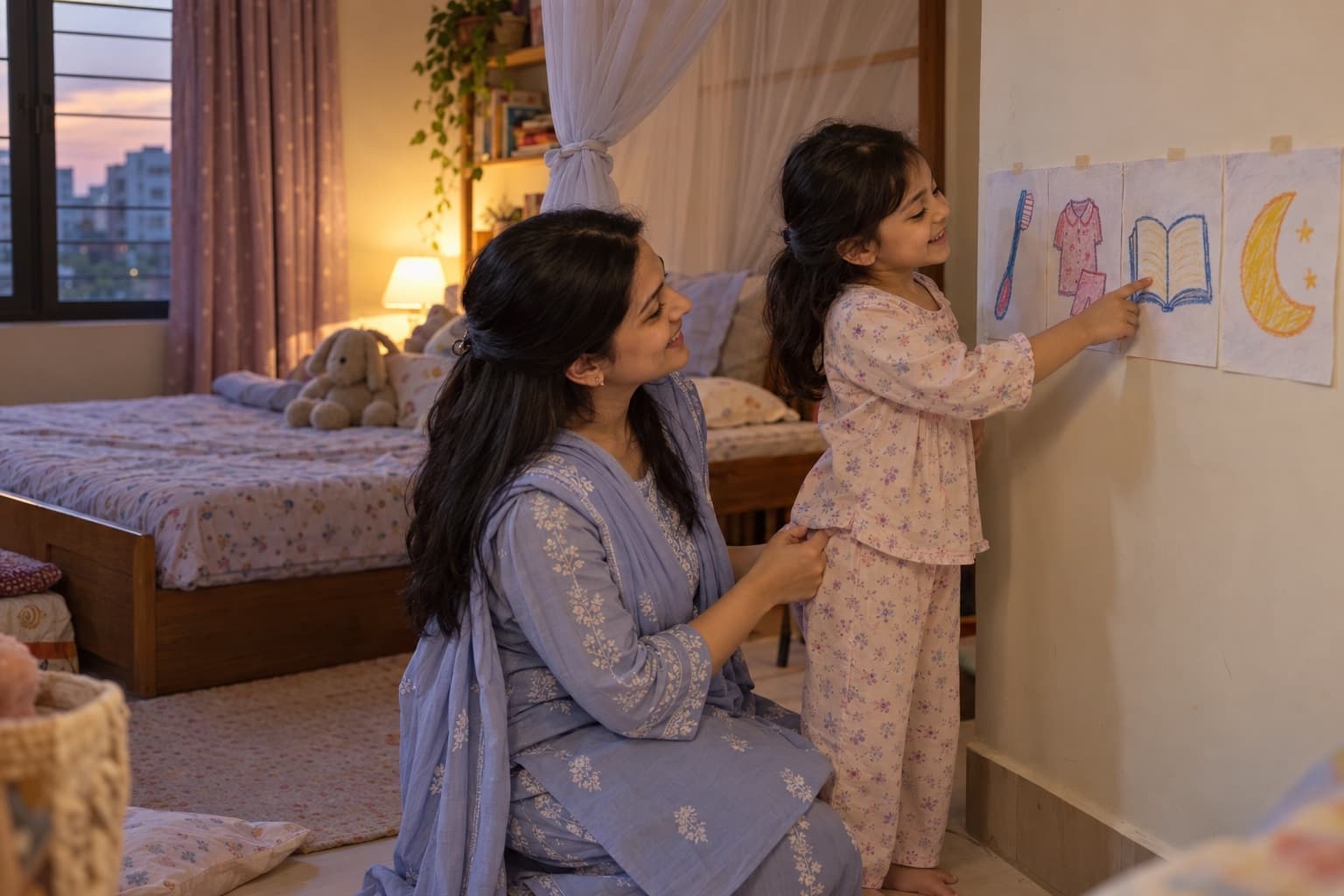
Ramadan routine for kids: sleep, school, screens and family time
Quick answer
A good Ramadan routine for kids keeps total sleep in 24 hours on target, about 10–13 hours at 3–5 years and 9–12 at 6–12, by adding an afternoon nap when nights run late. Keep wake-up and school times steady, let children who aren't fasting sleep through sehri, switch screens off an hour before bed, and ease back after Eid.
 By the ParentMind team11 min read
Listen to this article
15 min listen · Read by your device's voice
At a glance
- Who it is for
- Parents of children aged about 2–16 in Ramadan, whether the children are fasting or not
- Key takeaways
- Count sleep over 24 hours, naps included, and aim for the usual amount for your child's age.
- Children who aren't fasting can usually sleep through sehri and keep their normal meals, tiffin included.
- Keep the wake-up time steady, switch screens off an hour before bed, and plan calm evenings on tarawih nights.
- After Eid, move bedtime back a little each night rather than all at once.
Iftar at six, tarawih until half past nine, sehri (suhoor) at four and school at half past seven: a Ramadan routine for kids can feel impossible when the whole house runs on new times. Within days, many parents see grumpy mornings, sleepy afternoons and late, overexcited nights.
Children do not need the month to look like any other. A few fixed points, mainly sleep, meals and a steady wake-up time, usually keep them well and cheerful while the family enjoys Ramadan together.
Below: sleep in Ramadan, two sample days, food for children who aren't fasting, screens and tarawih nights, school and exams, a Bangladeshi home, the Eid week, a 7-day plan and when to get help.
Kids sleep during Ramadan: how much do they need?
A child's sleep need does not change in Ramadan; only the clock does. Count sleep over 24 hours, naps included, and aim for the same totals as the rest of the year:
| Age | Sleep in 24 hours | In Ramadan |
|---|---|---|
| 1–2 years | 11–14 hours | Usual bedtime and naps; sleeps through sehri and tarawih |
| 3–5 years | 10–13 hours | Bedtime close to usual; keep or bring back an afternoon nap if nights run late |
| 6–12 years | 9–12 hours | Bedtime close to usual on school nights; a short rest after school; sleeps through sehri unless practising a fast |
| 13–18 years | 8–10 hours | If fasting: bed soon after tarawih, back to sleep after sehri if school allows, and a nap after school |
The full chart, newborns included, is in how much sleep children need by age.
How to protect sleep in Ramadan
- Fix the wake-up time first. On school days it is set for you; on days off, keep it within about an hour.
- Count back the hours your child needs to find bedtime, and start winding down about 30 minutes before it.
- Let children who are not fasting sleep through sehri: keep the kitchen quiet and their door closed.
- If nights run late, add a rest after school or lunch, but end it by late afternoon so bedtime does not slip.
- Keep the bedtime steps the same as always: wash, teeth, a story or chat, lights out. See the bedtime routine by age.
- Keep the bedroom dark, cool and quiet, with a rechargeable fan or light ready for load-shedding.
A Ramadan routine for kids: two sample days
A Ramadan schedule for a family with children works best when each child has their own few fixed times. Below are example times for a school child aged 6–12 who isn't fasting and a little one aged 2–5, with iftar at about 6 pm; move them to match your iftar, sehri and school times.
| Time of day | School child (6–12) | Little one (2–5) |
|---|---|---|
| Morning | Up at 6:30 am, breakfast, school from 7:30 am | Up at 7:00 am, breakfast, play |
| Midday | Tiffin and water at school; lunch at home | Lunch at 12:30 pm, nap from about 1:30 pm |
| Afternoon | A short rest, then homework from 3:30 pm | Quiet play, a snack, helping wash fruit |
| Iftar (about 6 pm) | Helps set the table, eats with the family | Sits with the family and eats a little |
| Evening | Dinner at 7:30 pm, reading or a family game; screens off by 8:00 pm | Dinner at 7:00 pm, bath, story |
| Night | Asleep by 9:00 pm | Asleep by 8:00 pm |
| Sehri | Sleeps through it | Sleeps through it |
The school child sleeps about nine and a half hours a night plus a rest, and the little one about eleven hours plus a nap: both within their range. From age 6, the school-day planner can work out bedtime from your wake-up time, and a daily routine for school-age children has the year-round timetable.
Iftar and sehri for children who are not fasting
Children who are not fasting need their usual meals and snacks through the day, including tiffin and water at school. Iftar can be a happy family meal for them too, without being a meal they waited all day for.
- Keep breakfast, lunch and an afternoon snack at their usual times; don't make a young child wait for iftar.
- At iftar, offer water, fruit, chola, a little muri and some of the fried treats, then a proper dinner later.
- Go easy on jilapi, sweet sherbet and fizzy drinks in the evening; a lot of sugar close to bedtime can make settling harder.
- For children under about 5, take the stones out of dates and cut them small, mash or halve chickpeas, quarter grapes lengthways, skip whole nuts, and keep them seated while they eat.
- Older children and teens who fast need a filling sehri and water little and often from iftar to sehri; see children fasting Ramadan for what to give.
Screens and Ramadan activities on tarawih nights
Evenings change most in Ramadan: iftar, guests, tarawih and late shopping. While adults are busy, screens easily fill the gap and push bedtime later. The usual guidance still holds: at 2–5 years, at most an hour a day of good-quality content, ideally together; from 6, consistent limits that protect sleep; and no screens in the hour before bed.
- Give each child an iftar job: washing fruit, setting out glasses, handing round dates.
- Make a simple Ramadan calendar together, and colour in one small kind act each day.
- Keep a basket of quiet things for tarawih time: books, drawing, puzzles, play dough.
- Older children who want to go to tarawih can go with a parent on nights before a day off; on school nights, a shorter time often fits sleep better.
- If adults go out for tarawih or shopping, one adult stays with the little ones. Never leave a young child alone, or alone with a baby.
What you might say
- Iftar is at six. Will you be in charge of the dates today?
- The tablet goes to sleep at eight, just like always. Let's choose a book.
- Sehri is for the people who are fasting. You sleep, and I'll see you at breakfast.
- You can come to tarawih on Thursday night, when there's no school the next day.
- Everyone's busy tonight, but I've kept ten minutes just for you and me.
Ramadan and school routine: exams, homework and coaching
School hours often change in Ramadan, and some schools close for part of the month, so check your school's timetable each year. When school is open, protect the morning: a steady wake-up time, breakfast and tiffin for children who aren't fasting, and homework before iftar, while minds are fresh.
- In exam weeks, sleep is part of revision. Skip late-night study after tarawih; a fresh morning hour usually beats a tired late one.
- Coaching often moves to after iftar. If it ends late, keep the rest of the evening short: dinner, wash, bed.
- A teen who is fasting in exam season needs sleep, water and a filling sehri even more; plan revision for the hours they feel sharpest. Families follow their own scholars on religious questions.
Ramadan with kids in a Bangladeshi home
- Iftar parties and invitations: going out to iftar most evenings pushes dinner and bedtime late. Choose a few, and on school nights leave early with the little ones.
- A full house at sehri: in joint families, the kitchen and voices at 3 or 4 am can wake children who need not be up. A closed door, a fan for steady noise and soft voices help.
- Eid shopping: evening trips to crowded markets in the last ten days are tiring. Shop earlier in the month or in the daytime, and leave little ones at home with an adult if you can.
- Heat and load-shedding: on hot nights, a cool wash before bed and a rechargeable fan help children settle.
- The month's spirit: many families pray together at iftar, send food to neighbours or share with people in need. Children can join in ways that fit their age, such as carrying a plate next door.
The Eid week, and getting back to the usual routine
Eid brings late nights, trips to the village, visits and a lot of sweet food, and that is part of the joy. A few nights can undo a good Ramadan routine for kids, so plan the way back rather than worrying about the week itself:
- Two or three days before school restarts, fix the wake-up time first, and keep it the same each day.
- Move bedtime earlier by about 15 minutes each night until it is back to normal.
- Get morning daylight: a short walk, breakfast by a sunny window, or walking to school.
- Bring back the usual meal times and screen limits along with bedtime.
A 7-day plan for the first week of Ramadan
Start a few days before Ramadan if you can. Each day, note bedtime, wake-up time, naps and mood in one line.
- Day 1: Write down your family's new times: sehri, iftar, tarawih and school.
- Day 2: Choose each child's wake-up time and bedtime from the sleep table above.
- Day 3: Decide who sleeps through sehri, and make the house quieter for them.
- Day 4: Set the screen-off time an hour before bed, and fill the basket of quiet things for tarawih time.
- Day 5: Give each child an iftar job, and notice how evenings go.
- Day 6: If mornings are hard, add a short rest after school or move bedtime 15 minutes earlier.
- Day 7: Compare with Day 1: are mornings easier and moods calmer? Keep what helped for the rest of the month.
When to get help with sleep or health in Ramadan
Most children adjust to the month within a week or so. Talk to your child's doctor if:
Get help if
- Your child is very sleepy in the day or falls asleep in class for more than a week or two, even with earlier nights and a rest.
- Trouble falling asleep, or bedtime battles, still go on a month after Eid despite a steady routine.
- A child who is fasting has dizziness, vomiting or very little urine: stop the fast; if they are not better about an hour after water, food and rest, or if they faint, see a doctor the same day.
- Your child has diabetes or another long-term condition and wants to fast: ask their doctor first.
- Your child cannot be woken properly, has a fit or is struggling to breathe: call 999.
A Ramadan routine for kids is easier to judge over a week than on one late night. ParentMind helps you note what happens each day, see patterns and get guidance: see how ParentMind works.
Questions parents ask
Should young children wake up for sehri?
Usually not. Children who are not fasting need their full night of sleep, so most can sleep straight through sehri. An older child who is practising a fast, or who wants the experience, can join on a night before a day off. Keep the house quiet so the others sleep on.
Is it okay for kids to stay up late in Ramadan?
A few late nights, such as a family iftar or the night before Eid, are part of the month and usually fine. Many late nights in a row, especially before school, add up to tiredness and grumpy mornings. Keep school-night bedtimes close to usual, and let a nap or rest cover late weekends.
Can my toddler eat iftar with the family?
Yes. Sitting with the family at iftar is lovely for toddlers, as long as it is not their first meal for hours. Offer soft, safe pieces: dates with the stone out and cut small, mashed chickpeas, soft fruit. Keep them seated, skip whole nuts, and give their usual dinner at their usual time.
How can I keep my child busy during Ramadan?
Give them real jobs and calm projects: washing fruit and setting out glasses for iftar, a Ramadan calendar of small kind acts, and drawing, reading or puzzles during tarawih time. Short outdoor play in the cooler morning or late afternoon helps too. Keep screens within the usual limits.
How do I handle school exams during Ramadan?
Protect sleep first: a steady wake-up time, no late-night study after tarawih, and revision in the fresh morning or before iftar. Children who aren't fasting keep their normal meals and tiffin. For a fasting teen, plan revision for the hours they feel sharpest; families follow their own scholars on religious questions.
How long does it take to get a child's sleep back to normal after Eid?
Often about a week. Start two or three days before school restarts: fix the wake-up time first, move bedtime earlier by about 15 minutes a night, and get morning daylight. Bring back the usual meal times and screen limits too. A few grumpy mornings along the way are normal.
This article is general information, not medical advice. For health worries, talk to a doctor; if someone is in danger, contact your local emergency number.