Daily routine for school age children: a simple timetable and template
Quick answer
A good daily routine for school age children keeps the same wake-up time on school days and makes room for a rest after school, homework, at least 60 minutes of active play, family time and enough sleep: 9–12 hours at ages 6–12. Set bedtime by counting back from the wake-up time, with no screens in the last hour.
 By the ParentMind team12 min read
Listen to this article
17 min listen · Read by your device's voice
At a glance
- Who it is for
- Parents of children aged 5–14 who want calmer school days, from the morning rush to bedtime
- Key takeaways
- Start from the fixed points, such as the wake-up time, school hours and coaching, then count back from the wake-up time to find bedtime.
- Children aged 6–12 need 9–12 hours of sleep and 5-year-olds 10–13 hours; a routine should protect that first.
- After school, food and rest come first, then at least 60 minutes of active play and short homework blocks before dinner rather than late at night.
- Keep the order of the day steady, and keep weekend wake-ups within about an hour of school days.
If you are trying to build a daily routine for school age children, you probably know the problem: school, coaching, homework, tiffin boxes and bedtime all pull against each other, and the evening disappears. Many families of 5- to 14-year-olds feel the day is simply too full.
A routine doesn't have to be strict to work. Many children cope better when the order of the day is predictable, even if the clock moves a little: wake up, school, food and rest, play, homework, dinner, wind-down, sleep. That order can usually be set within a week or two.
Below: what a daily schedule for kids needs, the sleep, play and screen numbers, sample timetables for a morning-shift and a day-shift day, how the day changes by class, a routine chart, weekends, a 7-day plan and when to get help.
What should a daily routine for school age children include?
A routine works best when it is built around a few anchors that happen in the same order every day. The clock times can differ between families; the anchors stay the same.
- The same wake-up time on school days, with a calm start: wash, dress, breakfast.
- After school: food, water and real rest before anything else.
- At least 60 minutes of active play across the day, outdoors when possible.
- Homework at a set time, in short blocks that suit your child’s age.
- Family time: a meal together, a chat about the day, a small job at home.
- A wind-down without screens, then sleep at a time that gives enough hours before the alarm.
How much sleep, play and screen time fits in a school day?
Sleep is the part of the routine most often squeezed, so set it first. Count back from the school wake-up time to the latest time your child should be asleep, then start the wind-down before it.
| Age | Sleep in 24 hours | Wakes at 6:00 am | Wakes at 7:00 am |
|---|---|---|---|
| 5 years | 10–13 hours | Asleep by 8:00 pm | Asleep by 9:00 pm |
| 6–12 years | 9–12 hours | Asleep by 9:00 pm | Asleep by 10:00 pm |
| 13–14 years | 8–10 hours | Asleep by 10:00 pm | Asleep by 11:00 pm |
These are the latest times, not the ideal ones; many children, especially younger ones, do better asleep earlier. How much sleep children need has the full chart, and a calm bedtime routine covers the wind-down.
- Active play: at least 60 minutes of moderate-to-vigorous activity a day for 5–17-year-olds, such as running, cycling, skipping or cricket.
- Screens at 5: at most 1 hour a day of good-quality content, ideally watched together.
- Screens from 6: no fixed number, but consistent limits that leave room for sleep, active play, homework and family time; no screens in the hour before bed, and devices out of the bedroom at night.
Sample timetables: a morning-shift and a day-shift school day
These two templates are for a child in Class 3–5, about 8 to 10 years old, and work as a study timetable for Class 5 too. School and coaching times vary a lot, so move the clock to fit yours and keep the order.
| Time | What happens |
|---|---|
| 6:00 am | Wake up, wash, uniform (laid out the night before) |
| 6:20 am | Breakfast; the bag is already packed |
| 7:30 am–12:30 pm | School, with tiffin at break |
| 1:00 pm | Home: wash, lunch, then a quiet rest |
| 2:30 pm | Homework: two or three blocks of about 20 minutes, with short breaks |
| 3:30 pm | Free time: a hobby, or screens within your family’s limit |
| 4:15 pm | Active play outside, or on the roof with an adult, while it is light |
| 5:30 pm | Snack; coaching or a tutor if your child has one (optional) |
| 7:00 pm | Dinner together and a chat about the day; screens off after dinner |
| 7:45 pm | Bag and uniform for tomorrow, a wash, a story or a talk; prayers if your family prays together |
| 8:30–9:00 pm | Asleep by 9:00 pm at the latest |
| Time | What happens |
|---|---|
| 7:00 am | Wake up, wash, breakfast |
| 7:45 am | Active play or a walk: mornings are the play time on day-shift days |
| 9:00 am | Homework in short blocks while your child is fresh |
| 10:30 am | Free time, a snack, a small job at home |
| 11:30 am | Early lunch, uniform, leave for school |
| 12:30–5:00 pm | School, with tiffin at break |
| 5:30 pm | Home: snack, wash, rest; no homework straight away |
| 6:30 pm | Light revision or reading, or coaching if your child has it (optional) |
| 8:00 pm | Dinner together; screens off by 8:30 pm |
| 9:00 pm | Wind-down: bag, uniform, a wash, a story or a talk |
| 9:30–10:00 pm | Asleep by 10:00 pm at the latest |
How the day changes from Class 1 to Class 8
| Part of the day | Class 1–2 (about 6–7) | Class 3–5 (about 8–10) | Class 6–8 (about 11–13) |
|---|---|---|---|
| Homework | A few blocks of about 10–15 minutes, with you beside them | Blocks of about 20 minutes, with a list and a timer | Blocks of about 25–30 minutes, planned with them |
| Active play | At least 60 minutes; free play counts | At least 60 minutes, ideally outdoors | At least 60 minutes: sport, cycling, brisk walks |
| Coaching or tutor | If any, short and early in the evening | If any, still leave time to play and rest | Often heavier: agree a cut-off time for homework after it |
| Asleep by, for a 6:00 am wake-up | About 8:30 pm; 9:00 pm at the latest | 9:00 pm at the latest | 9:00 pm at the latest; 10:00 pm from age 13 |
| Their own part | A picture chart and one small job, such as shoes away | Packs their own bag and ticks their chart | Plans the week with you, including screen time |
An after-school routine: from the school gate to dinner
The after-school routine is where most arguments start, usually because a hungry, tired child is asked to do homework at once. A short, predictable order helps more than a long lecture.
- Greet first and ask one easy question; save the marks and the diary for later.
- Food and water: a proper snack or lunch, not just biscuits.
- Real downtime, about as long as your child needs to unwind, without questions.
- Homework at the same time every school day, in blocks that suit their age; see how to help kids with homework.
- Active play before dark, then coaching or free time if it fits.
What you might say
- Snack first, then ten minutes to rest. Homework starts at half past two.
- What was the best part of your day?
- Five more minutes of play, then we'll wash up.
- Let's check the chart. What comes next?
- Screens go off after dinner. Choose a story for tonight.
- You got ready all by yourself today. That made our morning easy.
How to make a routine for kids, with a routine chart
- Write down the fixed points: wake-up, school, coaching, travel time.
- Count back from the wake-up time to find the latest time to be asleep.
- Fill in food and rest after school, active play, homework and family time.
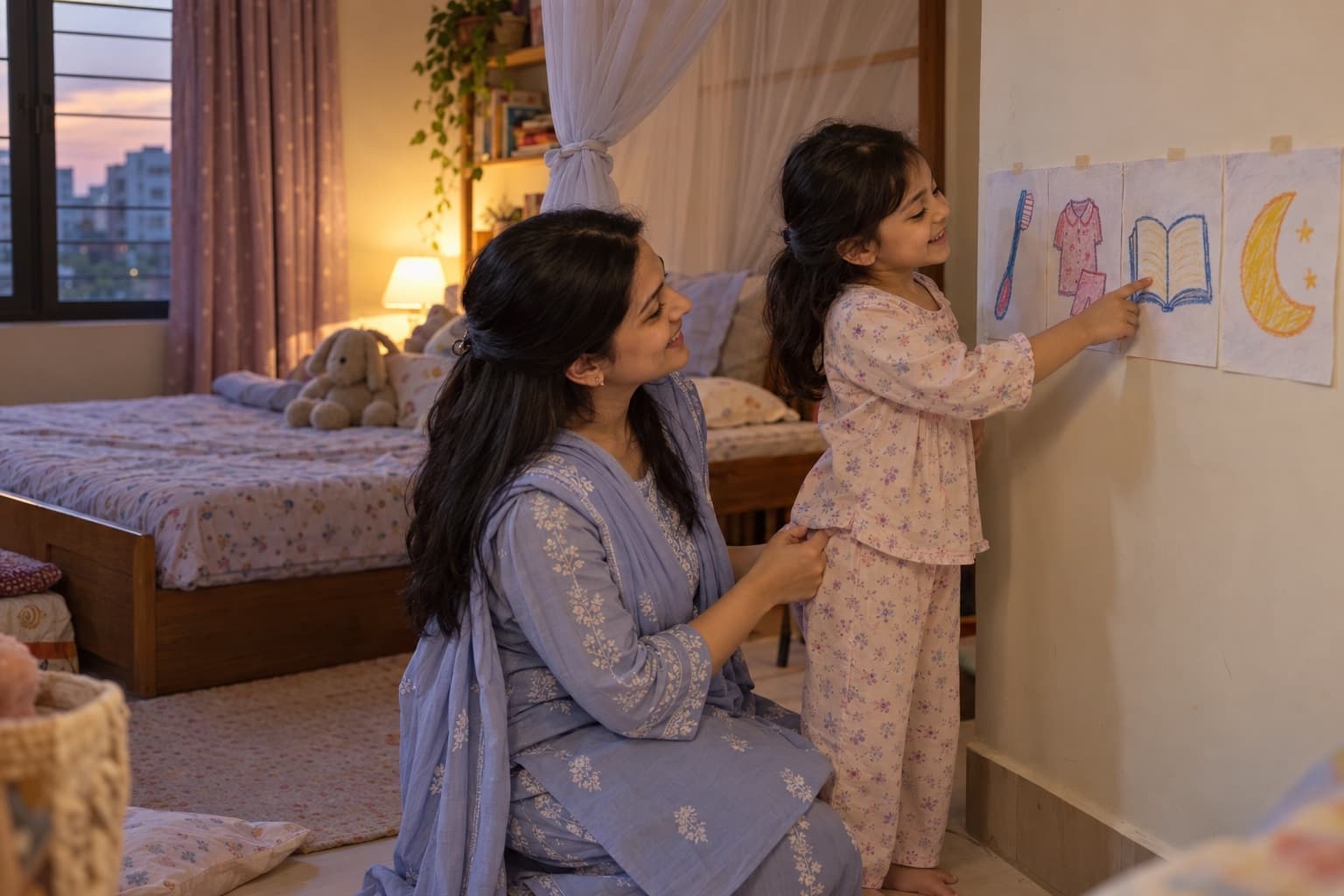
- Make a routine chart with your child: pictures for younger children, short words or times for older ones.
- Put it where it is used, by the door or the study table, and let your child tick each step.
- Keep the order the same for two weeks before changing anything, then review it together.
A school-day routine in a Bangladeshi home: coaching, prayer and family
A school-day routine in Bangladesh has to fit things few templates count: coaching, long commutes, late family dinners and a full house.
- The school week: in many schools it runs Sunday to Thursday, so Thursday evening can be relaxed, and Saturday night needs the school-night bedtime again.
- Coaching: count it in the timetable like school. If it ends late, agree which homework can wait, and keep at least one evening a week free of extra classes if you can.
- Prayer: if your family prays together, maghrib or isha can be a natural anchor in the evening, a calm pause between play and homework or before bed.
- Late dinners: if the family eats at 10 pm, give your child an earlier dinner on school nights and sit with them, or bring the family meal forward.
- Grandparents and house help: share the routine with everyone who looks after your child, so the afternoon looks the same whoever is at home.
- Traffic and load-shedding: build in the real travel time, use it for talk or a snack rather than a screen, and keep a charger lamp by the study table.
If homework time itself is the struggle, how to motivate your child to study and helping a child who can’t concentrate go into more detail.
What should a weekend or holiday routine look like?
Weekends can be looser, but not a different time zone: keep wake-up and bedtime within about an hour of school days, so the first school morning of the week is not a shock.
| Time | What happens |
|---|---|
| 7:00 am | Wake up, about an hour later than school days at most |
| Morning | A slow family breakfast, then outdoor play, a park or a cycle ride |
| Late morning | One homework or reading block at a set time |
| Midday | Family lunch; Jumu’ah prayers on Friday for families who go |
| Afternoon | Rest, visiting relatives, a hobby, screen time within your limit |
| Evening | Active play, a walk, a family game such as ludo or carrom |
| Saturday night | Bag packed, uniform out and the school-night bedtime |
A 7-day plan to start a new routine
Change one thing at a time and write one line each day: when your child woke, when they fell asleep, and where the day got stuck.
- Day 1: change nothing. Write down what really happens, from wake-up to sleep.
- Day 2: mark the fixed points and work out the latest time to be asleep.
- Day 3: make one change, usually an earlier wind-down or food and rest straight after school.
- Day 4: make a simple routine chart together and put it up.
- Day 5: add a set homework time and at least 60 minutes of active play.
- Day 6: on the weekend, keep wake-up within about an hour of a school day and plan something fun.
- Day 7: compare with Day 1. Earlier sleep? Fewer arguments? Keep what helped and change one more thing next week.
When is it more than a routine problem?
A steady routine often eases tiredness and evening battles. Some signs suggest something else is going on, such as a sleep problem, worry or too heavy a load.
Talk to the school or a doctor if
- Your child is very tired most days despite enough time in bed, or snores loudly with pauses in breathing.
- It takes your child more than about half an hour to fall asleep most nights for several weeks, even with a calm wind-down.
- School, coaching and homework leave no time to rest or play on most days, and your child often has headaches, stomach aches or tears: talk to the school about the load.
- Stomach aches, tears or refusal on most school mornings for a few weeks.
- Low mood, withdrawal or loss of interest in things your child used to enjoy, for two weeks or more.
- A sudden change in behaviour, or any sign of bullying or abuse: believe your child, act the same day, and call 999 if they are in danger.
A routine settles over weeks, and the small wins are easy to miss. ParentMind helps you note what happens each day, see patterns and get guidance: how ParentMind works.
Questions parents ask
What time should a school-age child go to bed?
It depends on the wake-up time. Children aged 6–12 need 9–12 hours of sleep, so a child who wakes at 6:00 am should be asleep by 9:00 pm at the latest, and earlier is often better for younger children. For a 7:00 am wake-up, 10:00 pm is the latest. Start the wind-down an hour before.
How many hours should a class 5 student study at home?
There is no fixed number; it depends on the homework and on your child. Many families find a few focused blocks of about 20 minutes, with breaks, cover most school days at this age, with more before exams. Protect sleep and active play first, and talk to the teacher if homework regularly takes far longer.
Should children do homework right after school?
Usually not straight away. Most children need food, water and some rest or play first; starting homework hungry and tired tends to end in arguments. A set time later in the afternoon or early evening, before dinner, often works better than late at night.
Is it okay for my child to nap after school?
A short rest is fine, especially for younger children after a morning shift. Keep naps short and early in the afternoon, because a long, late nap often pushes bedtime later. If an older child needs a long nap every day, check how much they sleep at night.
How much free time should a child have after school?
Enough for at least 60 minutes of active play plus some unplanned downtime every day. If school, coaching and homework leave no time to play or rest on most days, the week is probably too full; dropping or moving one activity often helps more than adding another.
How do I make a routine chart for my child?
List the steps of the morning or evening in order, five or six at most, with a simple drawing for each step for younger children. Make it together, put it where the steps happen, and let your child tick each one. Review it after a week or two and change one thing at a time.
This article is general information, not medical advice. For health worries, talk to a doctor; if someone is in danger, contact your local emergency number.