Child can't concentrate on studying? How to improve focus, ages 5–15
Quick answer
If your child can't concentrate on studying, try shorter blocks that suit their age (about 10–15 minutes at 5–7, longer as they grow), a clear table with the phone in another room, movement breaks, and enough sleep and food. If focus is poor at home and at school for many months, talk to the school or a doctor.
 By the ParentMind team12 min read
Listen to this article
16 min listen · Read by your device's voice
At a glance
- Who it is for
- Parents of children aged 5–15 who drift off, fidget or get distracted at study time
- Key takeaways
- Poor focus at study time often comes from blocks that are too long, tiredness, hunger or a nearby screen.
- As a rough guide, one focused block lasts about 10–15 minutes at 5–7 years and grows to about 30–45 minutes by 14–15.
- One clear table, phones in another room, the TV off and movement breaks often help more than any focus trick.
- Ask the school or a doctor if focus is poor at home and at school for many months, or if you notice squinting, mishearing or staring spells.
If your child can't concentrate on studying, the scene is probably familiar: five minutes in, they are sharpening a pencil, gazing out of the window or asking for water again. For many parents of 5- to 15-year-olds it is the hardest part of the evening.
A short attention span at the study table rarely means a child is lazy or not clever. Attention grows slowly through childhood, and tiredness, hunger, noise, a nearby phone or work that feels too hard can knock it off course at any age. Most of these are things you can change at home.
Below: focus by age, what to do in the moment, the room, sleep and food, focus games, a 7-day plan and when to get a check. If your child won't sit down at all, start with how to motivate your child to study.
Why does my child get distracted so easily?
A child who gets distracted easily is usually reacting to their body, the room or the work. Look for the pattern before deciding the problem is your child.
| What you see | What may be behind it | What to try first |
|---|---|---|
| Yawning, head on the table | Tiredness after a long school and coaching day, or late nights | Study earlier; check bedtime |
| Up and down every few minutes | A block too long for their age, or energy to burn | Shorter blocks with movement breaks |
| Cranky and slow after school | Hunger or thirst | A snack and water first |
| Looks up at every sound | TV, phones, chatter or a sibling nearby | A quiet spot, the TV off, phones away |
| Stares at one sum, then gives up | Work too hard, or an earlier step missed | One small step at a time; tell the teacher |
| Stomach aches before tests | Worry about marks or being scolded | Lower the pressure; praise effort |
| Squints, holds the book close, mishears | A possible eyesight or hearing problem | An eye test and a hearing check |
Screens play a part too: fast videos and games make ordinary schoolwork feel slow straight afterwards. Keeping screens for after study, and out of the hour before bed, often helps; screen time by age has the limits. If worry about marks is behind it, see exam stress in children.
How long should a child study at once? Attention span by age
Attention span grows with age, so a good block for a 6-year-old is far shorter than for a 14-year-old. These are rough guides many families find workable, not targets. Stop a block just before attention runs out, so it ends on a success.
| Age | One focused block | Between blocks | What helps most |
|---|---|---|---|
| 5–7 years | About 10–15 minutes | A few minutes of hopping, or a drink of water | Sitting beside them; one small task at a time |
| 8–10 years | About 20 minutes | A stretch or a walk to the balcony | A written list and a timer they can see |
| 11–13 years | About 25–30 minutes | A short break away from the table, not on a phone | Planning the evening; testing themselves |
| 14–15 years | About 30–45 minutes | Short breaks, and a longer one after two or three blocks | Their own plan, the phone out of reach |
Short blocks add up: two or three with breaks usually get more done than one long sitting spent half daydreaming.
What to do when your child can't concentrate on studying
- Pause before you react. A child who has drifted off needs a reset, not a scolding.
- Check the basics: hungry, thirsty, tired, too hot or needing the toilet?
- Shrink the task: 'just these three sums' or 'only this page'. A small finish line is easier to focus on.
- Set a timer that suits their age, where your child can see it.
- When it rings, take a short movement break: a few star jumps, a walk to the balcony, a glass of water.
- Remove whatever pulled them away, such as a toy, the TV noise or a phone, and praise the focus when it returns: 'You did all three without stopping.'
What you might say
- Your brain looks tired. Stand up and stretch, then three more.
- When the timer rings, you get a break. Until then, only this page.
- I'm putting my phone in the other room too. We'll both focus.
- Show me which bit is hard. We'll look at it together.
- You kept going until the timer rang. That's real concentration.
How to set up a study space that helps a child focus
A good study space does some of the work for you. In a small flat, one end of the dining table can work, as long as it is the same spot most days.
- The same table most days, facing a wall rather than the TV or a busy window.
- Phones in another room, yours included. If a school task needs a phone, use it for that task, then put it away.
- The TV off, or the study spot as far from it as your home allows.
- Only the book for the current task on the table; the rest stays in the bag.
- Good light, a glass of water, and a chair where feet can rest flat on the floor or on a box.
- A short written list of the evening's tasks and a timer your child can see, so the finish line is clear.
How sleep, food and play affect a child's concentration
If you are wondering how to improve a child's focus, start with the whole day, not just the hour at the table. These basics often matter more than any study trick.
- Sleep: 5-year-olds need 10–13 hours in 24 hours, 6–12-year-olds 9–12 hours and 13–18-year-olds 8–10 hours. A child short of sleep often looks restless rather than sleepy; see how much sleep children need.
- Food: breakfast before school and a snack before study. Roti with egg, fruit, chira, or muri with peanuts tends to last longer than sweets, crisps or soft drinks.
- Water at the table: thirst can make a child tired and cranky.
- Active play: at least 60 minutes of moderate-to-vigorous activity a day for 5–17-year-olds. A run, a bike ride or cricket before study often makes sitting easier.
- No screens in the hour before bed, and devices out of the bedroom at night, so screens don't eat into sleep.
Focus exercises and games for kids that build attention
Attention can be practised in play, away from the study table. These focus exercises for kids take a few minutes, need almost nothing and practise waiting, listening and remembering. They add to sleep and a calm room; they don't replace them.
- What's missing: put six to eight small things on a tray, let your child look, cover it and take one away. Add more as they improve.
- Listening minute: sit still on the balcony for one minute and count every sound: a rickshaw bell, a crow, a pressure cooker.
- Only if I say please: your child follows quick instructions only when you say 'please'. It practises listening before acting.
- Story recall: at dinner, everyone tells three things from their day, in order.
- Turn-taking games: ludo, carrom, snakes and ladders and card games practise waiting and keeping track.
- Hands-on focus: jigsaws, careful colouring, block towers, threading beads or paper folding.
- Slow breathing before study: smell the flower (breathe in through the nose), blow out the candle (breathe out slowly), five times.
Focus after school and coaching: concentration in a Bangladeshi home
For many Bangladeshi children the study day is long: school, then coaching or a home tutor, then homework. If focus fades late in the evening, the long day may be the reason, and pushing harder at that hour seldom helps.
- After coaching, give a real break first: a snack, play or rest. Then the homework due tomorrow; leave revision for another day if your child is spent.
- Agree a cut-off time so homework after late coaching doesn't push past bedtime. If it often does, talk to the tutor or teacher about the load.
- The drawing-room TV: in many flats the TV, guests, younger siblings and the study table share one room. Try a family TV-off hour at study time, or move study to a quieter corner.
- House help and grandparents: if a house help or a grandparent sits with your child at study time, share the plan (the timer, the breaks, phones away). A TV serial or an adult's phone can easily pull a child away.
- Load-shedding: keep a charged lamp by the table so a power cut doesn't end the evening's work, or use a short power cut for oral revision or a focus game.
- Comparison: 'Your cousin sits for two hours' tends to make a child feel worse, not more focused. Compare your child only with themselves last week.
For the whole day's timetable, with school, coaching, play and sleep, see a daily routine for school-age children.
A 7-day plan to improve your child's focus
Change one thing at a time and write one line a day: how long your child worked before the first break, what pulled them away, and how the evening ended.
- Day 1: change nothing. Time how long your child works before drifting off, and note the hour, what they had eaten and what was going on.
- Day 2: set up one study spot: a clear table, the TV off, phones in another room.
- Day 3: use blocks that suit your child's age, with a visible timer and movement breaks.
- Day 4: add a snack and water before study; move bedtime earlier if sleep is short.
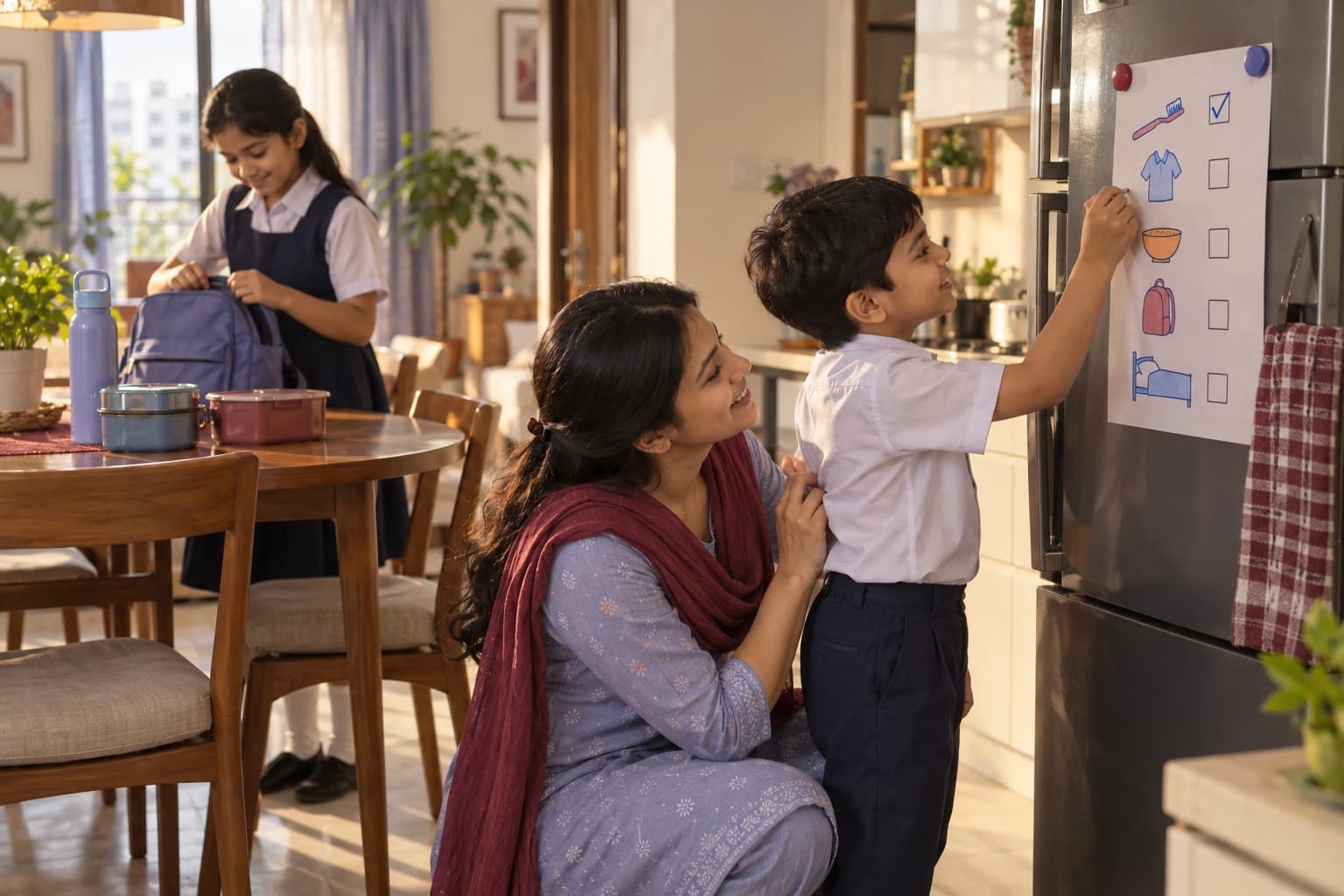
- Day 5: write the evening's tasks as a list your child ticks off.
- Day 6: keep the weekend lighter, with a focus game together and plenty of outdoor play.
- Day 7: compare with Day 1. Longer blocks? Fewer interruptions? Keep what helped; if focus is still hard, share your notes with the teacher.
When is poor concentration a reason to get help?
Most focus trouble eases with a better setup, enough sleep and blocks that suit the child's age. Some patterns are worth checking, because they can point to a problem with eyesight, hearing, learning, sleep or worry that a doctor or child psychologist can assess.
Talk to the school or a doctor if
- Concentration is a problem at home and at school for many months, even after these changes, and it holds back schoolwork or friendships.
- Your child tries hard, but reading, writing or maths stays far behind classmates, or what they learn doesn't stick.
- Eyesight signs: squinting at the board, holding books very close, headaches or rubbing eyes after reading. Book an eye test.
- Hearing signs: often mishearing, asking 'what?', not answering when called from another room, or turning the TV up loud. Ask for a hearing check.
- Staring spells: your child 'switches off' for a few seconds, often many times a day, doesn't respond to their name or a touch, then carries on as if nothing happened. See a doctor soon; they can check this.
- Loud snoring most nights, pauses in breathing during sleep, or daytime sleepiness: mention it to a doctor.
- A sudden drop in focus with low mood, poor sleep or not wanting to go to school, or any sign of bullying or abuse: believe your child, act the same day, and call 999 if they are in danger.
Focus improves slowly, and the change is easy to miss from one evening to the next. ParentMind helps you note what happens each day, see patterns and get guidance: how ParentMind works.
Questions parents ask
Is it normal for a child to get distracted easily?
Yes, for most children, especially younger ones. Attention grows slowly through childhood, and tiredness, hunger, noise and screens shorten it at any age. Look closer if poor focus shows at home and at school for many months, or comes with squinting, mishearing or staring spells.
How long can a 7 year old concentrate on homework?
Usually about 10–15 minutes at a time, sometimes longer for work they enjoy. Two or three short blocks with movement breaks tend to get more done than one long sitting. If your 7-year-old can't manage even a few minutes on most days when rested and fed, tell the teacher.
Why can my child focus on games but not on studying?
Games are built to hold attention with constant rewards, sound and movement, so they take far less effort than a page of sums. It doesn't mean your child can't concentrate. Schoolwork needs a quieter setting, shorter blocks and a clear finish line, and keeping games for after study often helps.
My child can't sit still to study. Is that a problem?
Not always. Many children think better while moving a little: swinging a leg, squeezing a soft ball or standing at the table. If the work gets done, that is usually fine, and a run before study often helps. If your child can't stay at the table even for a few minutes on most days, at home and at school, tell the teacher.
What foods help a child concentrate?
No single food improves focus, but regular meals help. Breakfast before school and a filling snack before study, such as roti with egg, fruit, chira or muri with peanuts, keep hunger out of the way. Sweets and soft drinks can give a quick burst, then a slump.
When should I take my child to a doctor for poor concentration?
See a doctor if poor focus shows at home and at school for many months, holds back learning despite effort, or comes with squinting, mishearing, staring spells, loud snoring or a sudden change in mood. An eye test and a hearing check are good first steps.
This article is general information, not medical advice. For health worries, talk to a doctor; if someone is in danger, contact your local emergency number.