How much screen time for kids? Screen time by age (0–18)
Quick answer
Most child-health guidance sets screen time by age: none under 18 months except video calls with family; at 18–24 months, only good-quality content watched with an adult; at 2–5 years, at most 1 hour a day; from age 6, steady limits that protect sleep and play, no screens in the hour before bed, and devices out of the bedroom.
 By the ParentMind team10 min read
Listen to this article
14 min listen · Read by your device's voice
At a glance
- Who it is for
- Parents of children from birth to 18
- Key takeaways
- Under 18 months, keep screens to video calls with family; up to age 5, choose good-quality content and watch together.
- From age 6 there is no magic number: limits should protect sleep, at least 60 minutes of active play, homework and family time.
- Switch screens off an hour before bed, and charge phones and tablets outside the bedroom.
- Bring limits down in small steps, with a warning and something real to do next; sudden bans usually start a war.
Screen time by age is one of the first things parents look up, often after a day when the phone or TV seemed to run the house. If your child watches more than you would like, you are in good company: screens often arrive for practical reasons, like a meal to finish or a long evening in a small flat.
The guidance is simpler than it looks online. The youngest children have clear limits; for older children the question becomes “what is the screen pushing out?” Below: the age table, what counts, better content, and a calm 7-day plan.
Screen time by age: how much is right at each stage?
How much screen time for kids is right depends first on age. Most child-health guidance agrees closely on the youngest children and is deliberately looser after 5. These limits are for screens used for fun: shows, cartoons, YouTube, games and short videos.
| Age | Guidance |
|---|---|
| Under 18 months | None except video calls with family |
| 18–24 months | Only good-quality content, watched with an adult |
| 2–5 years | At most 1 hour a day of good-quality content, ideally together |
| 6 years and over | No fixed number. Consistent limits that protect sleep, at least 60 minutes of active play, homework and family time. No screens in the hour before bed, devices out of the bedroom at night |
Why no number after 5? Children's days differ too much for one figure to fit. Sleep, active play, schoolwork and family time come first, and screens fit around them. Start with how much sleep children need: 9–12 hours at ages 6–12, and 8–10 for teenagers.
What counts as screen time? Homework, video calls and background TV
- School work and online classes usually sit outside the daily limit, but not in the hour before bed, and children still need breaks.
- Video calls with family are fine at every age, because a call is a conversation, not a show.
- Background TV counts, especially for children under 2. A TV on all evening pulls attention away from play and talk.
- Short videos and games on a parent's phone count, even five minutes at a time. Across a day, they add up.
Is educational screen time better? Why quality matters as much as minutes
Yes, what a child watches matters as much as how long. An hour of a slow programme watched together is very different from an hour of short videos playing alone, one after another.
- Good-quality content suits your child's age, moves at a calm pace, tells a story or teaches something, and has no ads for toys or snacks.
- Content with no natural end, such as autoplay, endless short videos or games built on rewards, is designed to keep children watching, so stopping is harder.
- Watching together turns a show into a conversation: “What is the cat doing?” “What would you do?”
What to do when screen time ends and your child protests
The hardest minute of screen time is the last one. Protest is normal, especially under 6, when children can't yet stop themselves easily. Ending the same way every day does most of the work.
- Warn before the end: “Two more minutes” for little ones, “At the end of this episode” for older children.
- Go and sit beside your child rather than calling from the kitchen.
- Say what is happening in a few calm words, then switch off, or let your child press the button.
- Name the feeling (“You wanted more. It's hard to stop.”) without arguing or explaining again.
- Move straight to the next thing: a snack, a bath, a game, helping you cook.
- Don't give the screen back to stop the crying, or crying can become the way to get it.
What you might say
- Two more minutes, then the TV goes to sleep.
- You wanted to watch more. I know, it's hard to stop.
- Screen time is over for today. You can watch again tomorrow after school.
- Come and help me make the roti. You can do the rolling.
How to set screen time limits that stick: a family screen plan
Screen time limits hold best when they are written down, the same every day, and kept by the adults too. A short family screen agreement on the fridge saves a lot of arguing.
- Pick set times, not just “less”: after homework and before dinner, for example.
- Keep meals, the hour before bed and the first hour after school screen-free.
- Give devices a home at night in the living room, never by the pillow. Phones at bedtime shows a gentle way to start with older children.
- Keep screens in shared rooms, where you can see and hear what is on.
- Agree weekend, holiday and travel rules in advance, so they aren't argued every time.
Screen time for toddlers, school children and teens: what changes?
Babies and toddlers (0–2 years)
Babies and toddlers learn language from faces, voices and play, which a screen can't replace. Keep background TV off, use video calls freely, and from 18 months share a short, slow programme if you choose.
Preschoolers (2–5 years)
Screen time for toddlers and preschoolers works best as one planned slot a day: at most an hour, ideally together, never at meals or just before sleep. Three- and four-year-olds need at least 180 minutes of activity a day. If your child eats only with a video on, see how to stop feeding with the phone.
School-age children (6–12 years)
From 6, the limit is about the shape of the day: homework, at least 60 minutes of active play, dinner without screens, and screens off an hour before bed. The recommended screen time for a 10-year-old isn't one number; if your child sleeps well, plays, keeps up at school and enjoys people, the balance is probably right.
Teenagers (13–18 years)
Teenagers need more say in the rules, and honesty from adults about their own phones. Agree the non-negotiables together (sleep, school, meals) and give them room inside those. Night-time use is the big worry: teens need 8–10 hours of sleep, and a phone in bed often cuts it short.
Screen time in a Bangladeshi home: small flats, grandparents and coaching
In Bangladeshi homes, screen battles often come from everyday life, not missing rules:
- Small flats with little outdoor space. Use the rooftop in the late afternoon, climbing the stairs together, dancing in the living room, a park or field on Fridays.
- Grandparents or house help who hand over the phone to calm crying. Share the plan kindly, and give them an easy alternative: a story, a rhyme, a box of toys.
- One family phone. Agree where and when your child may use it, and remove games and apps that don't suit their age.
- School and coaching on the phone. Keep “school phone time” separate from “fun phone time”, and both out of the bedroom at night.
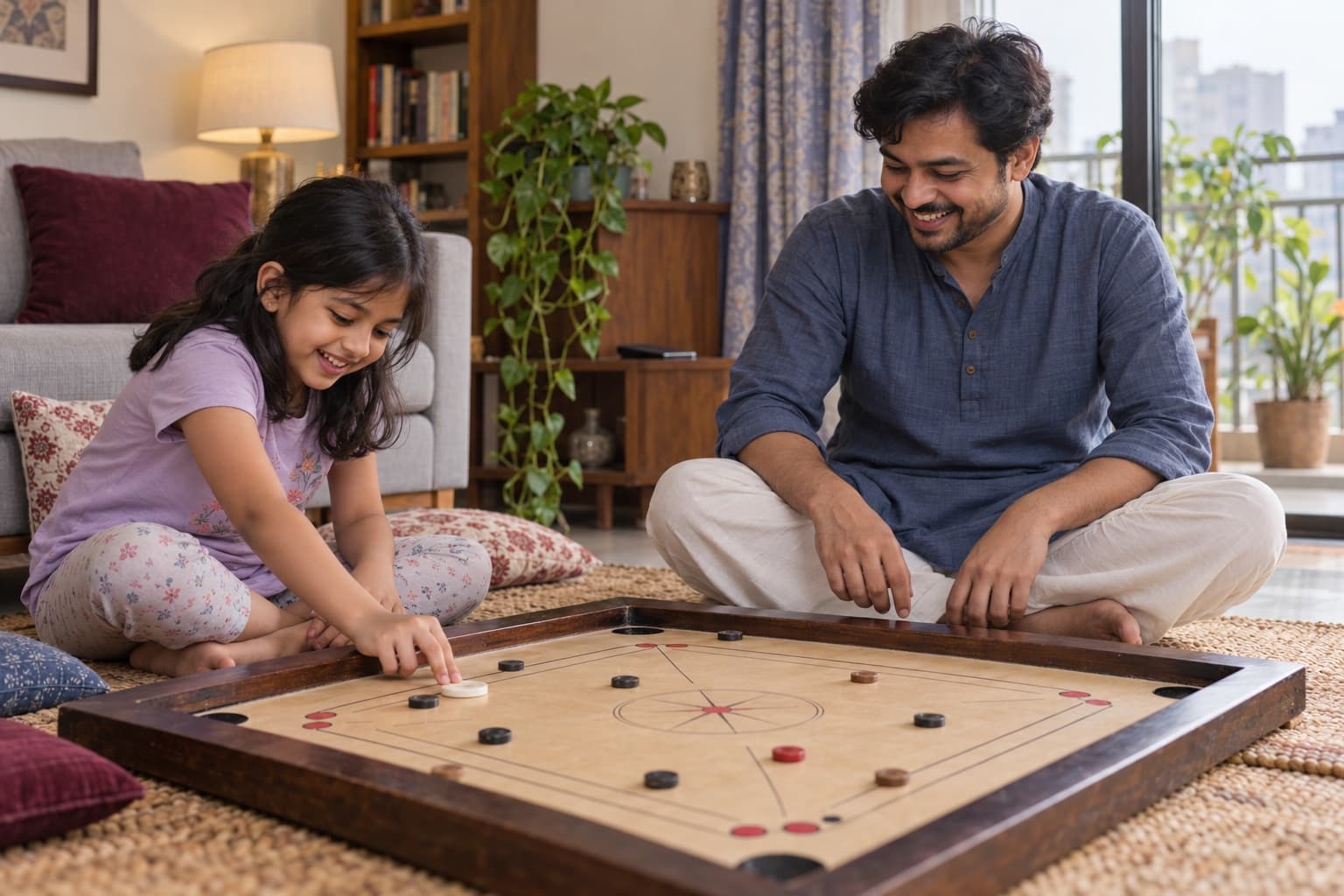
- Load-shedding evenings. When the power and the Wi-Fi go, try stories by torchlight, ludo, carrom or the songs grandparents know.
How to reduce screen time for kids: a gentle 7-day plan
Pick one change, note what happens each day, and compare after a week.
- Day 1: Just notice when screens are on, for how long, and what happened just before.
- Day 2: Choose one change, such as no screens at meals or switching off an hour before bed.
- Day 3: Tell your child about it in a sentence or two, at a calm time.
- Day 4: Start. Warn, end on time, and have the next activity ready.
- Day 5: Keep the same rule, and note how the ending went.
- Day 6: Add one real thing to do in the gap: a walk, a puzzle, a story, cooking together.
- Day 7: Compare the week. Was ending easier? Did sleep or mood change? Keep what helped, and choose the next change.
When is screen use a problem that needs help?
Most screen struggles are habits that can be eased at home, and our guide to phone addiction in children explains heavy use versus problem use. Talk to your child's doctor or a child psychologist if:
When to get help
- Screens cut into sleep most nights, or your child is too tired for school, after weeks of a clear night-time rule.
- Your child cannot stop even when they want to, and it has been getting worse for a month or more despite steady limits.
- Outbursts when screens end are violent or very long on most days, or your child seems low, anxious or secretive about what they do online.
- A toddler has very few words, rarely responds to their name, or rarely looks at you to share something. Ask for a development check, whatever their screen time.
- Your child has hurt themselves or talks about it: stay calm and stay close. Call 999 if they are in danger now; otherwise speak to a doctor the same day.
- Someone your child met online is threatening them or arranging to meet: keep your child close, keep the messages, send nothing, and block and report the account. Tell the local police station (thana) the same day, and call 999 if your child has gone to meet them, cannot be found or is in danger now.
ParentMind helps you note what happens each day, from screen time to sleep and moods, and spot the patterns over a week. See how ParentMind works.
Questions parents ask
How much screen time should a 10-year-old have?
There is no single right number. From age 6, most child-health guidance asks for steady limits that protect sleep (9–12 hours at this age), at least 60 minutes of active play, homework and family time, and no screens in the hour before bed. What's left after those is usually reasonable.
Does homework count as screen time?
Usually not in the daily limit, which is about entertainment. But school screens, including online classes, still shouldn't run into the hour before bed, and children need breaks to move and rest their eyes. Keep school apps and fun apps apart, so “I'm doing homework” doesn't drift into videos.
Is it okay to show cartoons to a baby under 2?
Under 18 months, most guidance advises no screens except video calls with family. From 18 to 24 months, a short, good-quality programme watched with an adult is fine if you choose. Cartoons playing in the background don't help babies learn; talking, singing and looking at picture books together do far more.
Do video calls with grandparents count as screen time?
Not in the usual way. Video calls are treated differently at every age, even for babies, because a call is a real conversation: a familiar face, their own name, a reply. Keep calls short for little ones, hold them on your lap, and help them wave, show a toy or sing a rhyme.
How long before bed should screens go off?
At least an hour before bed for children 6 and over, and the habit helps younger children too. Screen time before bed can keep the brain alert, so sleep often comes later. Use that hour for a bath, a story or quiet talk, and charge devices outside the bedroom.
How do I reduce screen time if my child cries every time?
Bring it down in steps, warn before the end, and have something real to do next. Stay close and calm through the crying, but don't hand the screen back to stop it. Many families find the protest eases within a week or two of a steady routine.
This article is general information, not medical advice. For health worries, talk to a doctor; if someone is in danger, contact your local emergency number.