When your child won't eat without phone videos: a gentle 14-day plan
Quick answer
When a child won't eat without phone cartoons, many families undo the habit gently over about two weeks: first a few bites without the screen, then one phone-free meal a day, then every meal. Sit and eat together, serve small portions with one food your child likes, let them feed themselves, and keep every adult on the same plan.
 By the ParentMind team10 min read
Listen to this article
14 min listen · Read by your device's voice
At a glance
- Who it is for
- Parents of children aged 1–6 who eat only with a phone, tablet or TV on
- Key takeaways
- A phone gets food in, but children eat without noticing taste or fullness, which can make picky eating worse over time.
- Wean the screen off in steps over about two weeks, starting with the easiest meal of the day.
- Make the meal itself the company: sit together, talk, sing, and let your child feed themselves.
- Grandparents and house help need the plan, the words and an easy job, not just a rule.
If your child won't eat without phone cartoons, you are one of a great many parents in Bangladesh living with exactly this. The mouth opens when the video plays and closes the moment it stops. It usually starts for loving reasons: a fussy phase, worry about weight, a tired evening, and a phone that made the food go in.
The habit can be undone gently, without empty plates or a fight at every meal. This page explains why the phone works so well, what it does to hunger, a 14-day plan to wean it off, what to do on hard days, and how to bring grandparents and house help onto the same plan.
Why won't my child eat without phone cartoons?
Feeding with a phone works, at least at first, and that is why it sticks. A child absorbed in a cartoon opens their mouth almost automatically and the plate empties. For a worried parent, that relief is powerful.
- Appetite naturally drops after the first birthday because growth slows, so parents worry and look for a way to get more food in.
- Toddlers become wary of new foods and want control. A screen slips food past the “no”.
- After a few weeks, the phone becomes part of the meal. The child expects it the way they expect a plate.
- Milk, juice or biscuits between meals mean the child isn't really hungry at mealtimes, so the screen seems the only way to get food in.
Is feeding with cartoons harmful? What screens at mealtime do
A cartoon at one meal on a hard day does little harm. As an every-meal routine, though, it changes how a child learns to eat.
- Hunger and fullness signals get missed. A child watching a screen often doesn't notice when they are full, so some eat past fullness and others eat very little without it.
- Food goes in unnoticed. Children learn to like foods by seeing, smelling, touching and tasting them, so eating while staring at a screen can make picky eating worse.
- Chewing and self-feeding skills can lag when a child is spoon-fed while watching.
- Meals lose their talk, one of the day's best chances for language and closeness.
- Screen time adds up. Three cartoon meals can use up a young child's whole daily limit; see screen time by age.
How to stop the phone at mealtime: the first phone-free meal
The first meal without a screen sets the tone. Choose the time of day your child eats best, and keep it short and friendly.
- Make sure your child is hungry: no milk, juice or snacks for about two hours before.
- Put the phone and remote out of sight before you call your child, and switch off the TV in the room.
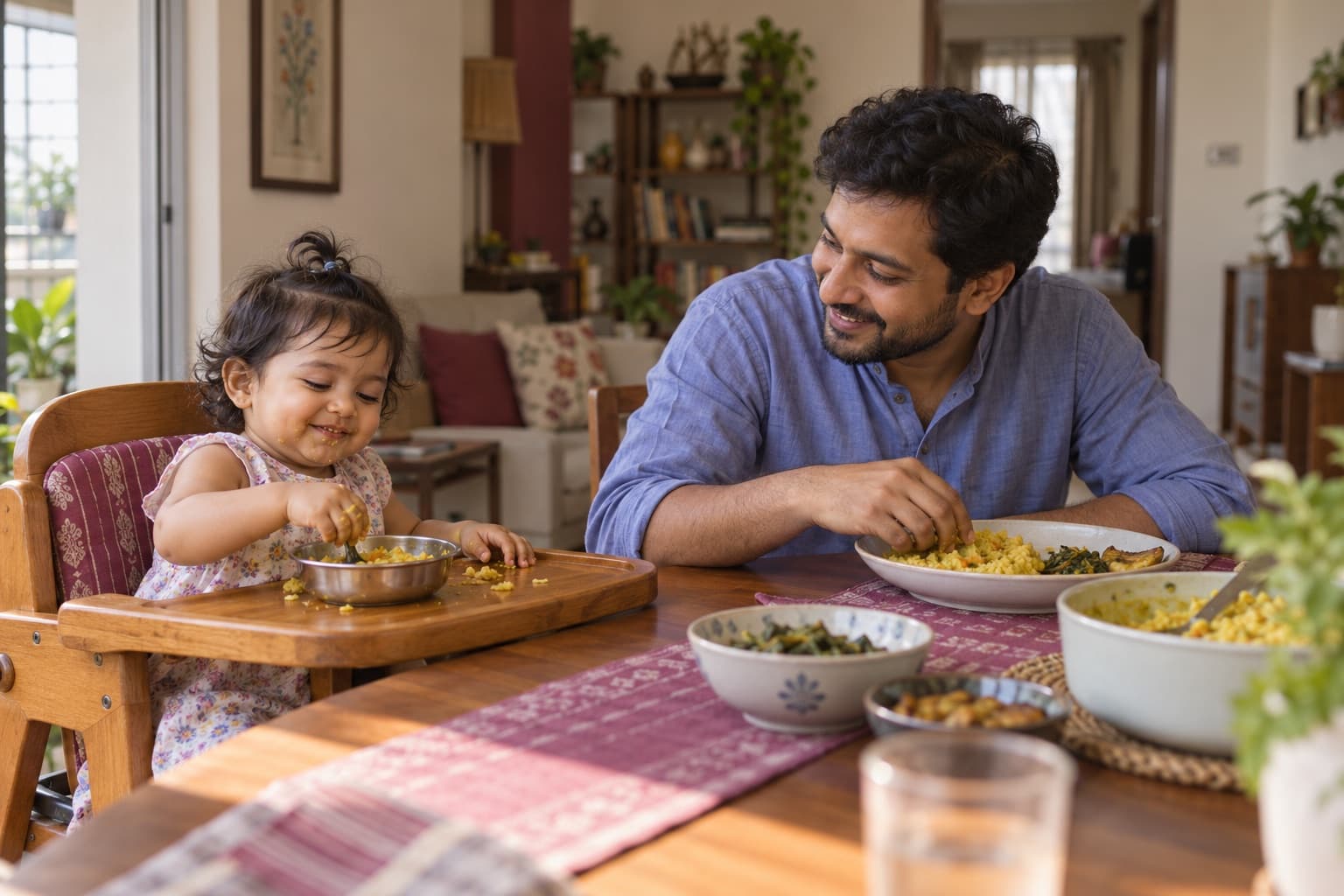
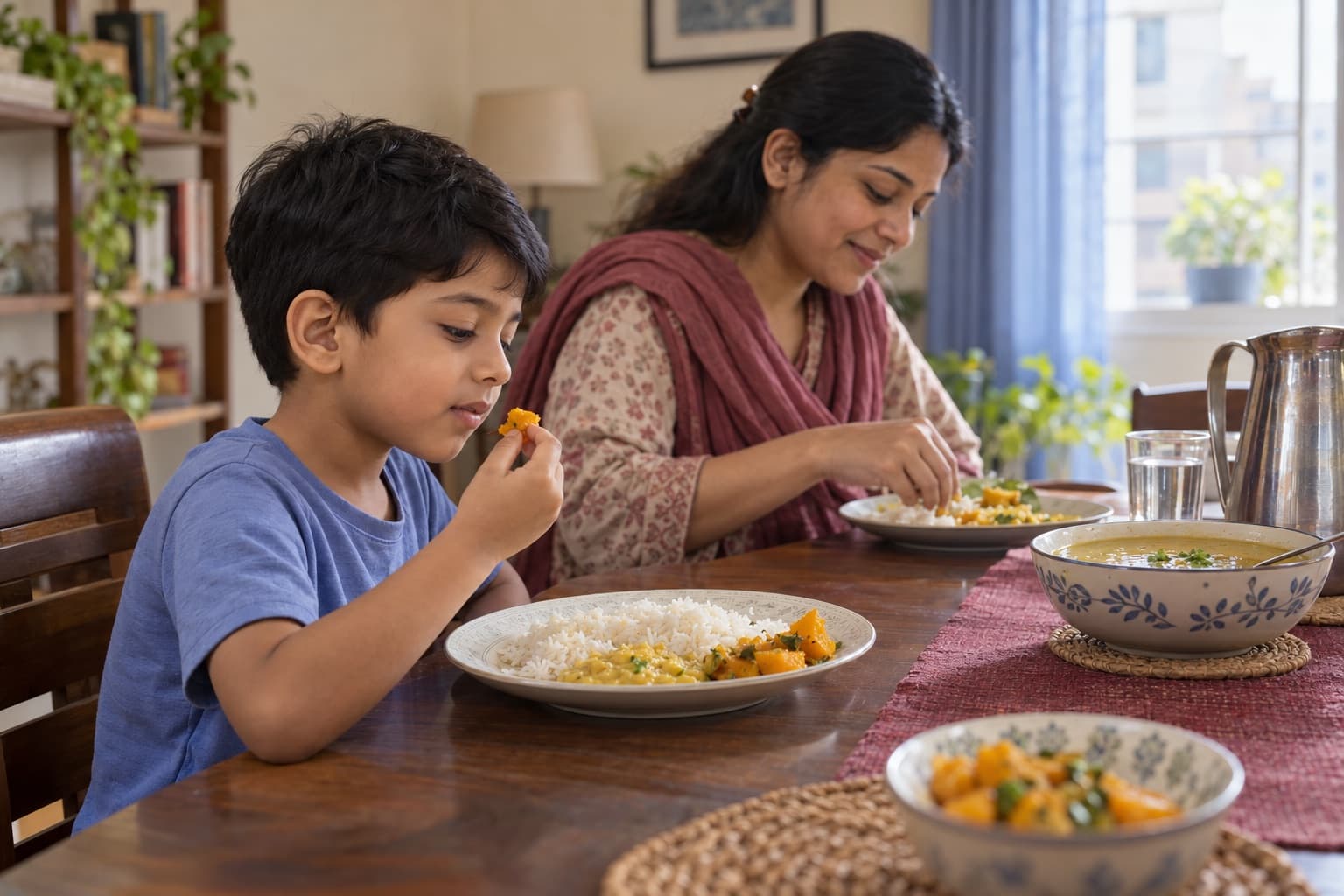
- Sit together at the table or on a mat, and eat the same food at the same time.
- Serve a small portion with one food your child already likes, beside a little of the family food.
- Let your child feed themselves with a spoon or their hand; mixing rice and dal with their fingers is real learning.
- Be the company, not the show: talk about the food, tell a short story, sing a rhyme.
- End calmly after about 20–30 minutes, however much was eaten, and offer no other food until the next meal or snack (water is fine).
What you might say
- The phone is sleeping now. Let's eat together, you and me.
- Look, the dal is yellow like the sun. Do you want to mix your own rice?
- You don't have to eat it. You can just touch it or smell it.
- I know you want the cartoon. Cartoons are for after your nap, not for eating.
- Is your tummy full? Okay, we're finished. Next we eat at fruit time.
A gentle 14-day plan to stop feeding with the phone
Some families stop all at once; many find steps easier. Note each day which meals were phone-free and roughly how much was eaten.
- Days 1–2: Notice, and change nothing yet. Note when the phone comes out, who is feeding, how long meals take and how much your child eats.
- Days 3–4: Start each meal without the screen: the first few bites with the phone away, then bring it in. Each day, add a few more bites before it appears.
- Days 5–6: Make the screen smaller and further away: out of your child's hand, onto a table across the room, sound low, while your child feeds themselves.
- Days 7–8: Choose one meal, often breakfast or the afternoon snack, to be fully phone-free every day.
- Days 9–10: Add a second phone-free meal. Put songs, stories or talk about the day where the video used to be.
- Days 11–12: All meals without a screen. Every phone sleeps in a drawer or basket at mealtimes, for everyone.
- Days 13–14: Keep it the same, then compare with days 1–2: meal length, mood at the table, and how much your child eats across the week.
What to do on the hard days
Some days will go backwards: illness, a late night, guests, a long journey. A hard day isn't a failed plan.
- If your child refuses the whole meal, stay calm, clear the plate after 20–30 minutes, and offer the next snack on time. Bringing the phone back to rescue a meal can teach that refusing works.
- If there are tears, stay close, name the feeling and keep the phone away; see toddler tantrums.
- When your child is ill, offer drinks and small amounts of easy food, and pause the plan until they feel better.
- If you're exhausted and need the phone for one meal, use it, and go back to the plan at the next one.
Grandparents and house help: everyone on the same plan
In many Bangladeshi homes a child is fed by several people: a mother, a father, a dadi or nani, a khala who helps at home. If one still feeds with the phone, the habit returns quickly, so bringing everyone on board matters more than any trick.
- Explain the why, not just the rule: with a cartoon on, children don't notice when they're full and won't try new food.
- Respect their experience, and ask for help with what they do best: stories, rhymes, patience at the table.
- Write the plan down: which meals are phone-free this week, and what to say. A note on the fridge helps.
- Give house help time and an easy setup: the child at the table, food cut small, the phone in the drawer. Feeding without a screen takes longer at first.
- Stop the chasing. Following a child around the house with a plate often goes hand in hand with the phone; meals happen sitting down.
- If a grandparent strongly disagrees, start with the meals you give yourself and let the results speak. Two parents, one plan has ideas for agreeing between adults.
What you might say to a grandparent
- Amma, you tell such lovely stories. Could you tell her one at lunch instead of the phone?
- I know you worry she isn't eating enough. Let's try this for two weeks and see together.
- If she eats only a little, that's all right. She can eat again at snack time.
Common mistakes when weaning off the phone at meals
- Swapping one screen for another. The TV in the room, or a tablet instead of the phone, keeps the same habit.
- A parade of toys and tricks. A new show at every bite turns you into the screen.
- Making up for a small meal with milk, biscuits or chips straight after, so the next meal is refused too.
- Force-feeding or threats, such as pushing food in or saying “No cartoons ever again”. Meals turn into a battle.
- Changing the rules from meal to meal. If the phone returns whenever the crying is loud enough, your child may learn to cry louder.
If the phone is hard to put down at other times of day too, screen addiction in kids has a calm plan for the rest of the day.
When is a feeding problem more than a phone habit?
Most phone-feeding habits ease at home with time and patience. Talk to your child's doctor if:
When to get help
- Your child is losing weight, or isn't growing as expected at check-ups.
- Your child eats only a handful of foods, refuses whole food groups, and the list is getting shorter.
- Your child often gags, chokes or vomits during meals, or eating seems painful or frightening for them.
- Your child is often very tired, pale or unwell, or has stomach problems such as constipation, diarrhoea or pain that last for weeks.
- After several weeks of steady effort, your child still eats no meal without a screen and you are worried about how much they eat.
- If your child is choking and can't breathe, cough or cry, call 999 at once and start choking first aid if you know it. Call 999 too if your child has trouble breathing, or a swollen face or lips, after eating.
ParentMind helps you note what happens each day, such as meals and screen time, see patterns over a week or two and get guidance. See how ParentMind works.
Questions parents ask
Is it bad to feed a toddler while watching cartoons?
Now and then, on a hard day, it does little harm. As a daily habit it gets in the way: children eat without noticing taste or fullness, learn to feed themselves later, and may refuse food anywhere without a screen. It also uses up a young child's screen time.
Will my child go hungry if I take the phone away at meals?
Your child may eat less for a few meals, which is usually fine for a healthy child; appetite balances out over the week. Keep meals and snacks at set times, stop milk and snacks in the two hours before meals, and serve one food they like. If your child loses weight or seems unwell, see a doctor.
How long does it take to stop feeding with the phone?
Many families find about two weeks of steady, step-by-step change makes most meals phone-free, though some children take longer. The first days of each step are usually the hardest. Going back a step for a day is fine; giving up after one bad meal is what usually brings the phone back.
Is the TV any better than a phone at meals?
Not really. A phone in hand or a TV in the room both pull attention away from the food, the feeling of fullness and the people at the table. If you need a bridge, soft songs or rhymes with no picture are a gentler step than any screen.
What can I do instead of the phone to make my toddler eat?
Use the meal itself. Sit with your child and eat the same food, let them feed themselves, talk about colours and tastes, and tell a short story or sing a rhyme. Let them help too: stirring dal, peeling an egg, carrying the plate. A hungry child at a calm, shared table often needs nothing more.
My mother-in-law keeps giving the phone at meals. What do I say?
Speak privately and respectfully, and explain why rather than simply saying no: with a screen, children don't notice when they're full. Ask for her help with what she is good at, such as stories or rhymes at the table, and agree a two-week trial. Seeing the child eat without the phone often persuades more than any argument.
This article is general information, not medical advice. For health worries, talk to a doctor; if someone is in danger, contact your local emergency number.