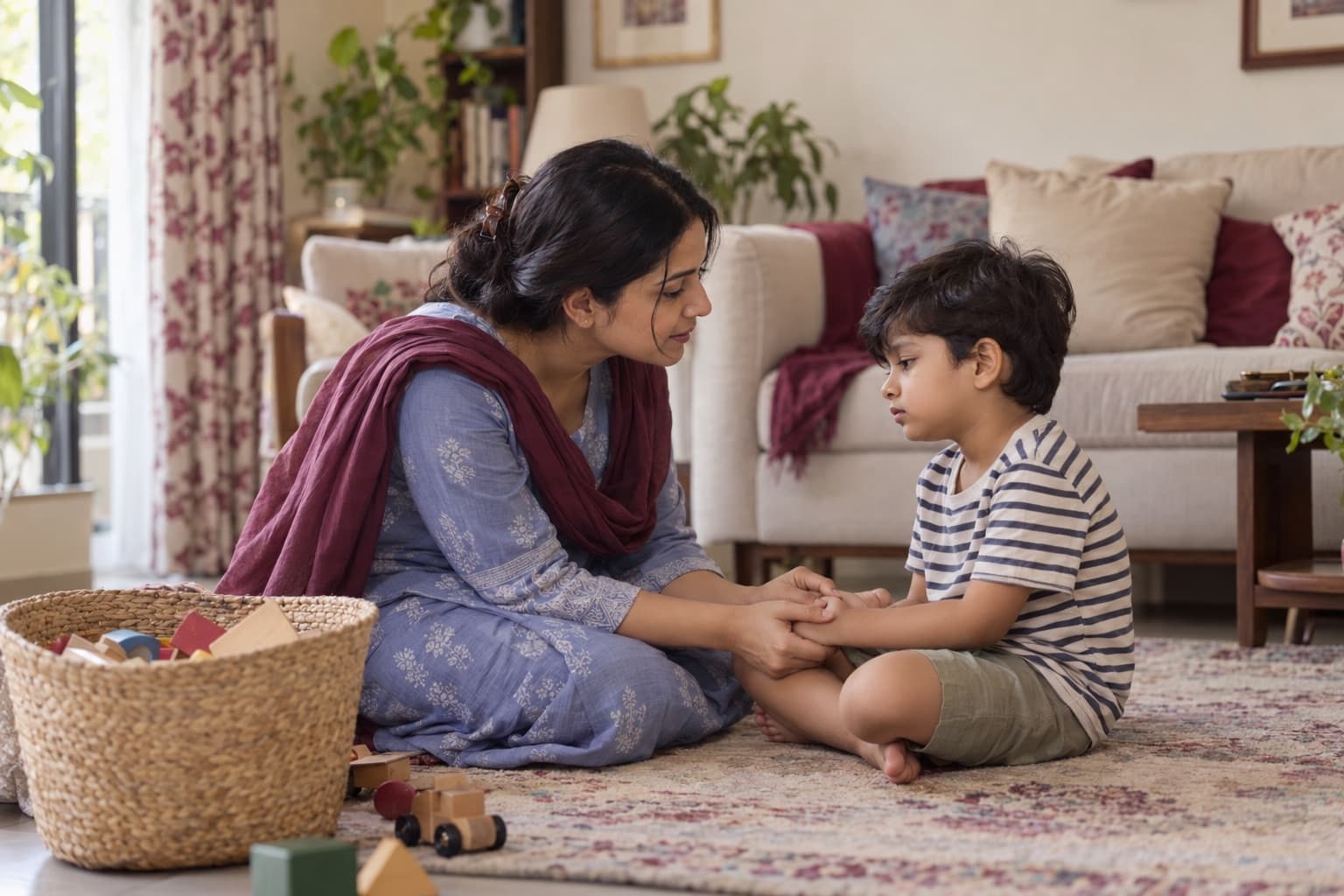
Toddler tantrums: what to do in the moment and how to have fewer
Quick answer
Toddler tantrums are normal from about age 1 to 4, when feelings arrive faster than words. In the moment, keep your child safe, stay calm and close, name the feeling, and don't give in to the demand. Most tantrums pass within minutes. Get advice if they still happen most days after age 5, or if anyone gets hurt.
 By the ParentMind team11 min read
Listen to this article
14 min listen · Read by your device's voice
At a glance
- Who it is for
- Parents of children aged 1–5, at home, in shops or at relatives' homes
- Key takeaways
- Tantrums are a normal stage: a young child's brain is still learning to manage big feelings, and being tired or hungry makes them much more likely.
- In the moment, your calm matters more than your words: stay close, say little, keep everyone safe, and don't hand over what the tantrum is about.
- Fewer tantrums usually come from prevention: steady sleep and meals, a warning before every change, and small choices through the day.
- Talk to a doctor if tantrums are still frequent after age 5, regularly last longer than about 25 minutes, or your child hurts themselves or others.
Toddler tantrums can turn an ordinary evening upside down: one moment your child is fine, the next they are on the floor, screaming because the biscuit broke in half. If this happens in your home, you are not doing anything wrong. Tantrums are one of the most common parts of being 1 to 4 years old.
A tantrum is not a sign of a spoiled child or weak parenting. It is a small child being overwhelmed, usually by tiredness, hunger, a 'no' or a sudden change. Below: what to do and say in the moment, how to prevent the next one, how tantrums change from age 1 to 5, and when to ask for help.
Why do toddlers have tantrums?
Temper tantrums happen because a toddler's feelings are big and their tools for handling them are still small. The part of the brain that helps us wait, calm down and find words is one of the last to mature.
- Tiredness: a missed nap, a late night, a long day at daycare.
- Hunger: a late dinner, or a long gap since the last snack.
- Not having the words: they know what they want but can't say it.
- Wanting to do it themselves: pouring the water, pressing the lift button.
- Sudden changes: leaving the park, a cartoon switched off.
- Too much at once: noise, crowds, visitors, a busy shop.
How to handle toddler tantrums in the moment, step by step
The goal is not to stop a tantrum fast but to get through it safely, without teaching your child that screaming gets results.
- Check safety. Move your child away from stairs, roads or hard edges, and move breakable things away from them.
- Calm your own body: one slow breath, lower shoulders, a lower voice. A child calms more easily next to a calm adult.
- Get down to their level and stay close, even if they don't want to be touched yet.
- Name the feeling in a few words, then stop talking. Reasons and lectures don't get through mid-tantrum.
- Hold the limit kindly. If the tantrum is about a 'no', the answer stays no; giving in teaches that bigger tantrums work.
- Stop hitting or biting gently but firmly: hold their hands or move them back, and say, 'I won't let you hit.'
- Reconnect when it passes, with a hug, some water and a fresh start. Talk about what happened later, briefly.
What you might say
- You really wanted that. You're so cross.
- I'm right here. I'll wait with you.
- You can be angry. I won't let you hit.
- The answer is still no. I'm staying with you.
- When you're ready, we'll wash your face and have some water.
- That was a big feeling, and you got through it. Come here.
Should you ignore a tantrum?
It depends. If your child is safe and the tantrum is about getting something, giving it little attention often helps: stay nearby and calm, and don't argue or bargain. If your child is frightened, overtired, unwell or completely out of control, they need comfort, not distance.
How to prevent tantrums before they start
Most of the work happens before tantrums begin; many families find a few steady habits help more than anything said in the moment.
- Protect sleep. Children aged 1–2 need about 11–14 hours in 24 hours, and 3–5-year-olds about 10–13 hours, naps included. See how much sleep children need.
- Feed before you go out. A snack before the shop or an evening visit avoids the hungry hour.
- Warn before changes: 'Two more slides, then home.'
- Offer two small choices: 'Red cup or blue cup?' Choices give a sense of control without changing the plan.
- Save your 'no' for safety and the few things that really matter, so it's easier to hold.
- Notice calm moments: 'You waited so nicely for your turn.'
How do tantrums change between 1 and 5?
Tantrums usually begin around the first birthday, are often at their most intense between about 2 and 3, and become less frequent between 4 and 5 as speech and self-control grow. For the age-2 stage itself, the 'no' to everything and the wish to do it alone, see the terrible twos.
Tantrums in 3 year olds
Three-year-olds have more words but not yet enough for big feelings, and they argue about fairness and turns. Naming the feeling for them, and praising the times they cope, builds the words they need.
4 year old tantrums
By 4, many children can say 'I'm angry' and wait a little, so tantrums come less often, though some last longer or turn into bargaining. A long day at preschool or a late night is a common trigger.
5 year old tantrums
Some tantrums at 5 are still normal, especially after a long school day. If they happen most days, regularly last longer than about 25 minutes, or involve hurting people, talk to a doctor. For older children, see a strong-willed school-age child.
Common mistakes that make tantrums bigger
- Giving in after a long tantrum, which teaches that the next one should be longer.
- Handing over the phone to stop the crying. It works for a minute, and soon the phone becomes what the tantrums are about.
- Shouting, threatening or smacking, which add fear and tend to make tantrums more frequent over time. Discipline without hitting has calmer ways to stay in charge.
- Threats you won't carry out, like 'I'll leave you here', which either mean nothing to a child or truly frighten them.
- Different rules from different adults. Tantrums tend to grow around the person who always gives in.
Tantrums in a Bangladeshi home: shops, relatives and the phone
The hardest tantrums often happen in front of other people, in situations most Bangladeshi families know well.
At the shop counter
Chips and chocolates often sit at a child's eye level by the till. Decide what you're buying before you go in, and say it: 'Today we're buying milk and eggs. No chocolate today.' If a tantrum starts, finish quickly or step outside together until your child calms down.
At a relative's home or a dawat
With relatives watching, it's tempting to give in, or to scold harshly to show you're in charge. Instead, take your child to a quieter room, help them calm down, and come back. Evening invitations often mean a late dinner, so feed your child before you leave and go home before they are exhausted.
When grandparents give in
Many grandparents find it hard to watch a grandchild cry, so they hand over the sweet or the phone. Their love is real, and so is the confusion it creates for a small child. Talk privately and kindly, and agree on one or two shared rules: 'When she cries for the phone, can we all say the same thing?' Ask any house help to use the same words too.
The phone to stop the crying
A cartoon on the phone can stop crying in seconds, but many children soon learn that crying is how a phone appears. For ages 2–5, child-health guidance suggests at most 1 hour a day of good-quality content, ideally watched together. If meals have become phone time, see feeding without the phone and screen time by age.
A 7-day plan for fewer tantrums
Pick one change, note what happens each day, and compare after a week.
- Day 1: Just notice. For each tantrum, note the time, what happened just before, how long it lasted and what you did.
- Day 2: Look for the pattern. Before dinner? After daycare? When a screen goes off, or after a 'no'?
- Day 3: Choose one change for the biggest trigger: an earlier snack, bedtime 30 minutes earlier, or a two-minute warning before screens go off.
- Day 4: Agree on the same words with everyone who looks after your child.
- Day 5: Add 10 minutes a day of play where your child leads.
- Day 6: Practise feeling words in a calm moment, with a story or a game.
- Day 7: Compare with Day 1: how many tantrums, how long, and how quickly your child calmed. Keep what helped, and choose the next change.
A tantrum is a child who can't cope yet, not a child who won't.
When to get help for tantrums
Most tantrums are a passing stage. Talk to your child's doctor or a child development specialist if:
Get help if
- Tantrums still happen most days after age 5, or are getting more frequent or intense despite a few weeks of calm, consistent handling.
- Tantrums regularly last longer than about 25 minutes, or happen several times a day on most days.
- Your child hurts themselves during tantrums, such as banging their head or biting themselves, or often hurts others.
- Your child holds their breath until they turn pale or blue, or faints. Tell a doctor the first time this happens, and call 999 if they don’t come round within about a minute.
- Tantrums come with other worries: speech well behind other children the same age, losing skills they had, or little interest in people.
- You feel you might hurt your child, or you can't cope. Make sure your child is safe, with another adult if possible, step away for a few minutes and get support for yourself. If anyone is in immediate danger, call 999.
ParentMind helps you note what happens each day and spot what keeps repeating, such as the time of day or the late nights, so you can choose your next small change; see how ParentMind works.
Questions parents ask
How long do tantrums last?
Most tantrums last a few minutes, even though they can feel much longer. They tend to pass sooner when you stay calm and close, keep words few and don't argue or give in. If tantrums regularly last longer than about 25 minutes, or happen several times a day, talk to your child's doctor.
Is it normal for a 3 year old to have tantrums every day?
Yes, for many children it is. Three-year-olds have more words than before but not enough for big feelings, and they want to do everything themselves, so daily tantrums are common, especially when a child is tired or hungry. Get advice if they happen several times a day, last longer than about 25 minutes, or your child hurts themselves.
What is the difference between a tantrum and a meltdown?
A tantrum usually has a goal, such as a toy or more time at the park, and often eases once the goal is clearly off the table. A meltdown is a child overwhelmed by noise, crowds, tiredness or too much going on; it isn't about getting anything, and it needs a quiet space, few words and comfort. If meltdowns are frequent, tell your child's doctor.
Is it okay to give my child the phone to stop a tantrum?
It's better not to make it a habit. A phone often stops crying fast, but children soon learn that a tantrum is how the phone arrives. Stay close, name the feeling and wait it out instead. Child-health guidance suggests no screens under 18 months except video calls with family, and at most 1 hour a day of good-quality content from 2 to 5.
What should I do if my toddler hits or bites during a tantrum?
Stop it calmly and right away: hold their hands or move them out of reach, and say, 'I won't let you hit.' Don't hit or bite back to show how it feels; it teaches the opposite. Once your child is calm, help them make up with the person they hurt. If hitting still happens most days after age 4, talk to a doctor.
This article is general information, not medical advice. For health worries, talk to a doctor; if someone is in danger, contact your local emergency number.