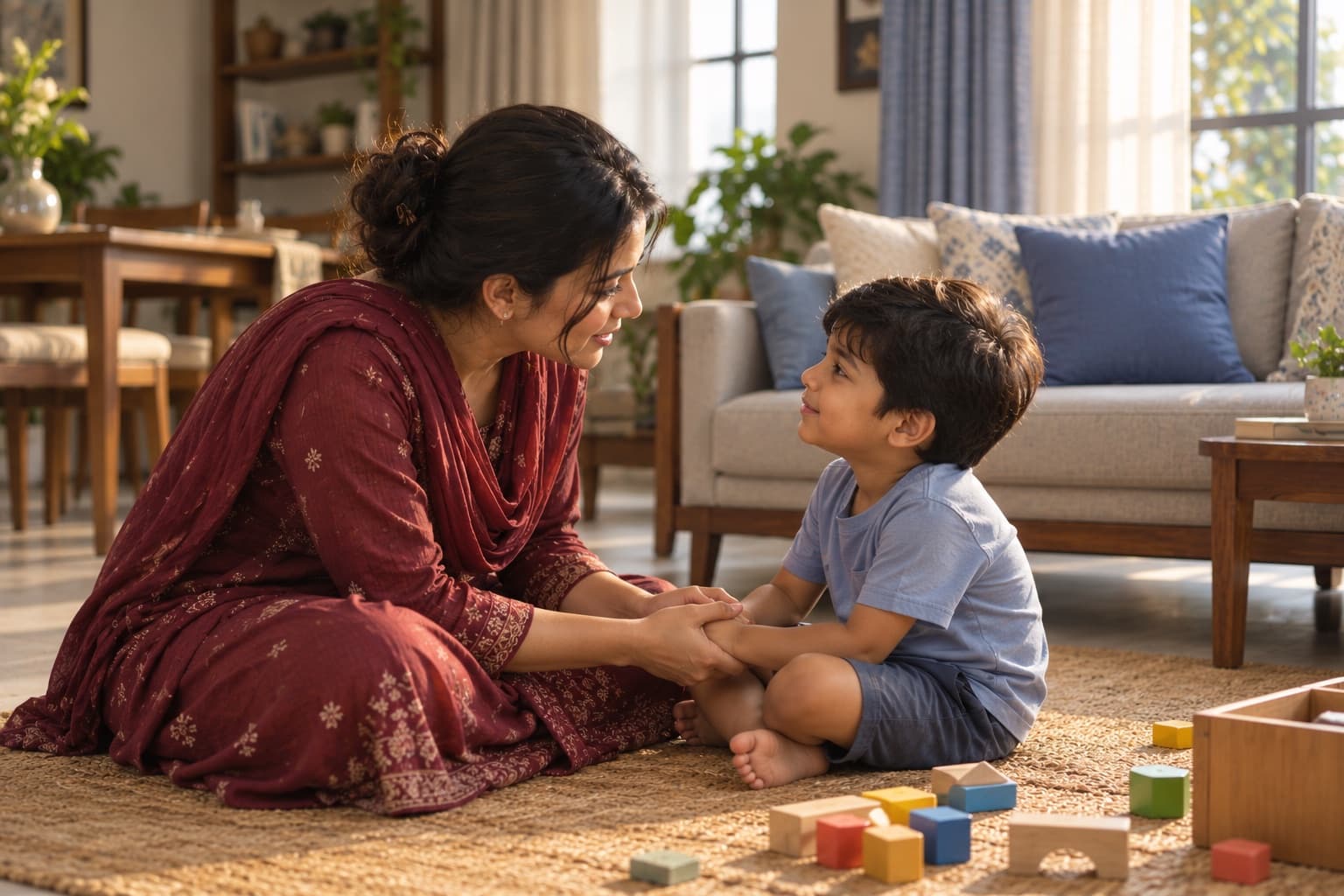
Positive discipline: how to discipline a child without hitting or yelling
Quick answer
Positive discipline means teaching your child what to do instead of hitting or yelling, through clear limits, calm follow-through and fair consequences. Physical punishment may stop behaviour for a moment but tends to make it worse over time and can harm trust. Try: calm yourself first, give one clear instruction, use a small logical consequence, and repair together afterwards.
 By the ParentMind team11 min read
Listen to this article
14 min listen · Read by your device's voice
At a glance
- Who it is for
- Parents of children aged 2–12, and anyone in the family who disciplines them
- Key takeaways
- Hitting may get quick obedience, but over time it tends to bring more defiance, more hiding and less trust, not better behaviour.
- Calm discipline still has firm limits: one clear instruction, a when-then, a small logical consequence, and follow-through every time.
- Your own anger comes first: pause, breathe and step away before you act, and say out loud that you are doing it.
- If you lose your temper, repair: name what you did, say sorry without 'but', and try again together.
If you are reading about positive discipline, or ways of discipline without hitting, you probably know the moment: your child does the thing you've told them a hundred times not to do, and your hand is up before you've thought. Many of us were raised with a slap, the cane or a slipper, and we love our parents. Wanting to do it differently is not disrespect to them.
Discipline means teaching, not hurting. Below: why hitting tends to backfire, a toolkit with words to say, a plan for your own anger, how to repair afterwards, what to do when grandparents or teachers hit, and a 7-day plan.
Why hitting tends to backfire: what children learn from it
Hitting often works in the moment, which is why it feels effective: a frightened child stops. But child-development experts broadly agree that, over months and years, physical punishment tends to make behaviour worse, not better.
- It teaches that hitting is how bigger people handle anger, so many children hit siblings and classmates more.
- It teaches children to avoid getting caught rather than why something was wrong, so lying often increases.
- It damages trust: a child who fears a parent is less likely to tell them about trouble at school, online or with an adult.
- It can injure, especially when a parent is angry, which is when most hitting happens.
Parents who smack are not bad parents. They are usually tired, worried about how their child will turn out, and using what they were taught. Calm discipline is a skill that can be learned at any age.
What to do in the moment instead of hitting
- Stop the behaviour safely: step between children, take the thrown object, hold the hand that is about to hit.
- Pause yourself. If you feel the urge to hit or shout, say 'I need a minute', breathe out slowly, and step away if your child is safe.
- Name the limit in one short sentence, in a low voice: 'We don't hit.'
- Say what to do instead: 'Use words. Say, “Give it back.”'
- Follow through calmly: help them do it, or use a small consequence linked to what happened, without a lecture.
- Talk later, when everyone is calm: what happened, and how to make it right next time.
What you might say
- I'm too angry to talk right now. I'm taking a minute, then we'll sort this out.
- I won't let you hit your sister. Hands down.
- You can be angry. You can't throw things.
- The toy that was thrown stays on the shelf until after dinner.
- When your homework is done, then you can watch cartoons.
- What can you do to make it right with your brother?
Positive discipline: the tools to use instead
Positive or gentle discipline, the main set of alternatives to spanking, is not permissive. It keeps firm limits and drops the fear.
A few clear rules, said the same way
Pick three to five house rules that matter most, such as 'We don't hit' and 'No screens at dinner'. Say them the same way every time, and make sure every adult at home knows them.
When-then instead of threats
'When your shoes are on, then we'll go to the park' is as clear as a threat, but it invites cooperation instead of fear, and you stay in charge without raising your voice.
Logical consequences that teach
A logical consequence is linked to the behaviour, respectful, small and short. It teaches cause and effect without humiliation.
| What happened | A logical consequence | Instead of |
|---|---|---|
| Throws a toy | The toy stays on a shelf until tomorrow | A slap |
| Draws on the wall | Helps clean it off | Shouting and name-calling |
| Won't turn the cartoon off | A shorter cartoon time tomorrow | No TV for a month |
| Hits a sibling | Plays apart for a while, then makes it up | Hitting back to show how it feels |
| Breaks a phone rule | The phone stays in the living room tonight | A beating, or locking them in a room |
Time-out vs time-in
A time-in means staying close while your child calms down, then talking; it suits younger children and those who panic when sent away. A time-out is a short, calm break in a quiet spot, never a dark or locked room. Either can help if it is calm and brief.
How to discipline a child at each age, from 2 to 12
| Age | What often helps | Keep in mind |
|---|---|---|
| 2–3 years | Redirecting, removing the object, time-in, very few words | They can't stop themselves yet; you are the brakes |
| 4–6 years | When-then, choices, short time-outs or time-ins | Consistency matters more than strictness |
| 7–9 years | Logical consequences, simple house rules | Fairness matters; explain the why once, briefly |
| 10–12 years | Agreeing rules together, privileges tied to responsibility | Shaming or hitting can hurt trust deeply; correct in private |
If you're wondering how to discipline a toddler, toddler tantrums walks through the moment itself, and helping an angry child covers big feelings at any age.
How to discipline a child without yelling: start with your anger
Most hitting and shouting happens when a parent is already full: tired, hungry, late, worried about money or exams. Learn your early signs, such as a hot face, a tight jaw or a rising voice, and have a plan ready before you need it.
- Notice the signal and say it: 'I'm getting angry.'
- Breathe out slowly, longer than you breathe in, three times.
- If your child is safe, step away for a few minutes and drink some water, then come back with one tool: a when-then or a logical consequence.
- If another adult is home, hand over: 'Can you take over for five minutes?'
What to do after you hit or shout: how to repair
Every parent loses their temper sometimes; what matters most is what happens next. A calm apology does not weaken your authority. It shows your child how a grown-up takes responsibility, and it rebuilds trust.
- Calm down first, so the apology doesn't turn into another lecture.
- Go to your child, get down to their level, and name what you did.
- Say sorry without 'but'. Their behaviour can wait for later.
- Tell them what you'll do next time, and then do it.
Words for repair
- I hit you, and that was wrong. Nobody should hit you, not even me.
- I shouted because I was angry. I'm sorry. My shouting wasn't your fault.
- Next time I'm that angry, I'm going to step away first.
- Can we start again? The homework still needs finishing.
In a Bangladeshi home: when elders or teachers believe in hitting
In many Bangladeshi families, a slap or the cane is seen as part of raising a good child, and you may hear that a child won't turn out right without a beating. The people who say it usually love the child, so answer the worry underneath rather than argue about the past.
With grandparents and relatives
- Talk privately, never in front of the child: 'I know you want him to grow up well. So do we. We're teaching him without hitting, and we need your help.'
- Give them a role, not just a rule: the bedtime story, the calm walk when a child is upset.
- Agree one shared rule: nobody hits in this house, including older cousins and house help.
- If a relative hits your child, step in calmly, comfort your child, and speak to the adult later, in private. If you and your partner disagree, start with two parents, one plan.
When a teacher or coaching tutor hits
Physical and mental punishment is banned in schools in Bangladesh, yet some children still face the cane, ear-pulling or humiliation at school or coaching. Ask your child calmly, and often, how class is going. If something happened, thank them for telling you, note what, when and who, and speak to the head teacher or the coaching centre.
For many families, their own values of patience, mercy and respect are the strongest reasons for calmer discipline. Children treated with respect usually learn to show it.
A 7-day plan for calmer discipline
- Day 1: Note every moment you felt close to hitting or shouting: the time, what happened just before, and how tired or hungry you were.
- Day 2: Choose your house rules and your pause plan, and tell your child about both at a calm time.
- Day 3: Use a when-then instead of a threat, at least once.
- Day 4: Plan one logical consequence for the behaviour that comes up most, so you aren't inventing one in anger.
- Day 5: Talk privately and kindly with the other adults at home about the no-hitting rule.
- Day 6: Notice and name three things your child does right: 'You asked for a turn instead of grabbing.' More in noticing the good.
- Day 7: Compare with Day 1: how many close calls, how often you paused, how your child responded. Keep what worked, and adjust one thing.
When to get help with discipline and anger
Get help if
- You hit, or nearly hit, your child most weeks even though you are trying to stop. Talk to a doctor or counsellor for yourself.
- Once you start shouting or hitting you can't stop, or your anger seems tied to low mood, old hurts, drinking or drugs.
- Your child has marks, bruises or injuries from being hit by anyone, at home, at school or at coaching. Have a doctor check them.
- Your child seems afraid of an adult, flinches when a hand is raised, or suddenly refuses to go to a class or a relative's home.
- Your child's own hitting, lying or aggression keeps getting worse over several weeks, despite calm and consistent discipline.
- You fear you might seriously hurt your child: make sure your child is safe, with another adult if possible, and step away now. If a child is in immediate danger, call 999.
Change rarely happens in a week, and slips are normal. ParentMind helps you note what happens each day and see patterns, such as which evenings are hardest, so you can plan for them; see how ParentMind works.
Questions parents ask
Does spanking work?
Spanking can stop behaviour for a moment, which is why it seems to work. Over time, though, it tends to make behaviour worse: more aggression, more lying and less trust, and it can turn into injury when a parent is angry. Most child-health guidance advises against any hitting, even a light smack. You can be just as firm without it.
How do I discipline my child without yelling?
Get close before you speak, so you don't need volume. Give one short instruction at eye level, then a when-then: 'When the toys are away, then we'll read.' If it isn't done, follow through calmly with a small consequence. When you feel yourself getting loud, say 'I need a minute' and step away.
My parents hit me and I turned out fine. Why should I do it differently?
Many people who were hit grew into loving, successful adults, often because of the love and effort their parents gave, not because of the hitting. Calm discipline keeps what worked, the high expectations and the care, and drops the part that carries the risks. Many parents also find they don't want their child to feel the fear they still remember.
What should I do if a teacher or grandparent hits my child?
Comfort your child first and tell them it wasn't their fault. Then talk to the adult privately: explain your family's no-hitting rule and what you'd like instead. For school, write down what happened and speak to the head teacher. If your child is injured, have a doctor check them; if a child is in immediate danger, call 999.
Does gentle discipline mean letting children do what they want?
No. Gentle or positive discipline keeps clear rules and real consequences; it drops the hitting, shouting and shaming. You still say no, still follow through and still expect the homework to be done. The difference is that your child learns why a rule matters, not only to fear getting caught. For everyday instructions, see when your child doesn't listen.
This article is general information, not medical advice. For health worries, talk to a doctor; if someone is in danger, contact your local emergency number.