Picky eater? What to do when your child won't eat (ages 1–8)
Quick answer
A picky eater aged 1–8 is usually in a normal stage: appetite drops after the first birthday, and many toddlers distrust new foods. You decide what is served and when; your child decides how much. Keep meals and snacks at set times, offer new foods often without pressure, and get help if your child loses weight or stops growing.
 By the ParentMind team10 min read
Listen to this article
14 min listen · Read by your device's voice
At a glance
- Who it is for
- Parents of children aged 1–8 who refuse meals or eat only a few foods
- Key takeaways
- Picky eating is common from the first birthday to early school age, and most children who eat this way grow well.
- You decide what and when; your child decides how much. Pressure, bribes and force-feeding usually make refusal worse.
- Snacks, chips, juice and milk between meals are often why a child won't eat rice and fish at mealtimes.
- Get help for weight loss or poor growth, very few accepted foods, frequent gagging or choking, low energy, or stomach problems that last.
Having a picky eater at home, or a fussy eater as many families say, can make every meal feel like a battle: the plate pushed away, rice and fish refused, biscuits or noodles demanded instead. If your child won't eat what the family eats, you are in good company. For most children, picky eating is a phase that eases with time.
What happens at the table matters more than any trick. Below: why children refuse food, what to do at the meal, how to stop force-feeding and plate-chasing, the snacks that quietly spoil appetite, ideas for Bangladeshi home food, and the signs that mean it's time to get help.
Why is my child a picky eater? The common reasons
Picky eating usually has ordinary causes, most of them about age and routine rather than the food you cook.
- Growth slows after the first year, so appetite drops. A toddler who seems to eat nothing often needs less than parents expect.
- Wariness of new foods is a normal stage, often strongest between about 2 and 5.
- Toddlers want control, and saying “no” to food is one of the few things they can decide.
- Small stomachs fill fast. Milk, juice, biscuits or chips between meals leave little room for rice and dal.
- Pressure backfires. The more a child is coaxed or forced, the more meals become a fight to win.
- Tiredness, teething, a cold or screens at the table can make a child eat less for a while.
| Age | What's common | What helps |
|---|---|---|
| 1–2 years | Appetite drops; wants to self-feed; plays with or throws food | Soft finger foods, a spoon of their own, accepting the mess |
| 2–5 years | Distrusts new foods; wants the same food daily; a strong “no” | Family food in small amounts, one safe food on the plate, no pressure |
| 5–8 years | More willing to try; copies friends; may still refuse vegetables | Cooking together, a choice of two vegetables, a say in the tiffin |
For school-age children, rushed mornings are a common reason food gets skipped; breakfast on busy school mornings has simple ideas.
What to do when your toddler refuses to eat at the table
- Serve a small portion, with at least one food your child usually eats, such as plain rice, roti or egg.
- Add a little of the new or less-liked food, without comment.
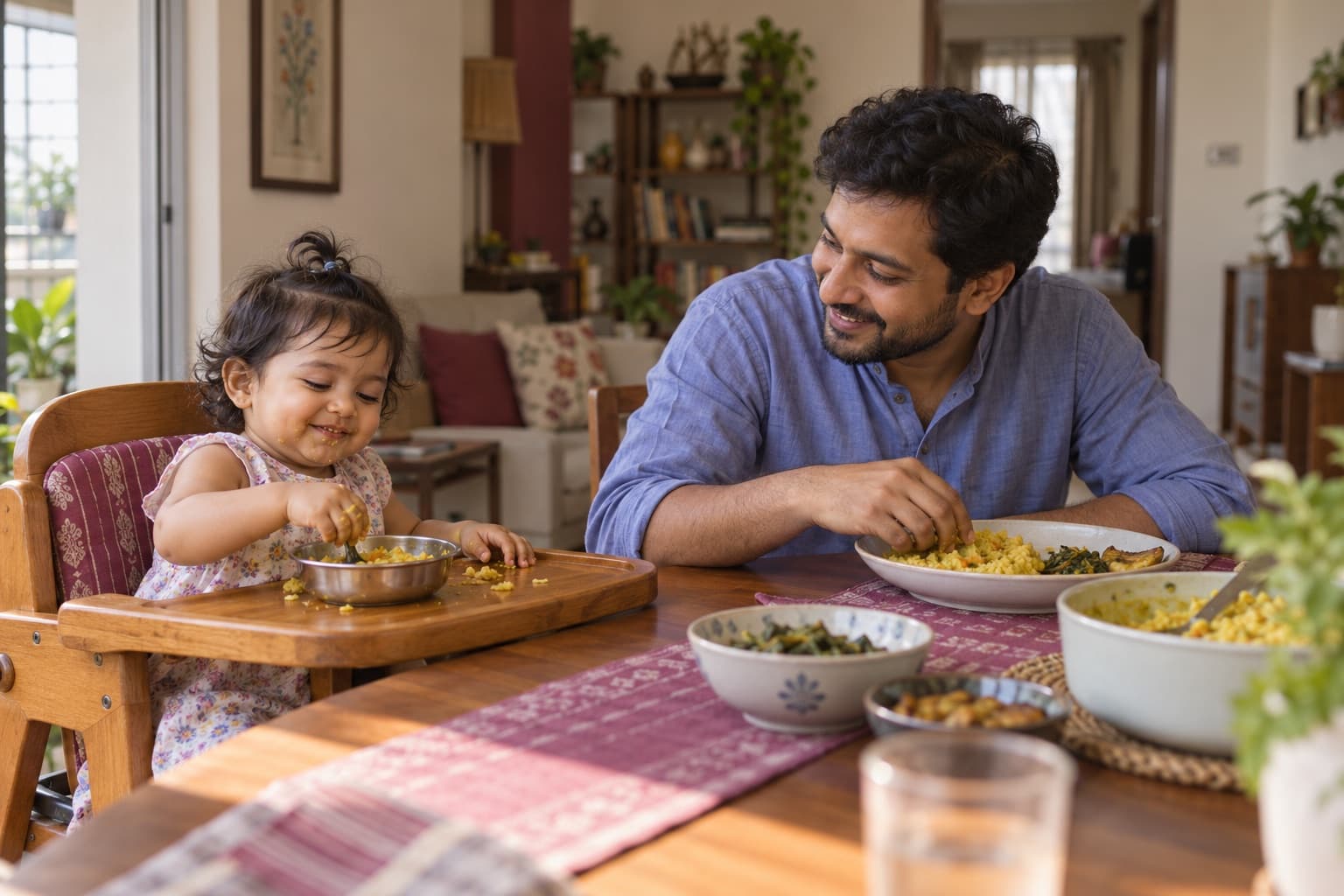
- Let your child feed themselves as much as they can, with a spoon or their own hand.
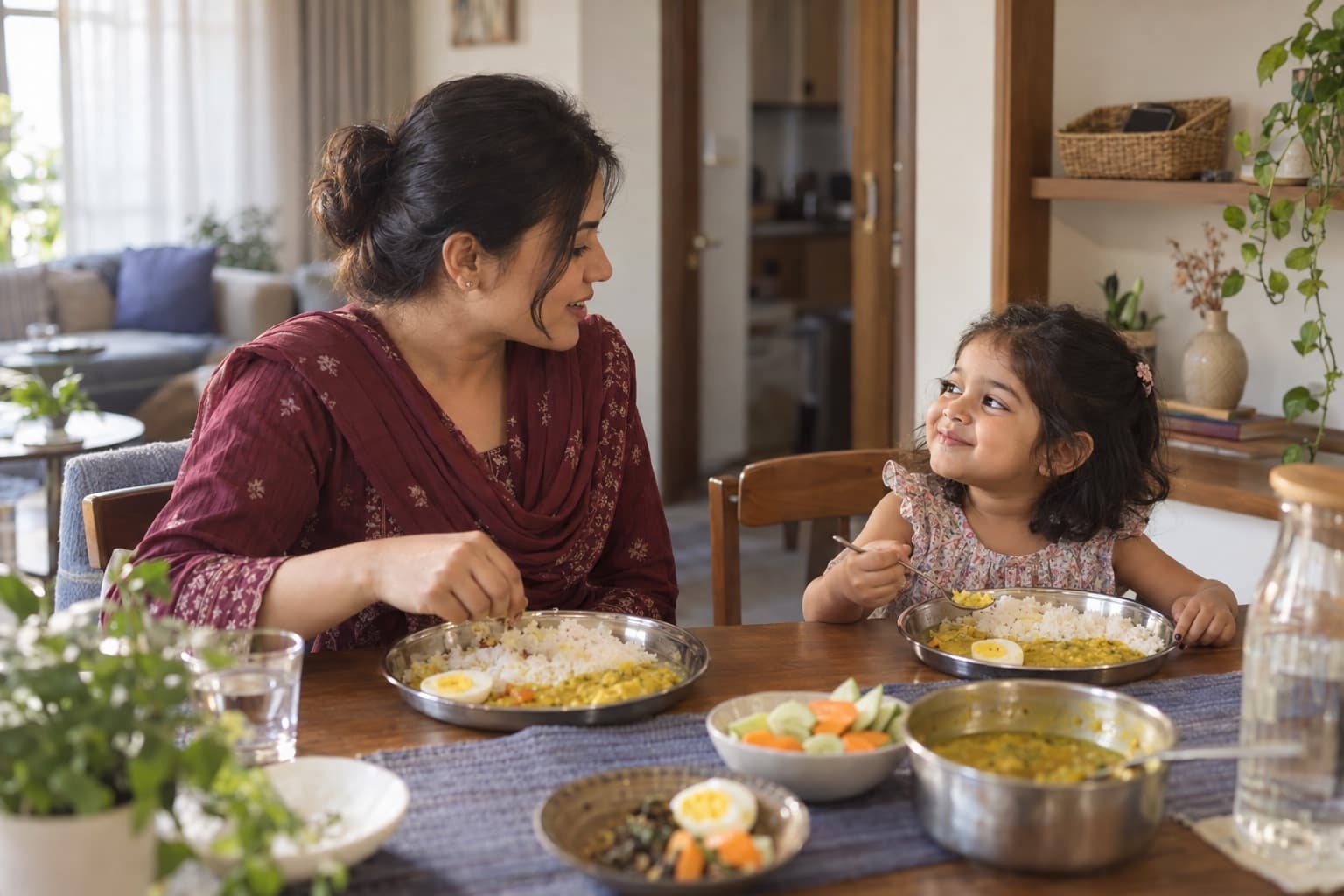
- Eat together and talk about other things, not about every bite.
- Skip the pressure: no “one more bite”, no bribes, no threats, no praise for an empty plate.
- When your child stops or starts playing, or after about 20–30 minutes, end the meal calmly.
- Don't offer a replacement snack straight after; the next food comes at the next planned time.
What you might say
- You don't have to eat it. It can just sit on your plate.
- This is fish. It's soft and a little salty. Do you want to smell it?
- Is your tummy full? Okay, you can get down.
- I love dal with rice. You can try it when you're ready.
- Lunch is finished now. We'll eat again at snack time.
You decide what and when, your child decides how much
Splitting the jobs at mealtimes takes a lot of pressure off, and many child-feeding experts suggest it. You choose what food is offered, when and where. Your child chooses whether to eat it and how much.
- Your job: three meals and two or three snacks at roughly the same times every day.
- Your job: family food, with at least one thing your child usually eats, at a calm table without screens.
- Your child's job: how much to eat from what is offered, including nothing at all.
- Your child's job: learning new foods at their own pace.
Why force-feeding and chasing with the plate backfire
Force-feeding comes from love and worry. Holding a child still, pushing food into a crying mouth, or following them around the house with a plate can get a few more spoonfuls in today. Over weeks it tends to make children dread meals and refuse more, and forcing food into a crying child's mouth can make them choke.
- Sit for meals: food is eaten at the table or on the mat, not on the move.
- Take “I'm full” at face value, and clear the plate without fuss.
- Don't use sweets as a reward for vegetables; it can teach that vegetables are a chore and sweets the prize.
- Leave screens out. A cartoon gets food in, but children stop noticing taste and fullness; see how to stop feeding with the phone.
Snacks, chips, juice and milk: why your child isn't hungry at meals
A child who won't eat at the table has often eaten a lot in between: chips from the corner shop, a glass of juice, a cup of milk, biscuits with tea. Each is small, but together they leave no room for rice and fish.
- Set snack times about two to three hours apart, and close the kitchen in between.
- Offer water between meals, and keep milk to meal and snack times.
- Keep chips, chocolate, sweet biscuits, soft drinks and packaged juice as occasional treats.
- Make snacks small meals: a banana, guava or papaya, muri, a boiled egg, roti with vegetables, yoghurt.
For what a school-age child's plate and drinks can look like, see food and nutrition for children.
Rice, dal, fish and eggs: a picky eater in a Bangladeshi home
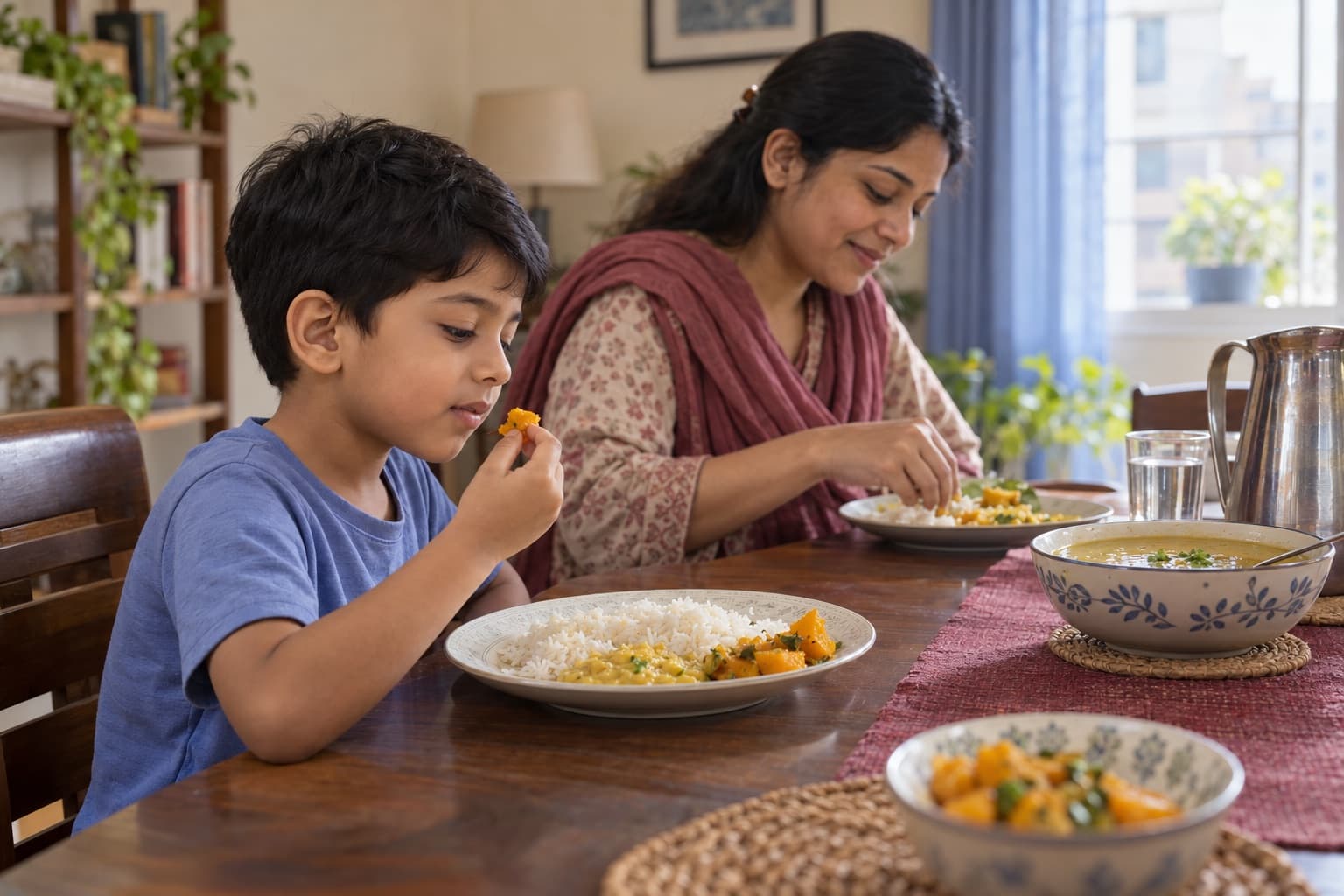
Everyday Bangladeshi food (rice, dal, fish, vegetables and eggs) is a good base for young children. A few changes often make family food easier, without cooking a separate meal.
- Take out the child's portion before the chilli goes in.
- Mash or mix: rice with dal, soft khichuri with vegetables, fish mixed into rice once the bones are carefully removed.
- Offer eggs in different ways: boiled, an omelette, egg bhaji, egg in khichuri.
- Let your child mix rice with their own hand and make small balls; many children eat more of what they mix themselves.
- Start with soft, easy fish. One bad bone can put a child off fish for weeks.
When relatives compare weights
“Why is she so thin? Look at her cousin” is a common comment at family gatherings, and it hurts. Comparing with another child says very little. What matters is steady growth along your child's own line at check-ups, energy to play and good development. For a rough idea of adult height from both parents' heights, try our child height predictor; your child's doctor is the one to judge growth. Relatives may also suggest an appetite syrup or tonic: don't give any medicine or syrup for appetite unless a doctor prescribes it after checking your child, and if you are worried about weight or growth, ask for a growth check instead.
When grandparents feed by hand
Many grandmothers feed children mouthful by mouthful, and it is an act of love that can stay part of family life. Ask for some meals where your child feeds themselves, so they also learn to stop when full.
How to get a toddler to eat new foods: small tastes, many times
Children accept new foods slowly. Many need to see, smell, touch and taste a food again and again, often ten times or more over weeks, before they eat it. A refused food isn't a failure; it's one try done.
- Offer a tiny amount next to familiar foods, at family meals.
- Eat it yourself and enjoy it, without asking your child to copy.
- Let your child help: washing vegetables, cracking an egg, stirring dal, choosing between two vegetables at the bazar.
- Count touching, licking and smelling as progress, and change the form: carrots raw, boiled or in khichuri.
A 7-day plan for calmer mealtimes
- Day 1: Notice. Write down everything your child eats and drinks, and when, including milk, juice and snacks.
- Day 2: Look at the gaps between meals, and choose one change, usually set snack times with water in between.
- Day 3: Set a daily rhythm of three meals and two or three snacks, with no screens at meals.
- Day 4: Serve family food in small portions with one safe food, and drop all pressure.
- Day 5: Add one new or less-liked food in a tiny amount, without comment.
- Day 6: Let your child help with one part of a meal.
- Day 7: Look at the whole week, not single meals. Are meals calmer? Is your child hungrier at mealtimes? Keep what helped.
When to worry about picky eating
Most children grow well and slowly widen what they eat. Talk to your child's doctor if:
When to get help
- Your child is losing weight, isn't growing as expected at check-ups, or clothes that fitted are getting loose.
- Your child eats only a very small number of foods, has dropped whole food groups, and the list is shrinking.
- Your child often gags, chokes or vomits while eating, or seems afraid of eating.
- Your child has little energy for play, seems pale or unusually tired, or is often unwell.
- Stomach problems such as constipation, diarrhoea, pain or vomiting last more than a couple of weeks.
- If your child is choking and can't breathe, cough or cry, call 999 at once and start choking first aid if you know it. Call 999 too if your child has trouble breathing, or a swollen face or lips, after eating.
ParentMind helps you note what happens each day, such as what your child eats and how meals go, see the pattern over a week and get guidance; a week is often a calmer view than one meal. See how ParentMind works.
Questions parents ask
Is it normal for a picky eater toddler to eat very little?
Yes, for most toddlers. Growth slows after the first birthday, so appetite drops, and many toddlers eat well one day and very little the next. Look at the whole week, not one meal. If your child has energy to play, grows steadily at check-ups and isn't unwell, eating little at some meals is usually normal.
Should I force my child to eat?
No. Force-feeding usually makes children eat less over time, because meals become something to resist, and pushing food into a crying child's mouth can cause choking. Offer food at set times, sit together, and let your child decide how much to eat from what you serve. Calm, regular meals do more for appetite than pressure.
Will my child grow out of picky eating?
Most children become less picky as they grow, often by early school age, especially when meals stay calm and new foods keep appearing without pressure. Some stay cautious eaters for longer. What helps most is regular family meals, many small tastes of new foods, and few snacks between meals.
My toddler won't eat anything but milk and biscuits. What should I do?
Keep offering family food at set times, with one food your child accepts on the plate. Move milk to meals and snacks instead of all day, offer water in between, and stop buying biscuits and instant noodles as everyday food. Expect some protest for a few days; hunger at mealtimes is what makes rice and dal look good.
How often should a toddler eat each day?
Most toddlers do well with three meals and two or three snacks at roughly the same times each day, about two to three hours apart. A predictable rhythm lets hunger build before meals. Water in between, and no grazing on milk, juice or chips, makes it more likely your child arrives at the table ready to eat.
This article is general information, not medical advice. For health worries, talk to a doctor; if someone is in danger, contact your local emergency number.