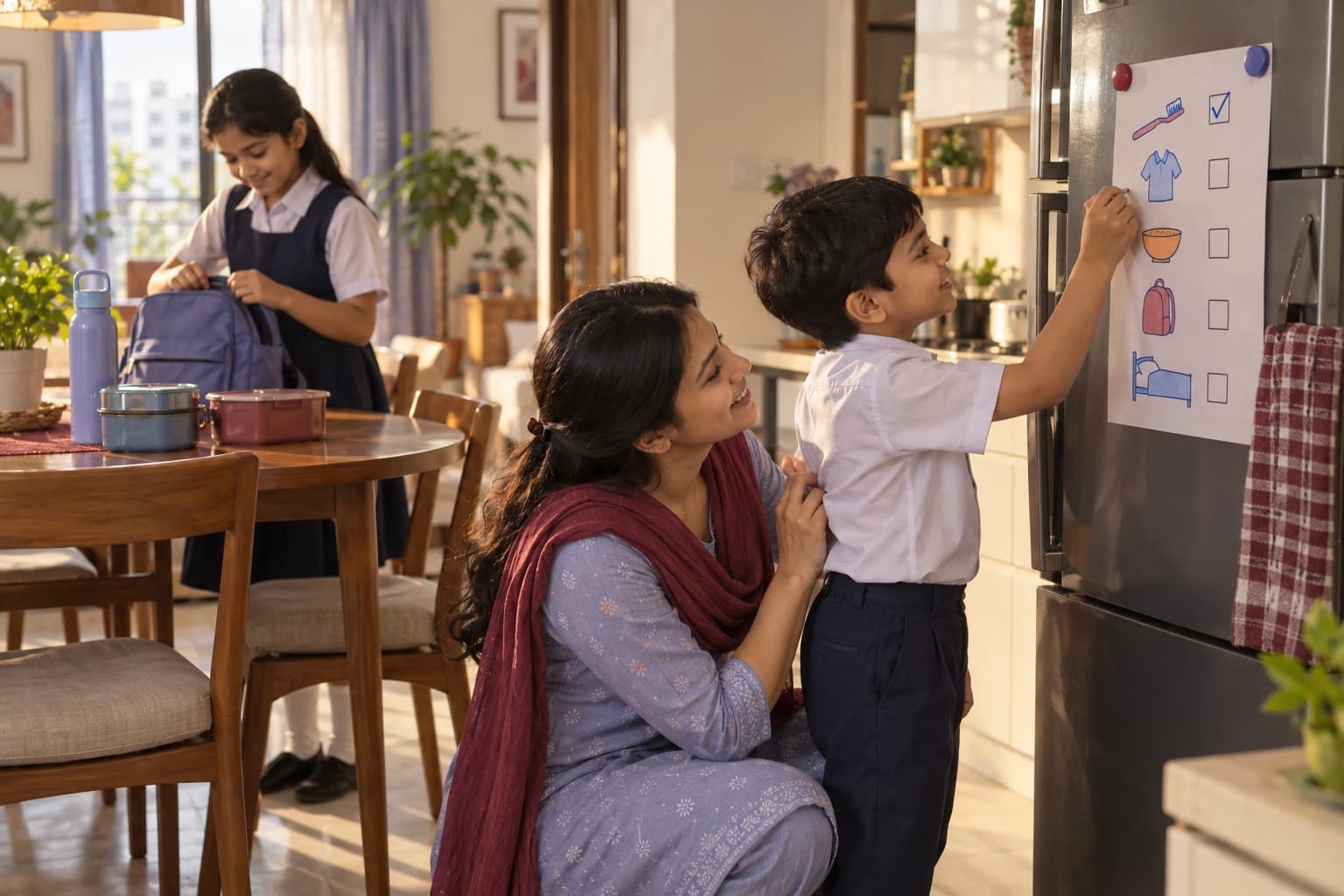
How to help kids with homework without the fights: a calm routine
Quick answer
How to help kids with homework without a fight: be the coach who asks questions, not the one doing it. After a snack and a break, keep the same time and place most days, split the work into small steps and sit nearby. If homework often ends in tears or takes far longer than expected, talk to the teacher.
 By the ParentMind team12 min read
Listen to this article
17 min listen · Read by your device's voice
At a glance
- Who it is for
- Parents of children aged 6–13 who refuse, cry over or drag out their homework
- Key takeaways
- Helping means getting your child unstuck, not getting the work done; let real mistakes reach the teacher.
- The same time and place most days, after a snack and a short break, takes the daily argument about when off the table.
- Start small: the first five minutes are the hardest, so ask for one easy question first.
- If homework often takes far longer than the teacher expects, or ends in tears most days, talk to the teacher.
“Later.” “I don’t have any.” “It’s too hard.” If you are looking up how to help kids with homework, you probably know these lines by heart. Many evenings, the hardest part of homework is starting it, and the homework battles that follow can leave you both in tears.
The reassuring part: a child who refuses to do homework is rarely lazy. Most are tired, stuck, or dreading something that feels too big. A calm routine and the right kind of help, close by but not on top of them, often turn the nightly fight into a shorter, quieter hour. Below: why it happens, what to do tonight, how to help without doing it, a routine by age, tears and tiredness, a Bangladeshi home and a 7-day plan.
Why does my child refuse to do homework?
When a child refuses to do homework, they are usually telling you something about their day, the work or how they feel about it. The cause decides what helps. For the bigger question of motivation, see how to motivate your child to study.
| What you see | What may be behind it | What often helps |
|---|---|---|
| “I’ll do it later,” every day | The task feels too big to start | One small first step: one question, one line |
| Tears or anger at the first hard question | The work is too hard, or there is a gap from an earlier class | Ask them to explain the question; tell the teacher if it keeps happening |
| Up every five minutes | Tired, hungry, or a block too long for their age | Snack and break first; shorter blocks |
| Rushing, messy work | The phone, TV or play is waiting | Phone in another room; play after homework, not instead of it |
| “I don’t have any homework” | Forgetting, avoiding, or nothing written down | Check the diary or the class parents’ group together, calmly |
| Fine with one adult, fights with another | The helper’s style: too many corrections or a raised voice | Swap helpers, or change how you help |
| Homework only starts at 9 or 10 pm | School, coaching and tuition fill the evening | Look at the whole week’s load (see below) |
How to help kids with homework without a fight: 6 steps for tonight
- Snack, water, toilet and a short break first, not straight from the school gate or coaching.
- Look at the evening’s work together, write a short list, and let your child choose the order.
- Shrink the first task to a tiny step: one question, one paragraph, five minutes. Once started, many children keep going.
- Clear the table and put the phone in another room, yours too.
- Stay nearby, not on top of them, and be ready when they call.
- Agree an end time. If the work keeps running past it, write a short note to the teacher rather than keeping a tired child up late.
What you might say
- Snack first. Then we’ll start with just the first question.
- Read me the question. What is it asking you to do?
- I’m right here with my book. Call me if you get stuck.
- You don’t have to finish it all now. Just this part.
- That one’s tricky. Let’s try a similar one together on a separate page.
- You were stuck, and you found a way through. How did you do it?
Be nearby, not on top of them.
How to help with homework without doing it for them
Helping means getting your child unstuck, not getting the work done. If you do it, the teacher sees your work, not your child’s, and cannot teach what is missing. Your child also learns that being stuck means someone else takes over.
- Ask them to read the question aloud and tell you what it is asking.
- Ask before you tell: “How did the teacher do it in class?”, “Where in the book is this?”
- Show one similar example on a separate sheet, then let them try their own.
- Check the method, not every answer. Point to a line with “Have another look at this one” instead of correcting it.
- Let real mistakes reach the teacher; that is how the teacher sees what needs teaching.
- Praise the effort and the strategy: “You checked your working before you showed me.” There is more in how to praise a child.
When the work is too hard: talk to the teacher
If your child is stuck most nights on the same kind of task, or homework takes far longer than the class seems to expect, tell the teacher. A short, friendly note works: what your child finds hard, how long it took and what you tried. Ask what the teacher sees in class, and agree one small step each.
A homework routine for kids, by age
A homework routine for kids takes the daily argument about when and where off the table. The details change with age: younger children need you beside them, older ones need you nearby, and then less and less. For the whole day’s timetable, see a daily routine for school children.
| Age | Your role | What helps |
|---|---|---|
| 6–7 years (about Class 1–2) | Sit beside them and read the instructions together | Short blocks of about 10–15 minutes, a picture checklist, lots of encouragement |
| 8–10 years (about Class 3–5) | Stay nearby; help them plan, then check at the end | A written list, a timer, one subject at a time |
| 11–13 years (about Class 6–8) | Be available; ask about their plan for the week | A homework diary, splitting big projects up early, the phone out of the room |
- A fixed homework time on most days, after a snack and some play.
- A fixed place: a clear table with good light, away from the TV, with pencils, eraser, ruler and a glass of water ready, so there is no reason to get up.
- A short break between subjects: a stretch, a drink, a walk to the balcony.
- A clear end time that protects sleep and family time.
- Packing the bag for tomorrow as the last step, so the morning starts calmer.
Why does my child cry over homework, and what helps?
Tears over homework usually mean a child is overwhelmed: too tired, too stuck, or afraid of getting it wrong. Arguing through the tears rarely works; calming down first usually does.
- Stop and name it: “This feels like too much right now.”
- Take a short break: water, a hug, a few minutes away from the table.
- Shrink the task: “Just the first two lines, then we’ll see.”
- If it is fear of mistakes: “Mistakes show the teacher what to teach. They’re allowed here.”
- If tears come most evenings, look at the load, whether the work suits your child’s level, and their sleep, not only at effort.
Tired children and late evenings
Many children start homework after school, coaching and a long ride home in traffic, and a tired brain makes everything harder. Protect a break and food first, keep the hardest task for when they are freshest, and stop at the agreed time. A child who regularly falls asleep over homework needs a lighter evening, not more pressure.
Homework in a Bangladeshi home: coaching, house help and busy parents
Coaching first, homework at night
Many children go from school to coaching or a home tutor, so homework starts at 8 or 9 pm. On coaching nights, keep the list shorter and do the hardest piece first, before tiredness wins. If school and coaching both set work on the same chapter, mention it to one of the teachers; they may be able to adjust. And look at the whole week: a child with coaching every evening may need one free evening more than another hour of practice.
If you didn’t study in English medium, or don’t know the subject
You don’t need to know the answers to help. Your part is the routine, the calm and the questions: “What is the question asking?”, “Where in the book did you see this?”, “Show me how you did it.” Asking your child to teach you is a good way for them to learn. For content you can’t follow, a classmate, an older cousin or the teacher can explain.
When you have little time
Working parents can still help in 10 minutes: look at the homework diary together, agree the plan for the evening, and check in at the end. A short call at the start (“What’s on your list today?”) keeps you part of it.
When house help or a relative sits with your child
If house help or a grandparent sits with your child while you are at work, share the same simple plan: snack, then homework at the set time, phone away, and no writing answers for the child. Ask them to call you rather than shout or hit if your child refuses, and look at the work together in the evening. Shouting, threats and hitting may get one evening’s homework done, but they tend to make homework frightening, and the fights usually grow.
A 7-day plan for calmer homework evenings
Change one thing at a time and write one line each evening: when homework started, how long it took and how it ended.
- Day 1: change nothing. Note the start time, the first protest and what happened just before.
- Day 2: agree a time and a place together, set the table up with everything needed, and choose a spot for the phone outside the room.
- Day 3: snack and a short break first, then start with one easy question.
- Day 4: write the evening’s list together and let your child choose the order.
- Day 5: when your child is stuck, ask a question instead of giving the answer, or show one example on a separate page.
- Day 6: notice one effort out loud, specifically.
- Day 7: compare with Day 1. How quickly did homework start? How long did it take? How many arguments or tears? Keep what helped, and if the load itself is too much, write to the teacher.
When should you talk to the teacher or a doctor about homework?
Most homework battles settle with a routine, rest and the right kind of help. Talk to the teacher, and to a doctor where it fits, if you notice any of these.
Talk to the school or a doctor if
- Homework regularly takes far longer than the teacher expects, or ends in tears most days for a few weeks, even with a calm routine.
- Trouble focusing at home and at school for many months, even with short blocks and breaks; see when a child can’t concentrate.
- Reading, writing or maths stays well behind classmates for several months despite regular help; or your child squints at the board or often mishears instructions, which a doctor can check with an eye or hearing test.
- Stomach aches, headaches or tears before school or tests on most days for a few weeks; see exam stress in children.
- Your child is afraid of a teacher or tutor, or says they are hit or shamed over homework: believe your child, act the same day (talk to the school, or stop that tutor’s sessions), and call 999 if your child is in danger.
- Talk of not wanting to live, or of hurting themselves: stay calm and stay close. Call 999 if they are in danger now; otherwise speak to a doctor the same day.
Homework patterns are easier to see over a week than in one tearful evening. ParentMind helps you note what happens each day, spot patterns and get guidance: how ParentMind works.
Questions parents ask
Should parents help with homework at all?
Yes, as a coach rather than a co-author. Your part is a calm routine, a quiet place, questions that get your child unstuck and interest in what they are learning. Doing the work for them hides from the teacher what your child doesn’t yet understand. As children grow, step back gradually so the work, and the pride in it, stays theirs.
Why does my child take so long to do homework?
Usually because of tiredness, distractions, or work that feels too hard to start; sometimes because a parent is checking every line. Break the work into short blocks with breaks, keep the phone out of the room and agree an end time. If homework regularly takes far longer than the teacher expects, tell the teacher; the amount or level may need adjusting.
What should I do when my child says they have no homework?
Check calmly, without accusing: look at the homework diary or the class parents’ group together. If “no homework” keeps turning out to be untrue, it often means the work feels too hard or too much, so ask what is difficult. On real no-homework days, a short reading time keeps the routine going.
Should I let my child face the teacher if they don’t do their homework?
For older children, letting the teacher see unfinished work can teach responsibility, as long as the teacher responds fairly. For younger children, keep supporting the routine instead. If your child is afraid of being hit or shamed at school over homework, talk to the school: physical and mental punishment is banned in schools in Bangladesh.
What is the best time of day for homework?
Usually after a snack and a short break, but well before your child is too tired; for many families that is late afternoon or early evening. On coaching days it may have to be later, so keep the list shorter. What matters most is the same time on most days, so it becomes a habit rather than a daily argument.
Should I punish my child for not doing homework?
Punishment rarely deals with the reason behind it. Look first at tiredness, difficulty and distractions, then use the routine and simple agreed rules, such as play or screen time coming after homework, not instead of it. Shouting, threats and hitting tend to make homework feel frightening and the fights worse.
This article is general information, not medical advice. For health worries, talk to a doctor; if someone is in danger, contact your local emergency number.