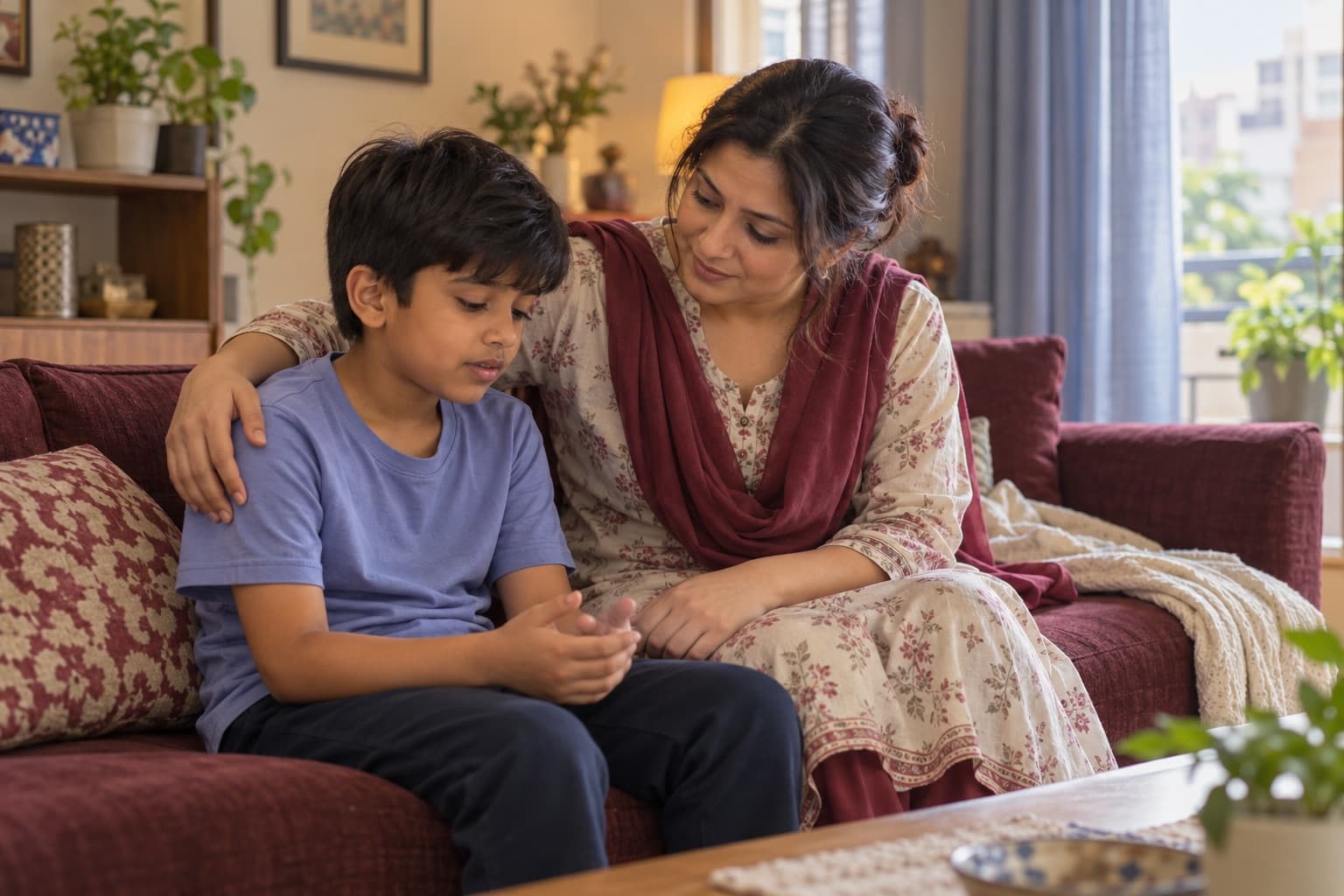
Exam stress in children: how to help your child through exam season
Quick answer
To help a child with exam stress, keep sleep, meals and breaks steady, praise effort rather than marks, and practise slow breathing together before the exam. Exam stress is common at ages 7–17 and often shows as poor sleep, stomach aches or going blank. Get help for panic attacks, days without sleep or food, or any talk of self-harm.
 By the ParentMind team11 min read
Listen to this article
15 min listen · Read by your device's voice
At a glance
- Who it is for
- Parents of children aged 7–17 facing class tests, half-yearly and annual exams, or SSC and HSC
- Key takeaways
- Exam nerves are normal; stress becomes a problem when it stops a child sleeping, eating or thinking clearly.
- Children often feel the adults' worry most: praise effort, drop comparisons and say your love doesn't depend on a result.
- The night before: light revision, the bag packed and a normal bedtime. The morning: breakfast and a short, warm goodbye.
- For any talk of self-harm, stay calm and close: call 999 if your child is in danger now, otherwise speak to a doctor the same day.
Exam stress can start weeks before the first paper: a child who can't sleep, snaps at everyone, has a stomach ache every morning or says 'I'll fail anyway'. In Bangladeshi homes, where class tests, half-yearly and annual exams and, later, SSC and HSC shape family life, it can fill the whole house.
Some exam nerves are normal and can even sharpen focus. The aim is not a child with no nerves, but a child who can sleep, eat and think on the day. Much of that depends on what happens at home, which is the part you can shape.
Below: the signs, the causes, what to say, easing pressure at home, the night before and the morning, the exam hall, what to say afterwards, a 7-day plan and when to get help. For the exam-week evening routine, see calm evenings in exam season.
What are the signs of exam stress in children?
Exam stress, sometimes called test anxiety in children, shows in the body, in behaviour and in what a child says. Most children show some of these in exam season; what matters is how strong they are and how long they last.
| Where it shows | Common in exam season | Needs more support |
|---|---|---|
| Body | Butterflies, a stomach ache or headache on exam mornings | Vomiting, shaking or a racing heart that won’t settle; aches on most days for weeks |
| Sleep and food | Trouble falling asleep the night before; eating a little less | Barely sleeping or eating for several days |
| Mood | Irritable, tearful, snapping at siblings | Low or hopeless most of the day for two weeks or more |
| Studying | Last-minute cramming, rereading the same page | Can’t start at all, or studies late into every night |
| Words | “What if I fail?” “I’m useless at maths.” | “There’s no point,” or any talk of not wanting to live or of self-harm (see when to get help) |
| In the exam hall | The mind goes blank for a moment, then it comes back | Panic attacks, or leaving whole papers blank |
Why do children get so stressed about exams?
A child anxious about exams is usually reacting to a mix of real pressure and how they read it. Common drivers:
- High stakes: marks that can decide a section, a roll number or, later, a college place.
- Comparison: GPA 5 and A+ talk at family gatherings, cousins' results, classmates' marks.
- Feeling unprepared: gaps from earlier classes or revision left late; a steady study routine through the year often helps.
- Tiredness: school, coaching, model tests and late nights all at once.
- Adults' worry: children pick up a parent's anxiety from tone, silence or constant questions about marks.
- Temperament: natural worriers and perfectionists often feel exams more; see anxiety in children if worry shows up everywhere.
How to calm a child before an exam: what to do and say
- Notice and name it: 'You seem worried about tomorrow.' Don't rush to reassure.
- Listen first. Ask which part feels worst: the subject, the time limit, the result or what people will say.
- Shrink it: make a short plan for what's left, one chapter at a time, with breaks.
- Move the body: a walk, stretching or a quick game often eases the tension.
- Practise slow breathing together: in for four counts, out for six.
- Keep the evening ordinary: dinner together, no lectures, phones away an hour before bed.
What you might say
- It makes sense to feel nervous. It means this matters to you.
- Which part feels worst? Let's look at just that.
- You've prepared. Whatever the result, we're on your side.
- Your marks don't change how much we love you.
- Let's breathe together: in for four, out for six.
Try to avoid 'Your cousin got GPA 5', threats about results, or 'Don't be nervous'. Comparisons and threats tend to add fear, and being told not to worry rarely helps a worried child.
Exam pressure from parents: how to ease it without dropping standards
Most parents push because they care. But children often feel the pressure at home more than the exam itself, and too much of it tends to make performance worse, not better.
- Praise effort and method ('you planned your revision'), not only marks.
- Agree one realistic target together instead of 'only A+ will do'.
- Keep comparisons out of the house, including with brothers and sisters.
- Limit the marks talk to one calm check-in a day about study.
- Look after your own nerves; a calm voice at home is one of the most useful things you can give.
- Keep some normal life: a short walk, a favourite meal, a little play or TV.
What helps the night before an exam, and on exam morning?
The night before
- Light revision only: notes, formulas or a summary, then stop. No new chapters.
- Pack the bag together: pens, pencils, eraser, ruler, geometry box, admit card if needed, water bottle and a watch.
- A normal dinner and a calm hour without screens before bed.
- The usual bedtime, not a late one: 6–12-year-olds need 9–12 hours of sleep and 13–18-year-olds 8–10. Staying up all night tends to make recall worse.
- If sleep won’t come: write the worries on paper, breathe slowly and lie quietly; rest still helps.
The exam morning
- Wake with enough time to avoid a rush.
- Breakfast, even a small one: roti and egg, chira with yogurt, or a banana and milk.
- Leave early enough to arrive without panic, and skip the crowd at the gate comparing answers.
- A calm goodbye: a hug and 'Do your best. I'll be here after.' No last-minute instructions.
My child panics in exams: what helps in the hall, and after
Going blank in the exam hall is common: stress can block recall for a moment, and it often comes back. These steps are easier to use on the day if your child practises them at home first.
- Breathe slowly: in through the nose for four counts, out through the mouth for six, three to five times.
- Feel both feet on the floor and the pen in the hand for a few seconds.
- Read the whole paper first, then start with a question you know.
- If the mind goes blank, mark the question, move on and come back later.
- Write something for every question: a heading, a formula or a first step.
- Check the clock after each section, not every minute.
What to say after each exam, and on result day
The talk after each paper sets the mood for the next one. Ask how it felt, not what they'll get.
- Ask 'Which part went well?' rather than 'How many marks will you get?'
- Skip the answer-by-answer post-mortem; the next paper matters more.
- Give food, rest and some downtime before the next subject.
- If a paper went badly, keep it calm: 'That one was hard. Let's get ready for the next.'
- Plan something to look forward to after the last paper: an outing, a visit, a favourite meal.
For the first evening after a low mark, see after a disappointing exam result.
Exam stress in a Bangladeshi home: the calendar, GPA 5 and relatives
In Bangladesh, exam worry follows the school calendar and the family's hopes, so it helps to plan for both.
- The calendar: class tests through the year, term or half-yearly exams, then annual exams, often around November and December; older students add model tests, test exams and then SSC or HSC. Plan a little rest after each one, and check your school’s dates.
- GPA 5 and A+: a fine goal, but when it is the only acceptable result, every mark below it can feel like failure. Celebrate improvement too.
- Coaching and mock tests: extra practice can help, but stacked on school exams it can leave no rest. Pause one if your child is exhausted.
- Relatives and parents' groups: you don't have to share your child's marks. 'They're working hard' is enough.
- Faith and comfort: if prayer is part of your family's life, a short dua together before leaving can be calming, alongside rest and preparation.
How to reduce exam stress for kids: a 7-day plan
Start a week before the first exam and write one line each day: sleep, appetite, mood and what your child said about the exam.
- Day 1: change nothing. Notice the signs and write them down.
- Day 2: make a realistic revision plan together, one chapter at a time, with breaks.
- Day 3: start practising slow breathing together, morning and night.
- Day 4: agree a bedtime and a phones-out time, and keep them through the exams.
- Day 5: have one calm talk about pressure: say your love doesn't depend on marks, and ask what worries them most.
- Day 6: try a past paper at the table with a loose time limit, then go over it calmly together.
- Day 7: the night before: light revision, the bag packed, a normal dinner and bedtime. Afterwards, compare your notes with Day 1 and keep what helped.
When is exam stress a reason to get help?
This kind of stress usually fades once the exams are over. Get help when it is severe, lasts, or spills into the rest of life; a doctor or child psychologist can help, and many children do well with that support.
Talk to a doctor or the school if
- Panic attacks: a racing heart, fast breathing, shaking or feeling faint, especially if they keep coming back.
- Barely sleeping or eating for several days, or exhaustion that doesn’t lift.
- Refusing to go to school or sit exams, or stomach aches and headaches on most days for weeks; see school anxiety.
- Low or hopeless mood most of the day for two weeks or more, or stress that carries on long after the exams.
- Any talk of not wanting to live, or of hurting themselves: stay calm and stay close; call 999 if they are in danger now, and otherwise speak to a doctor the same day.
- Signs of bullying, or of being hit or shamed over marks at school or coaching: believe your child, act the same day, and call 999 if they are in danger.
Exam seasons come round every year, and the patterns are easier to see when you write them down. ParentMind helps you note what happens each day, see patterns and get guidance: how ParentMind works.
Questions parents ask
Is exam stress normal for children?
Yes. Most children feel some nerves before exams, and a little can help them focus. It becomes a problem when it stops them sleeping, eating or thinking clearly, lasts for weeks, or comes with panic attacks or hopeless talk. Steady routines and calm adults help many children through.
What should I say to my child before an exam?
Keep it short and warm: 'You've prepared. Do your best on each question. I'll be here after.' Avoid last-minute instructions, comparisons and talk about marks. Children tend to remember how you sounded more than what you said, so a calm voice and a hug often matter most.
Why does my child forget everything in the exam hall?
Stress can briefly block recall, so a child who knew the answers at home can go blank under pressure. It often comes back within minutes. Slow breathing, reading the whole paper first and starting with an easy question can help the memory return, and enough sleep the night before matters too.
My child can't sleep before exams. What can I do?
Stop revision an hour or so before bed, keep screens out of that hour, and keep bedtime normal rather than late. If your child lies awake, suggest writing worries on paper and slow breathing. Resting quietly still helps, so tell them not to panic about sleep; one short night rarely ruins an exam.
Am I putting too much pressure on my child?
Possibly, if your child hides marks, cries or panics before tests, studies late every night, calls themselves a disappointment, or results are the main talk at home. Try praising effort, agreeing one realistic target together and keeping comparisons out of the house.
Should my child study all night before an exam?
No. Most children recall more after a normal night’s sleep than after staying up. Children aged 6–12 need 9–12 hours and 13–18-year-olds 8–10. A short, light review in the evening and a normal bedtime usually serve them better than an all-nighter.
This article is general information, not medical advice. For health worries, talk to a doctor; if someone is in danger, contact your local emergency number.