School readiness checklist: is your child ready, and how to prepare
Quick answer
A school readiness checklist for ages 3–7 is mostly about everyday skills, not letters: using the toilet, eating and dressing with a little help, following a short instruction, taking turns, saying what they need and playing with others. Practise them through play. If speech, understanding or play seem well behind other children, talk to a doctor.
 By the ParentMind team12 min read
Listen to this article
16 min listen · Read by your device's voice
At a glance
- Who it is for
- Parents of children aged 3–7 starting play group, nursery, KG or Class 1, or facing an admission test or interview
- Key takeaways
- Readiness is mostly self-care, listening, sharing, talking and play; letters and numbers come more easily once these are in place.
- Many government schools, and many private schools in cities, admit to the early classes by lottery; many English-medium schools and kindergartens hold a short test or interview. Rules change yearly, so check each school's notice.
- Short, playful practice helps more than drilling: a few minutes of stories, counting or drawing, not hours at a table.
- If speech, understanding, play or toileting seem well behind other children of the same age, talk to a doctor before school starts.
If you are looking for a school readiness checklist, your child is probably about to start play group, nursery, KG or Class 1, and admission season has the whole family talking. Which school? Is there a test? Should they know the whole alphabet already?
The reassuring part is that schools mostly need a child who can manage the day: use the toilet, eat their tiffin, listen for a few minutes, wait for a turn and say when something is wrong. Most of that can be practised through play at home, and letters and numbers come more easily once it is in place.
Below: what readiness means, the checklist, starting age, what to teach before KG, admission tests and interviews, the first weeks, a Bangladeshi angle, a 7-day plan and when to check.
Is my child ready for school? What readiness really means
School readiness is a set of everyday skills that help a child cope with a group, a teacher and a timetable. It covers self-care, separating from you, listening, talking, getting on with others and handling feelings, as well as early learning.
Preschool readiness, for play group or nursery, is mostly about separating, toileting and playing alongside others. Children get there at different speeds; a child who is behind on one skill but moving forward is often fine.
A school readiness checklist for ages 3–7
Use this checklist as a guide to practise, not a test. Most children starting school can do many of these, often with a little help; none of them needs to be perfect. If toileting is the sticking point, see potty training.
| Skill | What it looks like | How to practise at home |
|---|---|---|
| Self-care | Uses the toilet and washes hands with a little help; eats from a tiffin box; puts on shoes | Let them do it themselves, slowly; practise opening the tiffin box and bottle |
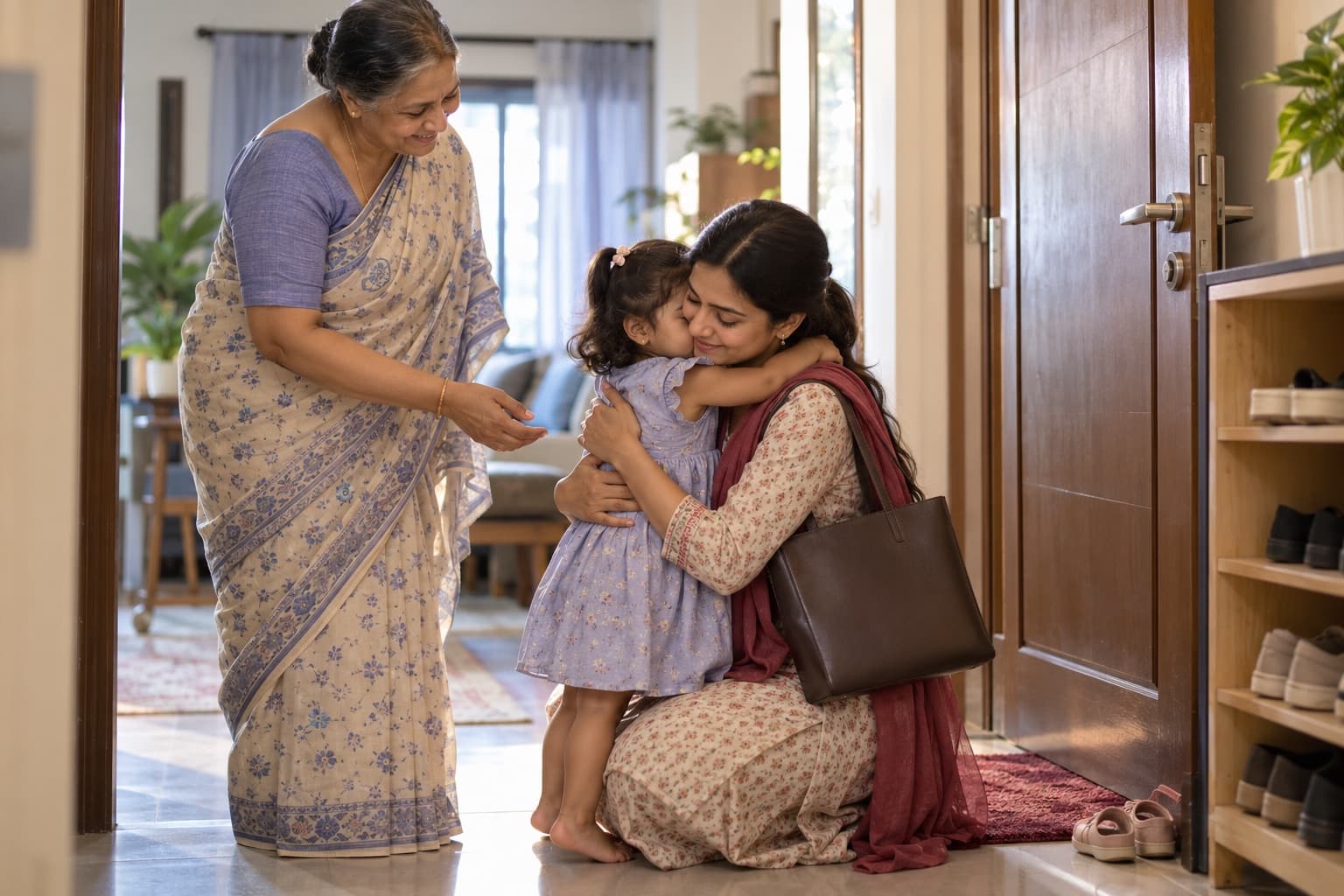
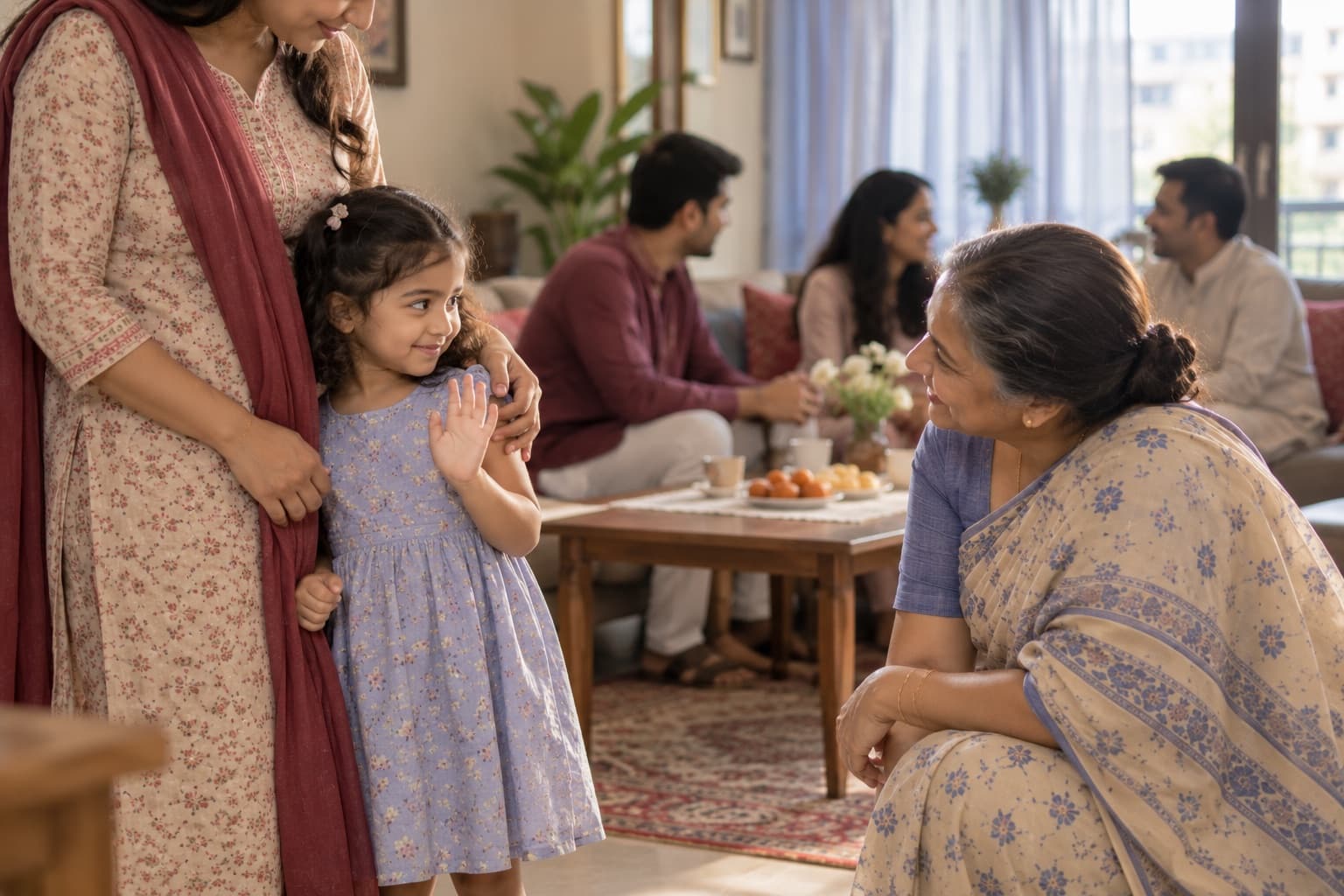
| Saying goodbye | Can say goodbye and stay with a trusted adult for a while | Short stays with a relative, with the same short goodbye each time |
| Listening | Follows a short instruction ('wash your hands, then sit down'); listens to a short story | Two-step instructions in play; a story every night |
| Talking | Says what they need ('I need the toilet'), their name and a parent's name | Practise asking for help: 'Miss, can you open this?' |
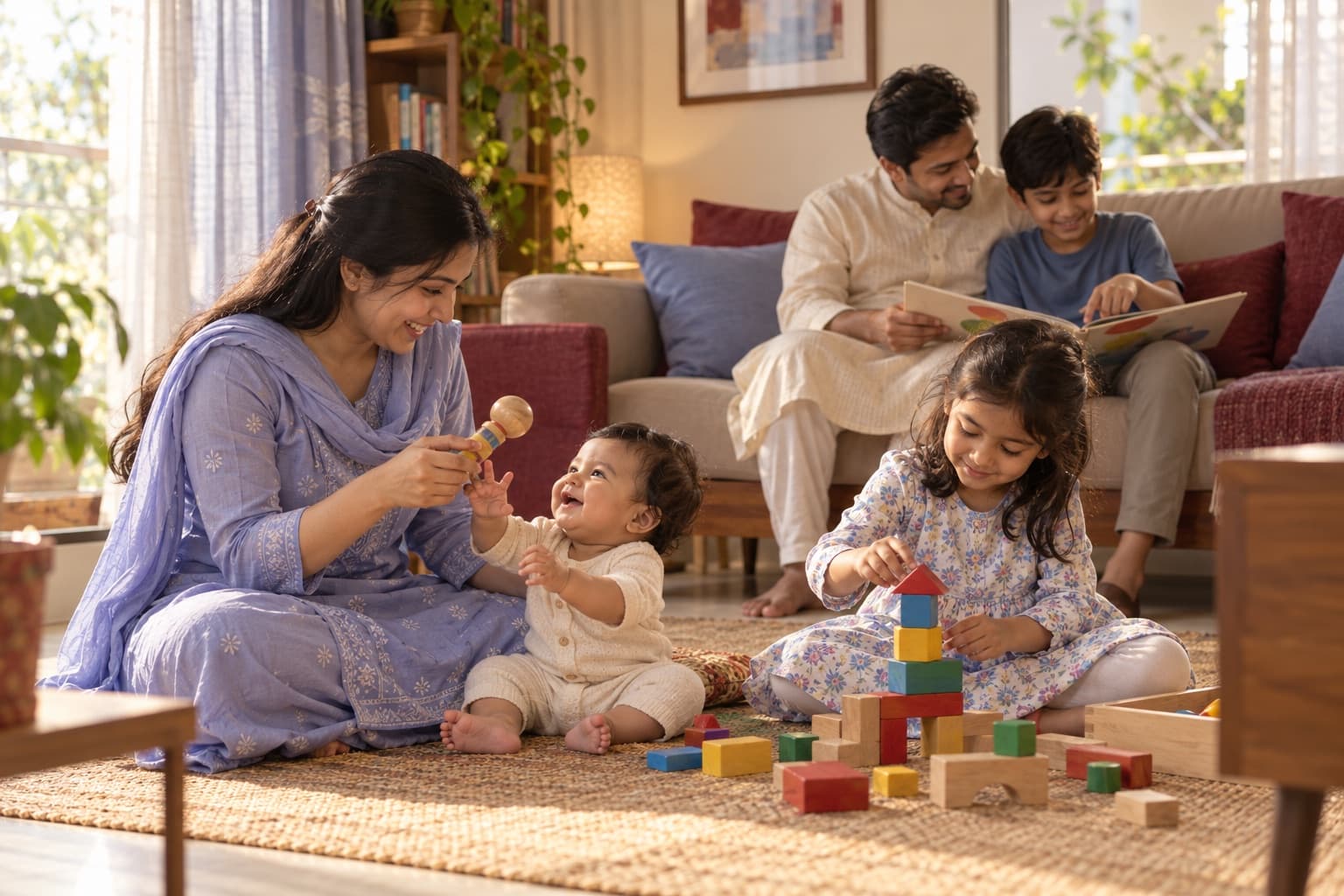
| Getting on with others | Takes turns, sometimes shares, plays near or with other children | Ludo, ball games, play time with a cousin or neighbour |
| Feelings | Calms down with help after being upset; can wait a little | Name feelings out loud; play waiting games |
| Using their hands | Holds a crayon, scribbles or draws, turns pages | Drawing, play dough, threading beads, tearing and sticking paper |
| Early learning | Enjoys books and rhymes; may know some letters, colours and numbers | Read together; count stairs, spoons and rickshaws; sing rhymes |
| Moving | Runs, climbs, sits on a chair for a short activity | Daily active play: at least 180 minutes of activity a day at 3–4 years; from 5, at least 60 minutes of moderate-to-vigorous activity |
What age should a child start school? Play group, nursery, KG and Class 1
There is no single right starting school age; it depends on the school's rules and on your child. Many children in Bangladesh start play group or nursery at about 3 or 4, KG or pre-primary at about 4 or 5, and Class 1 at about 5 to 7. Each school sets its own age limits, and they can change from year to year, so check the admission notice for the exact rule.
- Look at the checklist more than the birthday: a child who can manage the toilet, a goodbye and a group is often ready to start somewhere.
- Play group and nursery are mainly for play, routine and getting used to other children, not a race to learn letters.
- Earlier is not automatically better. Many children do well starting a little later, with more time for play and talk at home.
- If your child was born early, is very young for the class, or you have a speech or development worry, talk to the school and a doctor before deciding.
What to teach before kindergarten and Class 1
The skills needed for Class One are mostly the same everyday skills, plus a love of books. Short, playful practice tends to work better than sitting a 4-year-old at a table.
- Their full name, a parent's name and a phone number, written on a card in the bag too.
- Asking a teacher for help, and saying 'I need the toilet'.
- Opening the tiffin box, the water bottle and the bag zip without help.
- Listening to stories and talking about the pictures; rhymes and songs in Bangla and English.
- Counting real things: stairs, spoons, rickshaws on the road.
- Holding a crayon: drawing, colouring and tracing big shapes. Neat handwriting can wait.
- Waiting and taking turns in simple games.
Admission tests and school interviews: how to prepare without pressure
Admission varies a lot from school to school and from year to year. In recent years many government schools, and many private schools in cities and district towns, have admitted children to Class 1 and other early classes by lottery, with no test. Many English-medium schools and kindergartens hold a short written test, a play-based check or an interview with the child and parents. Ages, dates and documents differ too, so read each school's admission notice carefully, and ask the office if anything is unclear.
Where there is an interview, schools often look less at what a child has memorised and more at whether they can leave you calmly, answer simple questions (name, age, colours, a picture), follow an instruction and hold a pencil. Here is how to prepare a child for a school interview without pressure:
- Visit the school, or walk past it, and talk about it as a nice place.
- Play 'school' at home: you ask easy questions as the teacher, then let your child be the teacher.
- Practise talking to new adults: greeting a neighbour, paying at a shop.
- Keep practice short and fun, and stop if your child is tired or upset.
- On the day: a good sleep, a familiar breakfast, comfortable clothes, the toilet before going in, and arriving early.
- Afterwards, praise their effort whatever happens, and don't quiz them on what went wrong.
What you might say before an interview
- We're going to see a new school. A teacher will ask you some easy questions, like your name.
- If you don't know an answer, you can say 'I don't know'. That's okay.
- I'll be right outside. When you finish, we'll go for a walk together.
- You tried so hard today. I'm proud of you.
If your child does not get a place, it is not a verdict on your child or on you. Many children who miss one school settle happily in another.
First day of school tips: the first day and the first weeks
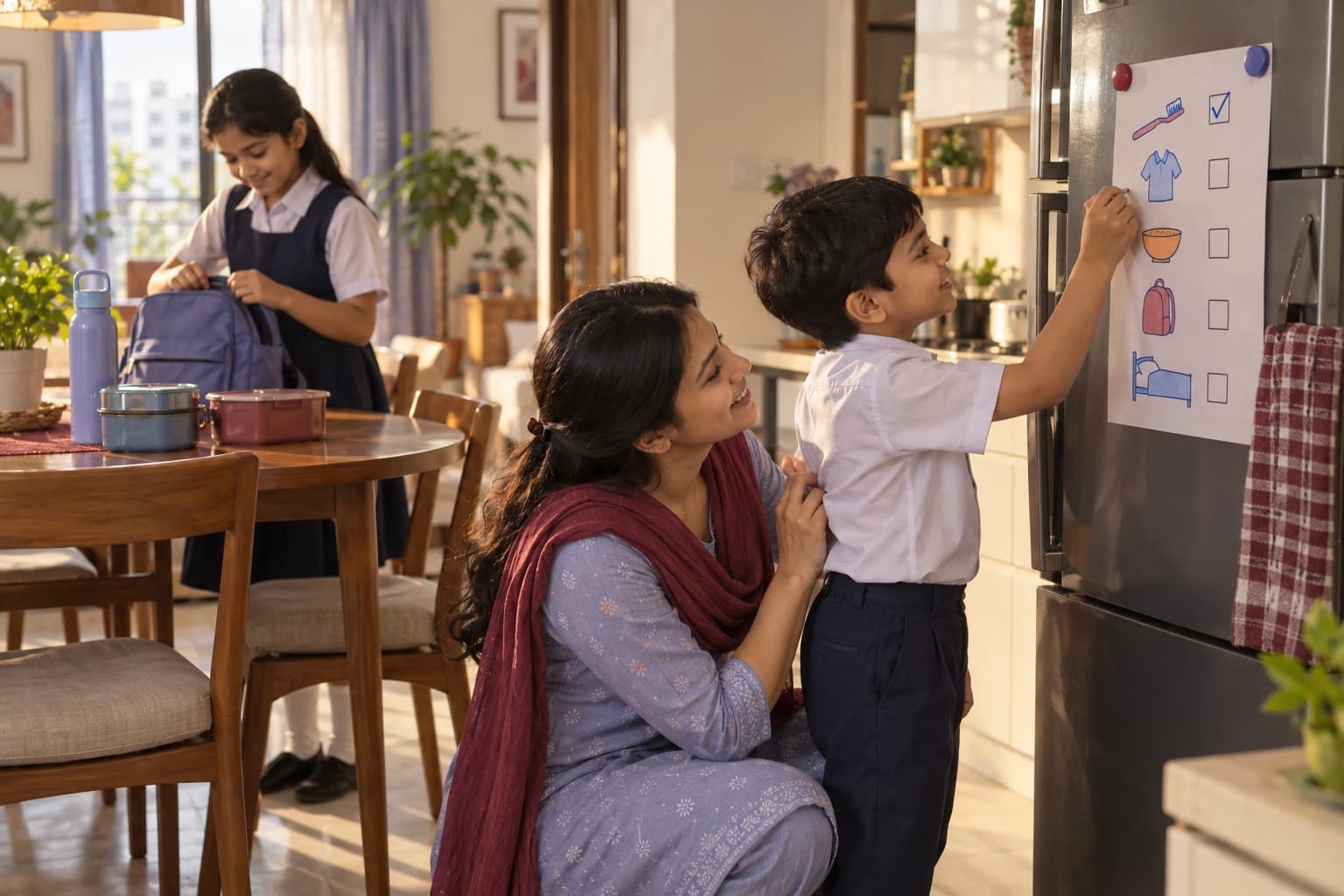
- Before: visit the classroom and meet the teacher if you can, and practise the morning routine a week ahead.
- The night before: lay out the uniform, pack the bag together, and let your child choose between two tiffins.
- At the gate: a short, warm, confident goodbye, the same every day. Don't sneak away; see separation anxiety for a goodbye routine.
- The first weeks: expect tiredness, tears or clinginess, and bring bedtime earlier; children aged 3–5 need 10–13 hours of sleep in 24 hours, naps included, and 6–12-year-olds 9–12 hours.
- After school: ask about one good thing; a quiet child often talks later, at bedtime. If your child is slow to warm up, see helping a shy child settle.
- Talk to the teacher if tears at drop-off have not eased after the first few weeks.
School admission in a Bangladeshi home: pressure, relatives and language
Admission season, often from about November to January, can feel like an exam for the whole family. A few things help keep it in proportion; check each school’s own dates.
- The admission rush: talk of 'good schools', question banks and coaching for 4-year-olds can make families panic. A calm, playful child often does better in an interview than a drilled one.
- Admission coaching: if you use it, keep it short and playful, and stop if your child cries or dreads going.
- Relatives and comparisons: 'Your cousin knew the whole alphabet at three.' Children develop at different speeds; answer briefly and change the subject.
- Language: many children speak Bangla at home and meet English at school. Lots of talk and stories in your home language tend to support learning a second language too.
- Everyone who looks after your child, including grandparents and house help, can play the naming, counting and story games; share the checklist so everyone practises the same skills, kindly.
- Early shifts and long rides: a small child with an early start needs an earlier bedtime. Practise using a different toilet, such as at a relative’s home, and drinking from their own bottle.
A 7-day plan to get your child ready for school
Pick two skills from the checklist and write one line each day: what you practised, how long it lasted and what your child managed.
- Day 1: go through the checklist with your child in mind, tick what they can do, and choose two skills to practise.
- Day 2: practise self-care: the toilet, washing hands, opening the tiffin box and bottle.
- Day 3: play 'school' for ten minutes: a story, a song and a two-step instruction.
- Day 4: visit the school, or walk past it, and talk about what happens there.
- Day 5: arrange a short stay with a trusted adult, with a short, warm goodbye.
- Day 6: practise the school-morning routine: wake up, wash, breakfast, shoes, bag.
- Day 7: look back. What got easier? Keep practising the two skills, and add one more next week.
When to talk to a doctor before school starts
Every child develops at their own pace, and most worries before school are about normal differences. Some signs are worth checking, ideally months before school starts, so any support can begin early. For what children usually do at each age, see child development by age.
Talk to a doctor if
- Family members understand little of your child’s speech by about 3, or they use far fewer words than other children their age; see speech delay in toddlers.
- Your child doesn't seem to understand simple instructions, or doesn't respond to their name.
- Little interest in other children, or little eye contact or shared play.
- Your child loses words or skills they had. Get this checked promptly.
- Daytime wetting accidents on most days well after age 4.
- Strong distress at goodbyes after age 3 that hasn't eased after about a month of a steady goodbye routine.
- Any sign of abuse, or a sudden change in behaviour: believe your child, act the same day, and call 999 if they are in danger.
Readiness grows in small steps that are easy to miss. ParentMind helps you note what happens each day, see patterns and get guidance: how ParentMind works.
Questions parents ask
What age should my child start school?
It depends on the school's age rules and on your child. Many children start play group or nursery at about 3 or 4, and Class 1 at about 5 to 7. Each school sets its own limits, so check the admission notice, and look at readiness skills such as toileting, listening and playing with others.
What should a child know before kindergarten?
Mostly everyday skills: using the toilet with a little help, eating from a tiffin box, saying their name and what they need, following a short instruction, taking turns and enjoying stories. Some letters, colours and numbers help, but schools expect to teach those, and a child who can manage the day usually catches up.
How do I prepare my child for a school interview?
Keep it playful: play 'school' at home with easy questions, practise talking to new adults and visit the school beforehand. On the day, make sure your child has slept, eaten and used the toilet, and arrive early. Tell them it's fine to say 'I don't know', and praise their effort afterwards.
Is it a problem if my child can't read or write before Class 1?
Usually not. Many children start Class 1 still learning their letters, and schools expect to teach reading and writing. What helps most beforehand is being read to every day, lots of talk, drawing and holding a crayon. If reading is still very hard after a year of school, talk to the teacher.
When should a child start play group?
Many children start play group at about 3, but there is no rush. Play group is for play, routine and getting used to other children, not early academics. A child who can manage a short goodbye, use the toilet with help and enjoy playing near others is often ready; if not, a few more months at home is fine.
How can I reduce admission test pressure on my child?
Keep practice short and playful, a few minutes at a time, and stop while it is still fun. Avoid drilling, comparisons and talk about 'big schools' in front of your child. Applying to more than one school, where you can, means no single result feels like everything; praise effort whatever happens.
This article is general information, not medical advice. For health worries, talk to a doctor; if someone is in danger, contact your local emergency number.