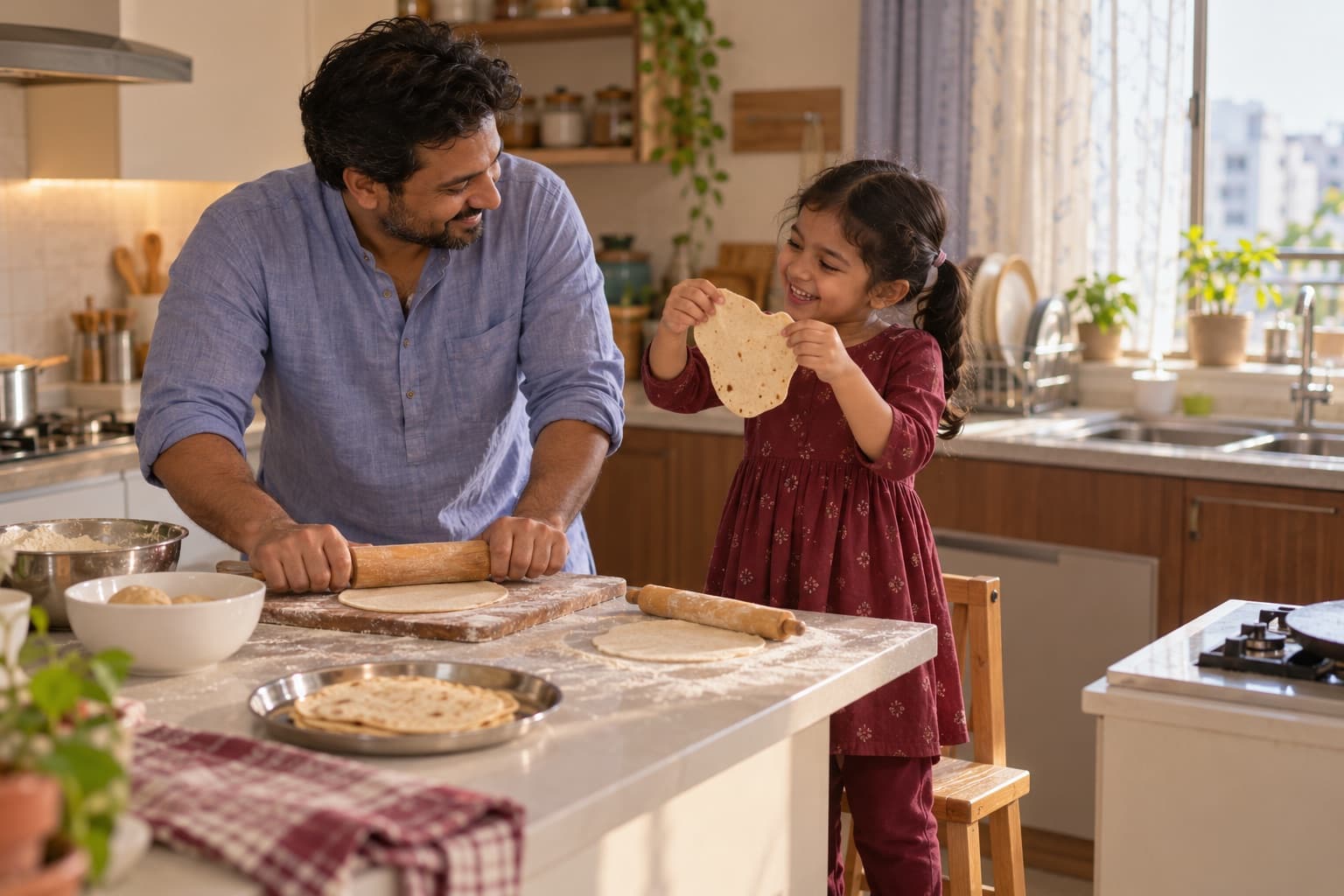
A father's role in parenting: how dads can share the everyday work
Quick answer
A father's role in parenting is hands-on, everyday care: feeding, bathing, bedtime, school, play and talking about feelings, not only earning money or giving discipline. Children aged 0–18 often feel safer and more confident when both parents are close. Busy fathers can keep one daily ritual. If your child seems afraid of you, that is the sign to change course.
 By the ParentMind team12 min read
Listen to this article
17 min listen · Read by your device's voice
At a glance
- Who it is for
- Fathers of children aged 0–18, mothers who want their husband more involved, and dads who work long hours or abroad
- Key takeaways
- Fathers can do almost every part of daily care, from feeding and nappies to homework and bedtime talks.
- When only the father punishes, children often fear him and hide things; sharing calm rules with the mother usually works better.
- Busy or faraway fathers can stay close through small, regular rituals: a fixed call time, a bedtime story, one Friday outing.
- Daughters and sons both gain from a warm, respectful father who listens, shows feelings and shares the housework.
Many fathers in Bangladesh grew up with a father who earned the money and gave the punishments, and now wonder what a father's role in parenting should look like for their own children.
The answer is simpler than it sounds: children need their father in the everyday moments, not only for the big decisions. Feeding, bath time, school runs, play and a ten-minute talk at night all count, and fathers can do almost all of it.
Below: what fathers do, ideas by age, sharing the daily work, moving beyond the disciplinarian role, busy and faraway fathers, daughters and sons, a 7-day plan and when to get help.
What is a father's role in parenting?
A father's role in parenting covers the same ground as a mother's: keeping the child safe, cared for, loved and guided. Families share the work in different ways, but children usually do best when both parents are part of daily life, rather than one doing everything and the other stepping in only for big moments.
Children with a warm, involved father often gain:
- Security: a second close adult to turn to when things go wrong, who comforts as well as protects.
- Confidence: active play with their father, such as chasing games, cycling or climbing at the park, can help children feel brave and capable.
- A mother who can rest: shared care leaves the mother less exhausted, which helps the whole family.
How fathers can bond with children at every age
What a father does changes as children grow, but the core stays the same: show up, pay attention and be safe to come to.
| Age | Everyday care | Ways to connect |
|---|---|---|
| Newborn to 1 year | Nappies, bathing, burping, settling at night, night feeds if the baby takes a bottle, holding the baby so the mother can sleep | Skin-to-skin cuddles, talking and singing, carrying the baby around the flat |
| 1–5 years | Meals, bath and bedtime, potty training, calming tantrums, doctor visits | Rough-and-tumble play, walks on the roof, a bedtime story every night you are home |
| 6–12 years | School runs, homework, packing tiffin, teaching chores | Cycling, cricket or football, carrom, cooking together, a weekly outing for just the two of you |
| 13–18 years | Talks about puberty, studies, friends, phones and money; picking them up; waiting up for late returns | Talking side by side on a rickshaw, a walk or over a late-night snack; respecting privacy; taking an interest in their world |
For more ideas at every age, see how to bond with your child.
Sharing parenting work: how can dads take on feeding, bedtime and school?
Dad involvement in parenting often starts with helping. The shift that matters most is from helping to owning: taking a whole job from start to finish, including remembering it. Try taking one area completely:
- Feeding: one meal a day is yours, from serving to wiping the table. With a baby, take a night feed if your baby takes a bottle, or bring the baby to the mother and do the burping and settling.
- Bedtime: a wash, teeth, a story and lights out are yours every night you are home. If your family says a dua at bedtime, you can say it together.
- School: know the teacher's name, go to parent-teacher meetings, check the diary and help with homework one evening a week.
- Health: keep the vaccination card, take your child to the doctor yourself, and know their medicines and allergies.
- Talking: ten minutes a day without your phone, asking about friends, worries and what made them laugh.
- The mental load: birthdays, school fees, uniform sizes, the next vaccine. Put them in your own phone calendar instead of waiting to be reminded.
What a father might say
- Tell me one good thing and one hard thing about today.
- You can tell me anything, even if you think I'll be angry. I'll listen first.
- I shouted earlier, and I'm sorry. Let's try that again.
- I'm proud of how hard you tried, whatever the result.
- To your wife: “Tonight I'll do bath and bedtime. You rest.”
In a Bangladeshi home: is discipline only the father's job?
“Wait till your father comes home” is a line many Bangladeshi children grow up with. In many homes the mother is the soft one and the father is the one who punishes, so a child learns to fear his footsteps at the door. It comes from love and worry, but it often has a cost:
- Children hide mistakes and problems from the parent they fear, so the father is often the last to know when something is wrong.
- The father misses the warm side of his children, and the mother carries all the comforting alone.
- Punishment saved up for hours later rarely teaches anything; the child remembers the fear, not the lesson.
- Hitting and harsh punishment tend to make behaviour worse over time, and can damage the relationship well into the teenage years.
A kinder way to share discipline
- Agree the main rules together, as parents, and tell your children that both of you hold them.
- Whoever is there deals with it, calmly and at the time, instead of saving it for the father.
- Use calm consequences that fit the problem, such as losing screen time after breaking a screen rule, and never hitting or shaming. See positive discipline.
- When the father comes home, let the first minutes be a welcome, not a report of the day's wrongs.
- Repair after you lose your temper: say sorry, and show that the relationship is safe again.
In joint families, an elder may tease a father who changes nappies or cooks. A smile and “I enjoy it” is usually enough, and children notice a father who cares for them in front of everyone.
Busy dad quality time: fathers who work long hours or abroad
Long office hours, six-day weeks and Dhaka traffic leave many fathers with little time on weekdays, and many Bangladeshi families have a father working in the Gulf, Malaysia or elsewhere for years. Long hours and distance do not have to mean a distant father.
If you work long hours
- Keep one daily ritual you never skip: breakfast together, the school drop or a story at bedtime, even a late one.
- Give the first ten minutes at home to your children, before the phone and the news.
- Make Friday count with one outing or activity that belongs to you and your child, such as the market, a park or cooking lunch together. More ideas in quality time for working parents.
If you work abroad
- Call at a fixed time, so your child can look forward to it. Short, regular calls usually work better than long, rare ones.
- Do ordinary things on video: read a bedtime story, look at homework, let them show you a drawing.
- Stay part of decisions about school, health and rules, and back the mother's decisions in front of the children.
- Let gifts be extra, not the main way you show love; your time and attention matter more.
- When you come home, go slowly. Younger children may be shy for a few days. Play first, and leave the rules to the routine the mother has built.
What do daughters and sons need from their father?
Daughters and sons need the same warmth, time and respect from their father. A few things are worth extra care.
The father and daughter relationship
- Take her ideas, studies and dreams seriously. Ask what she thinks, and listen to the answer.
- Show her how a good man treats women, through the way you speak to her mother, your own mother and the women who work in your home.
- Stay close through puberty. Let her lead, support her mother, and be a father who can buy sanitary pads without embarrassment, so she learns her body is nothing to be ashamed of. See puberty talk with daughters.
- As she grows, ask before a hug and accept a no. It teaches her that her body is her own.
The father and son relationship
- Show that men have feelings. Saying “I was worried” or “that made me sad” tells your son that boys can cry and talk, whatever “boys don't cry” says.
- Let him see you cook, clean and care for younger children, so he grows up thinking it is normal.
- Be the one who talks about puberty, body changes and respect for girls, before friends and the internet do. See puberty talk with sons.
- Build a friendship by doing things side by side: cricket, fixing something, a long walk. Many boys talk more when they don't have to look at you.
A 7-day plan for a more involved dad
Each evening, note one line: what you did with your child, for how long, and how they responded. A father's role in parenting grows through small, repeated moments like these.
- Day 1: change nothing. Note every moment you spent with your child today, and what you did.
- Day 2: choose one daily job to own from start to finish, such as bedtime or the school drop, and tell your family.
- Day 3: give the first ten minutes after you come home to your child, with your phone away.
- Day 4: ask one question that needs more than a yes or no: “What was the best part of today?”
- Day 5: if a rule is broken today, handle it yourself, calmly and at the time, with no shouting.
- Day 6: plan a Friday activity for just the two of you, chosen by your child. If you are abroad, plan a longer video call with a story.
- Day 7: read your notes with your wife. What did your child enjoy most? Keep that, and add one more job next week.
When should a father get help?
Fathers are often the last to ask for help, yet asking is part of a father's role in parenting too. Talk to a doctor or counsellor if any of these sound familiar, and act at once where there is danger:
Get help if
- You feel low, numb, anxious or short-tempered most days for two weeks or more, including after a new baby. Fathers can struggle after a birth too.
- You often shout or hit, or you feel you might hurt your child. Step away now: first put your child with another adult, or a baby on their back in a cot, then go to another room to calm down, and get help the same day.
- Your child seems afraid of you: goes quiet or hides when you come home, flinches, or begs others not to tell you things. Talk to a counsellor, and start the repair steps above.
- Anyone at home is being hit or threatened. Call 999 if someone is in danger now; you can also report it to your local police station (thana).
- Drinking, drugs or gambling, including online betting, are affecting your temper, your money or your time with the family.
- Your child shows a sudden change, such as becoming withdrawn or suddenly afraid of one person or place: believe your child, act the same day, and call 999 if they are in danger now.
Closeness between fathers and children is built in small, steady moments. ParentMind helps you note what happens each day, see patterns and get guidance: how ParentMind works.
Questions parents ask
Why is a father's role important in a child's life?
Because a warm, involved father adds a lot to a child's life: a second safe person to turn to, more confidence to try new things, and an example of how a respectful man behaves. Shared care also leaves the mother less exhausted. What matters most is closeness and kindness, not strictness or the number of hours.
How can a busy father spend time with his children?
Through short, regular moments rather than rare big ones. Keep one daily ritual, such as breakfast or a bedtime story, give the first ten minutes at home to your child with the phone away, and make one Friday activity yours. Children often remember being listened to more than the number of hours.
What is a father's role in a daughter's life?
Much the same as with a son: warmth, time, respect and guidance. A father who takes his daughter's ideas seriously, treats women with respect and stays close through puberty can help her feel confident and recognise respect when she sees it. Asking before a hug as she grows also teaches her that her body is her own.
How can a father bond with a newborn baby?
By doing hands-on care from the start: skin-to-skin cuddles, changing nappies, bathing, burping and settling at night. Talk and sing to your baby, who soon knows your voice. Holding the baby so the mother can sleep is bonding time too. If you feel sleepy, lay your baby on their back on their own firm, flat surface, with nothing soft or loose in it, and never fall asleep with your baby on a sofa or in a chair.
Should only the father discipline the children?
No. When only the father punishes, children often fear him and hide their problems from him. It usually works better when both parents agree a few rules, the parent who is there handles problems calmly at the time, and nobody hits or shames. The father can then be someone children run to, not away from.
Is it bad for children when their father works abroad?
It can be hard, but it does not have to harm the bond. Children often cope well when calls are regular, the mother has support from family, and the father stays part of everyday news and decisions. Watch for changes that last weeks, such as very low mood, refusing school or a big change in behaviour, and talk to the school or a doctor if you see them.
How can I get my husband more involved with our child?
Invite rather than criticise. Hand over one whole job, such as bath and bedtime, and step away while he does it his way. Thank him for what he does, and plan the week together. If you keep disagreeing about rules or arguing about who does what, sit down together and agree one shared plan.
This article is general information, not medical advice. For health worries, talk to a doctor; if someone is in danger, contact your local emergency number.