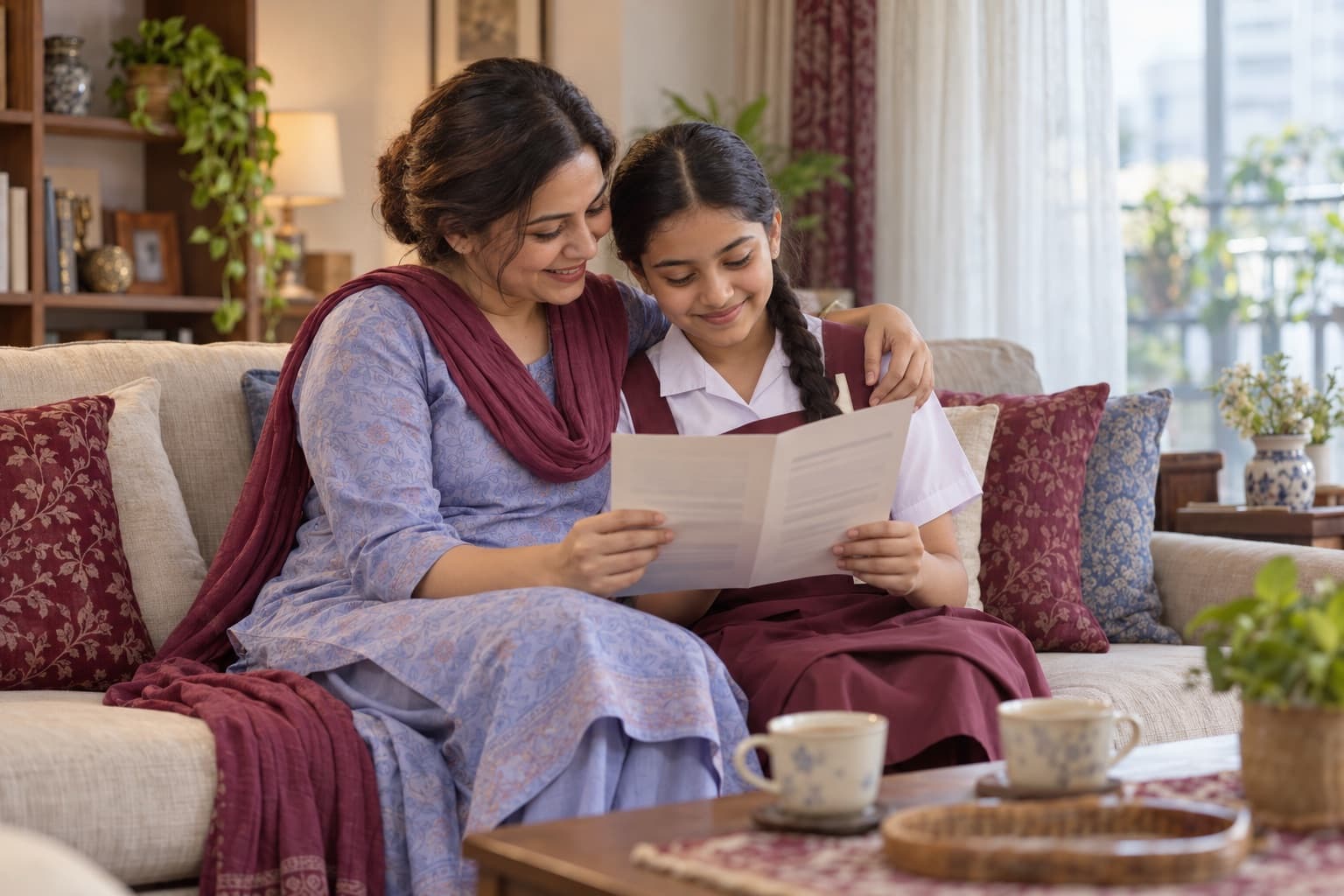
Raising children in a joint family: many adults, one gentle plan
Quick answer
Raising children in a joint family works best when the adults agree on a few basics, such as sleep, meals, screens, study time and no hitting, and both parents have the final say on them. Settle disagreements away from the children, protect some privacy and one-to-one time, and stop comparisons between cousins. The many loving adults are a real strength.
 By the ParentMind team11 min read
Listen to this article
16 min listen · Read by your device's voice
At a glance
- Who it is for
- Parents raising children of any age with grandparents, uncles, aunts or cousins under the same roof
- Key takeaways
- A joint family gives children many loving adults; the hard part is many different rules.
- Agree three or four basics as a household, and leave the final say on them with both parents.
- Never compare cousins, and give each child a little privacy and time alone with their parents.
- Keep adult quarrels away from the children, and let them see the making-up too.
Your son has three people telling him to eat, two telling him to stop crying, and a cousin who always seems to get more. Raising children in a joint family can feel like parenting by committee, especially when your own voice gets lost among elders you love and respect.
Yet many children thrive with grandparents, uncles, aunts and cousins around them. What tends to help is not fewer people but a few rules everyone shares, a little privacy, and adults who settle their differences away from the children.
Below: the good side, agreeing the basics, cousins, privacy, the mother's voice, quarrels, a Bangladeshi home, a 7-day plan and when to get help.
What's good about raising children in a joint family?
A joint family gives a child something many small families miss: lots of people who love them. Before tackling the hard parts, it helps to name what is already working:
- Many caring adults: when a parent is tired, ill or at work, someone the child knows is always there.
- Cousins who grow up like brothers and sisters, with someone to play with every day.
- Grandparents' stories, songs, recipes and faith habits, passed on in daily life.
- Daily practice in sharing, waiting, helping and respecting elders.
- Help for working parents, and less loneliness for everyone.
| The strength | The hard part | What helps |
|---|---|---|
| Many caring adults | Many different rules | Three or four basics everyone agrees |
| Cousins to play with | Comparisons, rivalry and fights | No comparing; coaching fights, not judging them |
| Help with childcare | The mother's say can get lost | Parents decide the basics together |
| A lively, busy home | Noise, late nights, little privacy | A protected bedtime and a quiet corner |
| Elders' experience | Old habits, such as smacking or home remedies | Kind, firm lines on safety and health |
Too many voices in parenting: how to agree the basics
When every adult has their own way, a child hears a different rule from each one and soon learns to go to whoever says yes. Raising children in a joint family gets easier with a short list everyone keeps:
- Parents first: agree between the two of you what matters most. When parents disagree on discipline shows how to find common ground.
- Keep the list to three or four basics: sleep times, meals and snacks, screens, study time, and how mistakes are handled, with no hitting or shaming.
- Share it with the household at a calm time, such as after dinner, as rules for all the children, not as complaints about anyone.
- Ask for the elders' blessing and advice. Grandparents who help shape the list are often far more willing to keep it.
- Agree who decides what: whoever is with the child handles small moments; bigger decisions, such as school, doctors or punishment, come back to the parents.
- Write the basics down, and look at them together again after a month.
What you might say to relatives
- Chachi, you're so good with her. Could you help us keep her bedtime at 9 on school nights?
- We've agreed no phones at meals for all the children. Thank you for helping with it.
- If he's naughty, please call me rather than scolding him in front of everyone.
- To your child: Everyone in this house loves you. Abbu and I decide the rules, and we'll keep them fair.
Cousins living together: comparisons, sharing and fights
Cousins in one house are often best friends and fierce rivals on the same day. The rivalry grows when adults compare them: who is fairer, who came first in class, who eats properly. Every comparison, even a joking one, can tell one child they are not enough. Comparing your child with others explains what to say instead.
- Treat cousins the same on gifts, treats and Eid salami, even when the families have different incomes.
- Talk about marks and results with each child privately, never at the dinner table.
- In fights, coach rather than judge: help each child say what they want and find a fix, instead of deciding who is guilty.
- An older cousin can help, but is never put in charge of a baby or a toddler. Never leave a young child alone, or alone with a baby.
- Cousins of different ages play where adults can hear them, with doors open.
Privacy and space for children in a shared home
In a full house, a child may share a bed with a grandparent, do homework in the drawing room and rarely be alone with their own parents. Privacy in a joint family with children takes a little planning:
- Sleep: one bedtime for all the children, with the evening TV and guests kept away from where they sleep. Children aged 6–12 need about 9–12 hours of sleep, and teenagers about 8–10.
- Study: a quiet hour for the whole house, or one corner with a table and a lamp that is only for study.
- Their own things: a drawer, a shelf or a box that nobody else opens, even in a shared room.
- Body privacy: from school age, children dress and bathe in private, and everyone knocks before going in.
- Time with parents: ten minutes a day alone with each child, a walk, a rickshaw ride or the rooftop with you, often does more than a whole day out.
- Teenagers: knock, let them close a door for part of the day, and don't read their messages aloud or share their news.
The mother's voice in decisions about her own child
In many joint families, a young mother lives in her in-laws' home and may feel she has little say in how her own child is raised: what the baby eats, when the toddler sleeps, whether a smack is acceptable. This is nobody's fault; many households have long worked this way. But children do best when both parents lead, and a mother who feels unheard can grow tired and low.
- Decide the big things as a couple first: feeding, sleep, school, doctors and discipline. Then share them together.
- Fathers: speak to your own parents for your wife, rather than leaving her to argue alone. A son's word often carries further in his parents' home.
- Credit the elders out loud. “Amma's khichuri is the only thing he eats when he's ill” makes the rest easier to accept.
- Remember that a mother-in-law is often a young mother's greatest help. Most disagreements are about how, not about love, and can be settled that way.
For scripts that thank first, see when grandparents bend your rules.
When relatives argue in front of the children
In a shared home, children overhear a lot: quarrels about money, property, chores or how the children are raised. Occasional disagreements handled calmly do little harm, and can even show children how people make up. Loud, frequent or frightening quarrels are different, and children often blame themselves.
- Move the children away, or move the conversation, as soon as voices rise.
- Never ask a child to take sides, carry messages or report what another adult said.
- Afterwards, reassure them in a few words, without blaming anyone: “The grown-ups disagreed. It's not your fault, and we're sorting it out.”
- Let them see the repair: a shared meal, a kind word, the adults talking again.
Arguing in front of children has more on repair and what to tell children afterwards. If anyone in the house is being hurt or threatened, call 999 if they are in danger now; you can also report it at the local police station.
In a Bangladeshi home: Eid, weddings, a father abroad and the family name
Growing up among grandparents, uncles and aunts is a familiar picture in Bangladesh, and every family runs it differently. Joint family parenting tends to meet the same few situations again and again:
- A father working abroad: when the mother and children live with his family, agree the basics before he leaves. On video calls, he can back the mother's decisions in front of everyone.
- Eid and weddings: late nights, sweets and crowds are part of the joy. Relax the small rules, keep the safety ones, and agree which adult is watching the youngest children.
- Dadabari and nanabari: children belong to both sides. Fair visits and calls to the mother's family, without competition, spare a child from feeling torn.
- “What will people say?”: worry about the family's name can push adults to shame a child in public. A child's feelings matter more than any guest's opinion; correct them quietly, later.
- Faith and routine: prayer times, Friday family lunches and Ramadan evenings can give a busy house a shared rhythm that children find calming.
A 7-day plan for a calmer joint household
Choose an ordinary week. Each evening, note one thing that went well and one moment when the rules clashed.
- Day 1: List who cares for your child, and when, through a normal day.
- Day 2: With your partner, choose the three or four basics that matter most.
- Day 3: Thank each adult for one thing they do for your child, in front of the child.
- Day 4: Share the basics with the household, kindly, after dinner.
- Day 5: Set up one quiet corner and one protected bedtime for all the children.
- Day 6: Spend ten minutes alone with each of your children.
- Day 7: Read your notes with your partner. What eased? Choose one next step.
When is it more than everyday family friction?
Every big household has friction. Get help, from a family counsellor, your child's doctor or someone you trust, if you notice:
Get help if
- Your child seems anxious, sleeps or eats poorly, or struggles at school for more than a few weeks while tension at home goes on.
- A relative keeps hitting, threatening or humiliating your child after you have asked them to stop.
- Your child is suddenly afraid of one person or one room, or tells you something that worries you. Believe your child, keep them away from that person and act the same day. You can report it at the local police station; call 999 if your child is in danger now.
- Quarrels at home turn violent, or anyone is hurt or threatened: call 999 if anyone is in danger now. You can also report it at the local police station.
- You or your partner feel low, trapped or hopeless on most days for more than two weeks: talk to a doctor. If you have thoughts of harming yourself, call 999 if you are in danger now; otherwise see a doctor the same day.
Raising children in a joint family can give them one of the warmest places to grow up. A few shared rules, a little privacy and adults who make up after they disagree help children enjoy all that love. ParentMind helps you note what happens each day, see patterns and get guidance: see how ParentMind works.
Questions parents ask
Is a joint family good for children?
It can be. Many children in joint families gain loving adults, cousins to play with and a strong sense of belonging. What makes the difference is how the household runs: shared basic rules, no comparisons, some privacy and adults who keep quarrels away from children. Calm small families and calm joint families can both raise happy children.
How do I handle my mother-in-law disciplining my child?
Thank her for caring, then agree together how mistakes are handled: a calm “no”, a short break, or bringing the child to you, and no hitting or shaming. Ask your husband to speak with her if that is easier. In the moment, step in quietly rather than correcting her in front of your child.
How can we get some privacy in a joint family?
Start small: a protected bedtime, a drawer or shelf for each child, knocking before entering, and ten minutes a day alone with each child, such as a walk or time on the rooftop with you. As a couple, a regular short time together, even a walk after dinner, matters too.
Why does my child behave worse when relatives are around?
Usually because there are more people to test, more attention to win, and different adults give different answers. Children often push hardest when they sense the adults disagree. Agreeing a few basics, reacting the same way in front of everyone, and noticing your child's good behaviour tend to help.
Should cousins in the same house have the same rules?
For the basics, yes: similar bedtimes for similar ages, the same screen and meal rules and the same no-hitting rule make life fairer and easier. Ages differ, so a 12-year-old can sleep later than a 5-year-old. Each set of parents can still decide personal things, such as extra classes, for their own child.
How do I stop relatives comparing my child with cousins?
In the moment, change the subject kindly, “Every child has their own strengths,” and praise something specific about each child. Later, ask the relative privately not to compare, especially about marks, looks or skin colour. Afterwards, tell your child that you love them as they are.
Who makes the final decisions about my child in a joint family?
The child's parents, together, with the elders' advice. Grandparents and other relatives guide everyday moments, but big decisions such as school, health, discipline and screens work best when both parents agree first and then share them respectfully with the family. Living with in-laws and raising kids goes more smoothly when this is clear.
This article is general information, not medical advice. For health worries, talk to a doctor; if someone is in danger, contact your local emergency number.