Arguing in front of children: what it does and how to repair
Quick answer
Arguing in front of children isn't always harmful: calm disagreement that ends in repair can show them how problems get solved. Frequent, frightening fights and being made to pick sides tend to hurt most. Afterwards, reassure your child and make up where they can see. Hitting, threats or fear are not arguing: call 999 if anyone is in danger now.
 By the ParentMind team11 min read
Listen to this article
15 min listen · Read by your device's voice
At a glance
- Who it is for
- Parents whose children have seen or heard them argue, at any age, including in joint-family homes
- Key takeaways
- Children of every age notice tension at home, even through a closed door, and young children often blame themselves.
- Calm disagreement that ends in repair can teach problem-solving; frequent, frightening fighting is what tends to harm.
- Afterwards, tell your child it wasn't their fault and that you are working it out, and let them see you make up.
- Hitting, threats or fear at home are not arguing: your and your children's safety comes first, and 999 is for anyone in danger now.
If you have argued in front of your children and then lain awake worrying about it, you are not alone. Arguing in front of children happens in most families at some point. What matters most is how often it happens, how loud and frightening it gets, and what happens afterwards.
This guide covers what children notice at each age, the difference between disagreeing and fighting, what to do in the moment, how to repair in front of your child, joint-family tension, a 7-day plan, and when conflict at home is no longer safe.
What do children notice when parents argue?
Children notice more than parents think: raised voices through a closed door, a cold silence at dinner, a parent crying in the bathroom. Even babies react to tense voices around them. What children make of it depends on their age:
| Age | What they may notice or think | What you might see |
|---|---|---|
| 0–2 years | Raised voices, tense faces and rushed handling; no understanding of the words | More crying and clinging, harder to settle, changes in sleep |
| 3–6 years | Loud voices and anger; often thinks they caused it: 'because I was naughty' | Tantrums, going back to wetting or baby talk, trying to stop the fight, fears at bedtime |
| 7–12 years | The words and what they mean; worries that someone will leave; feels torn between parents | Stomach aches, trouble concentrating, taking sides, being 'extra good' or acting out |
| 13–18 years | Who is 'right'; may feel they must protect a parent or younger siblings | Withdrawal, anger, staying out late, defending one parent, worrying about money or the family |
Some of these reactions are normal after one bad row; the pattern over weeks matters more. If your child seems flooded by worry or anger, see big feelings in children.
Do arguments harm kids? Disagreeing versus fighting
Not all conflict hurts children. Calm arguing in front of children, where both parents are heard and something gets settled, can show them that people who love each other can disagree and still be safe. Parents fighting in front of kids is a different thing when it is frequent, frightening, about the child, or never resolved: that can leave children more anxious, easily upset and less able to settle at school.
| Disagreement that can teach | Fighting that tends to harm |
|---|---|
| Voices stay fairly calm, and both people get to finish | Shouting, slamming doors, throwing things |
| About the problem: money, a visit to Nanu's, screen rules | About the person: insults, name-calling, mocking |
| Ends in a decision, a pause, or a plan to talk later | Never ends, or ends in days of silence |
| Children are kept out of it | Children are made to listen, carry messages or pick a side |
| Repair happens, and children see some of it | No repair, or a 'sorry' with no change |
Fights about the child are especially hard on them, because children tend to hear 'this is my fault'. Disagree about discipline in private; for agreeing on a shared plan, see when parents disagree on discipline.
What to do when you start arguing in front of children
Once voices rise, an argument is hard to stop halfway, so plan the pause before you need it.
- Notice the rise: a louder voice, a hot face, the urge to win. That is the moment to slow down.
- Lower your voice and sit down; it is harder to shout sitting down.
- Call a pause with a phrase you agreed in advance, such as 'Let's finish this tonight.'
- Move the talk away from the children, and tell them why: 'We're going to talk in the other room. You're safe, and this isn't about you.'
- Never use your child as a messenger, a judge or an audience.
- Come back to it when you are both calm, and settle it or agree on a next step.
Words for the moment
- I'm getting too angry. Can we finish this after the children are asleep?
- I don't want to win this. I want to sort it out with you.
- We're upset with each other, not with you.
- Grown-ups disagree sometimes. We're going to work it out.
How to repair after an argument in front of children
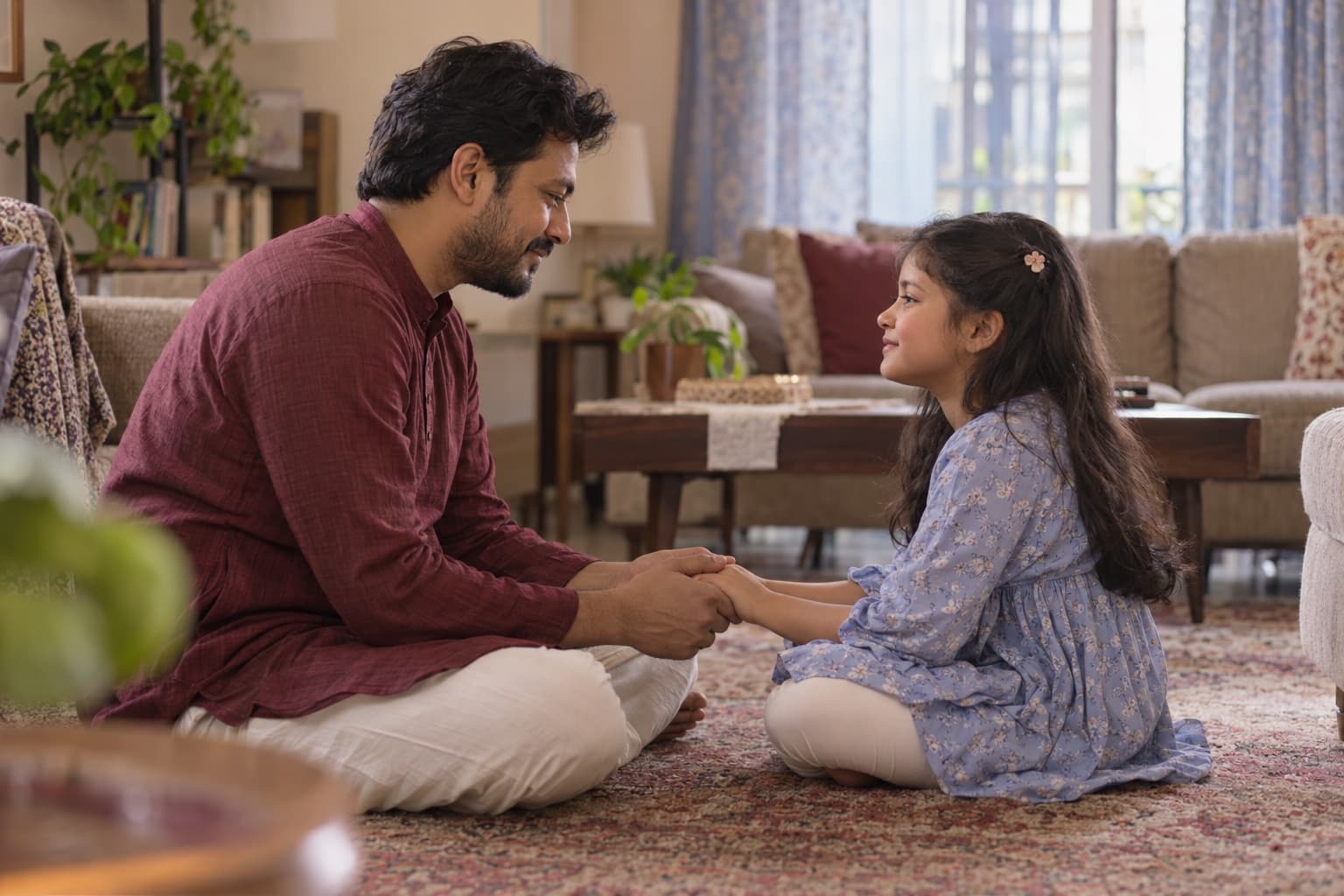
Children don't need parents who never argue. They need to see that a rupture can be mended. If the argument happened in front of them, let some of the making up happen in front of them too.
- Make up with each other first, at least enough to be calm together.
- Then talk to your child, together if you can, briefly and calmly.
- Name what they saw: 'You heard us shouting last night.'
- Say it wasn't their fault and that you are working it out, without the adult details.
- Show the repair: an apology to each other, a normal family meal, a joke between you.
- Ask how they felt, and listen without arguing with their feelings.
What to tell children after parents fight
- We were shouting, and that was scary. We're sorry. We're okay now.
- It wasn't your fault. Nothing you did made us argue.
- We disagreed about money. We've talked, and we're sorting it out together.
- You don't have to choose. You can love us both.
- We handled that badly. You shouldn't have had to hear it.
- Do you want to tell us how it felt?
Repair works the same way after a fight with your child; see how to bond with your child for words and daily habits.
Why you should never make a child pick sides
Children love both parents. Being asked to choose, even as a joke, puts them in an impossible place, and many carry that weight for a long time.
- Don't ask who is right, or whom they love more.
- Don't send messages through them: 'Go and tell your father dinner is ready, if he can be bothered.'
- Don't criticise the other parent, or their family, to your child.
- Don't lean on your child for comfort about your marriage; find another adult for that.
- If your child takes a side on their own, gently release them: 'This is between us grown-ups. You don't have to fix it.'
In a Bangladeshi home: joint families, in-laws and thin walls
In joint families and small flats, quarrels are rarely private, so arguing in front of children is hard to avoid completely. Children overhear parents, and also parents and in-laws, uncles arguing over property, or a grandmother and an aunt. Some of this tension isn't yours to fix, but you can protect your child from the worst of it.
- Have hard conversations away from the children: on the roof, on a walk, or after they sleep, not across the table at a family meal.
- If relatives argue in front of your child, step in calmly: 'Let's talk about this later; the children are here.'
- Keep children out of the middle, between grandparents and a parent or between two sides of the family.
- Tell your child a simple truth for their age: 'Chacha and Abbu disagree about the land. It's a grown-up problem, and they'll sort it out.'
- In exam season, protect the study corner and sleep; a quarrel the night before an exam can stay in a child's head all morning.
- Keep routines steady when the house is tense: meals, bedtime and school as usual.
A 7-day plan for calmer disagreements at home
If arguing in front of children has become a habit, try this together. Take one step a day, note what happens, and compare after a week. This plan is for everyday disagreements; if anyone at home is afraid, start with the safety section below.
- Day 1: Notice. Each of you jots down when tension rose, what it was about, and whether the children were there.
- Day 2: Agree a pause phrase that either of you can use, such as 'Let's finish this tonight', and a place to talk.
- Day 3: Choose a regular time for hard topics, such as after the children are asleep.
- Day 4: Talk to your child about the last argument they saw, using the words above.
- Day 5: Let your child see one small repair: a thank you, a joke, a cup of tea made for the other.
- Day 6: Agree one rule for family quarrels with the adults at home: 'Not in front of the children.'
- Day 7: Compare with Day 1. Fewer arguments in front of the children? Calmer endings? Keep what helped.
When it isn't arguing: safety first, and when to get help
Hitting, pushing, grabbing, threats, breaking things to frighten, or living in fear of a partner's temper are not 'arguing'. They are abuse, and children who see or hear them can be harmed too. Your safety and your children's safety come first.
Get help if
- Anyone at home is being hit, threatened or hurt, or you fear they will be: call 999 if anyone is in danger now.
- Your child has been hurt, or is frightened of a parent or another adult at home: believe your child, keep them away from that person, and act the same day. You can report it at the local police station; call 999 if your child is in danger now.
- You are afraid of your partner: talk to a doctor or someone you trust, and plan where you and your children could go in an emergency, such as a relative's home.
- Arguments happen most days or end in long silences, and your child has struggled with sleep, school or mood for several weeks: talk to a doctor or counsellor, for your child and for yourselves.
- Your child talks about not wanting to live or about hurting themselves: stay calm and close, call 999 if they are in danger now, otherwise speak to a doctor the same day.
If your own anger frightens you, or you fear you might hurt someone, step away now, make sure everyone is safe, and talk to a doctor or counsellor for yourself the same day. Call 999 if anyone is in danger now.
ParentMind helps you note your child's sleep, mood and behaviour each day, so you can see how they are coping over a week; see how ParentMind works.
Questions parents ask
Is it okay to argue in front of your kids?
Sometimes, yes. Calm disagreement that ends in a solution can show children how people who love each other sort out problems. What tends to harm is fighting that is frequent, loud, insulting or frightening, or that is about the child. Keep big or personal arguments for private, and let your child see the repair.
What should I tell my child after we fight?
Keep it short and true for their age: you were upset with each other, it wasn't their fault, and you are working it out. Apologise for the shouting, not just the argument. Skip the adult details and don't blame the other parent. Then let your child see you being kind to each other again.
Can parents fighting cause anxiety in a child?
It can. Frequent, frightening conflict at home can leave children more anxious, easily upset, and struggling with sleep or schoolwork, especially if they blame themselves. Children usually cope much better when arguments are calmer, kept away from them and followed by repair. For signs of worry and what helps, see anxiety in children.
Should we hide all our arguments from the children?
No, and it is rarely possible: children sense a cold silence as clearly as a shout. It is better to disagree calmly, take heated or adult topics such as money worries or in-law problems somewhere private, and let children see that disagreements end. What they need most is to know they are safe and it isn't their fault.
My child tries to stop us arguing. What should I do?
Stop the argument, and thank your child for caring. Then gently take the job away: 'It's not your job to fix grown-up problems. We'll sort it out.' A child who keeps stepping in may be frightened or feel responsible, so talk calmly afterwards and look at how often arguments are happening in front of them.
Does fighting in front of a baby affect them?
Babies don't understand the words, but they do react to raised voices and tense handling: they may cry more, cling, or sleep less well. Keep your voice low near a baby, hand the baby to a calm adult or take the argument elsewhere, and comfort the baby afterwards. Calm, warm care each day matters far more than one bad evening.
This article is general information, not medical advice. For health worries, talk to a doctor; if someone is in danger, contact your local emergency number.