How to help a child with big emotions: what to say and do, ages 2–12
Quick answer
To help a child with big emotions, stay calm, name the feeling, show it makes sense and stay close until it passes; then solve the problem together. Children aged 2–12 learn to handle feelings mostly by being helped through them. Teach feeling words when calm. Get help if low mood lasts two weeks, or outbursts fill most days for months.
 By the ParentMind team13 min read
Listen to this article
18 min listen · Read by your device's voice
At a glance
- Who it is for
- Parents of children aged 2–12 whose feelings turn into tears, meltdowns, sulking or shouting
- Key takeaways
- Big emotions are normal: the brain's brakes for feelings develop slowly, so children need an adult's calm to borrow.
- Name the feeling and show it makes sense, while keeping the limit: accepting a feeling is not giving in.
- Feeling words, taught when everyone is calm, often help children say what is wrong instead of showing it.
- Get help if big feelings stop everyday life for weeks, or if your child talks of hurting themselves.
If you are looking up how to help a child with big emotions, you have probably just lived through one: tears over a broken biscuit, a scream at leaving the park, a 9-year-old sobbing that nobody likes her. In the middle of it, it can feel as if nothing you say gets through.
Big feelings are a normal part of growing up, not a sign that something is wrong with your child or your parenting. Children learn to handle emotions mostly by being helped through them, again and again, by a calm adult. Below are the steps, the words, the tools and a 7-day plan to do exactly that.
Why do children have such big emotions?
Children's feelings are as strong as ours, but the skills to manage them are still being built. Emotional development is slow and uneven, and several things usually add up:
- A brain still growing its brakes: the parts that calm a feeling and think ahead develop slowly through childhood and the teens, so feelings often arrive faster than control.
- Body needs: tiredness, hunger, illness and noise make every feeling bigger, which is why evenings are often hardest.
- Not enough words yet: a child who cannot say “I felt left out” may show it by crying, hitting or refusing.
- Changes: leaving a game, a new sibling, a new school or a move can stir feelings for weeks.
- Temperament: some children feel everything more intensely. That is a trait to understand, not a flaw to fix.
Emotions by age: what to expect from 2 to 12
Children's emotions change shape as they grow. This table shows what is common at each age and what usually helps most.
| Age | What big feelings often look like | What helps most |
|---|---|---|
| 2–3 years | Sudden, loud storms: crying, dropping to the floor, hitting; usually over within minutes | Staying close, naming the feeling for them, few words, comfort |
| 4–5 years | More words, but still big reactions to small things; jealousy, new fears, wanting things their way | Naming it, offering two simple choices, practising calming in play |
| 6–8 years | Strong feelings about fairness, losing, friends and school; tears or temper after holding it in all day | Talking once calm, “feelings weather” check-ins, a snack and rest after school |
| 9–12 years | Feelings go inward: moods, sulking (obhiman), worry about marks, friends or a changing body; “I'm fine” | Side-by-side talks, listening more than fixing, respecting privacy |
Under 4, most big storms are tantrums: toddler tantrums has the step-by-step for that age, and separation anxiety covers tears at every goodbye. When an older child answers every question with “fine”, see talking about feelings when the answer is “fine”; when they often say “I can't do it”, see how to build a child's confidence.
How to help a child with big emotions in the moment
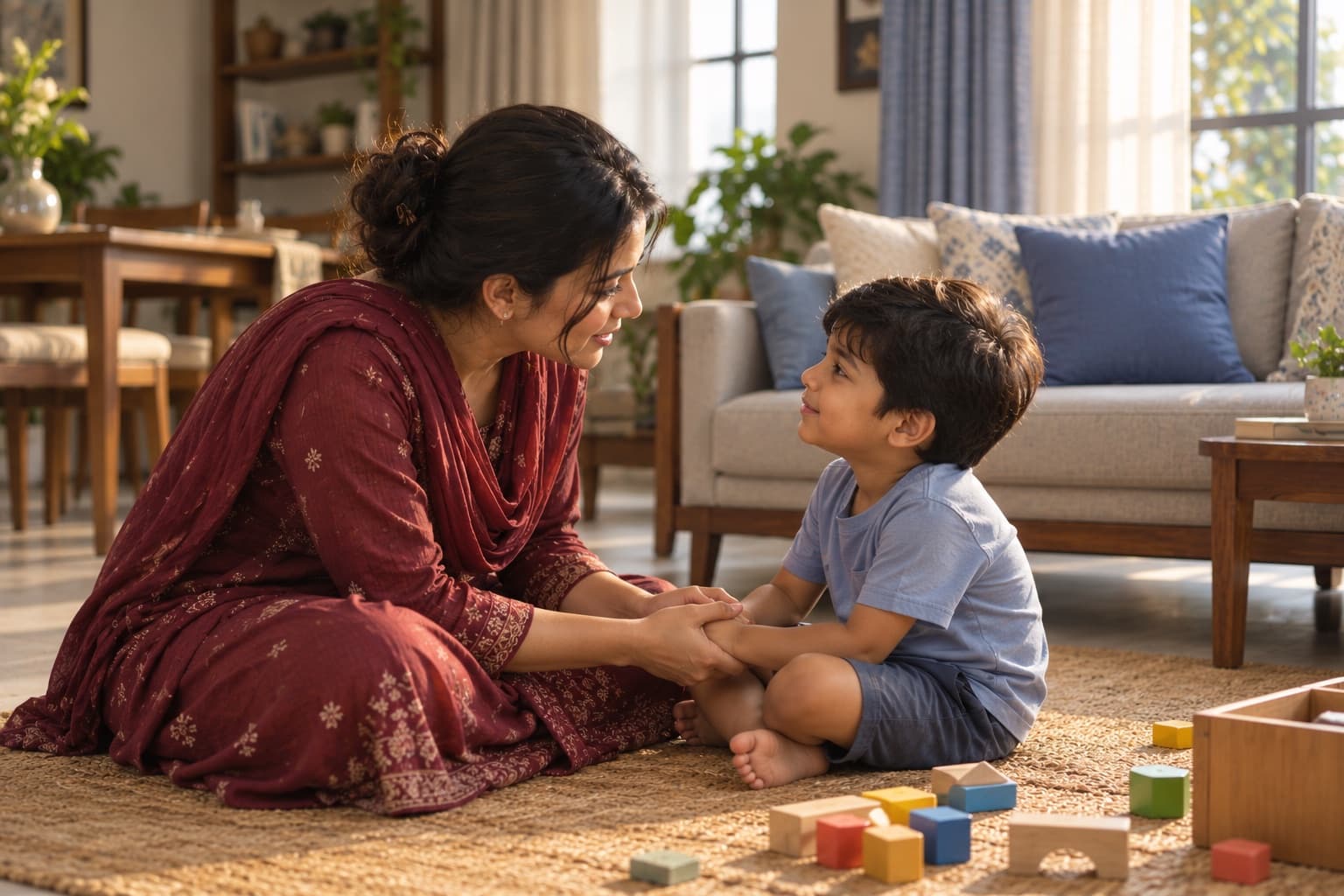
Emotion coaching is a simple way to guide a child through a feeling instead of shutting it down: notice it, name it, accept it, then solve the problem together. In the moment, it looks like this:
- Steady yourself first: breathe out slowly, lower your voice and get down to your child's eye level.
- Keep everyone safe: move a younger sibling or anything breakable out of reach.
- Name what you see, without judging: “You're really disappointed.” A guess is fine; your child can correct you.
- Show the feeling makes sense: “You were looking forward to it all week.”
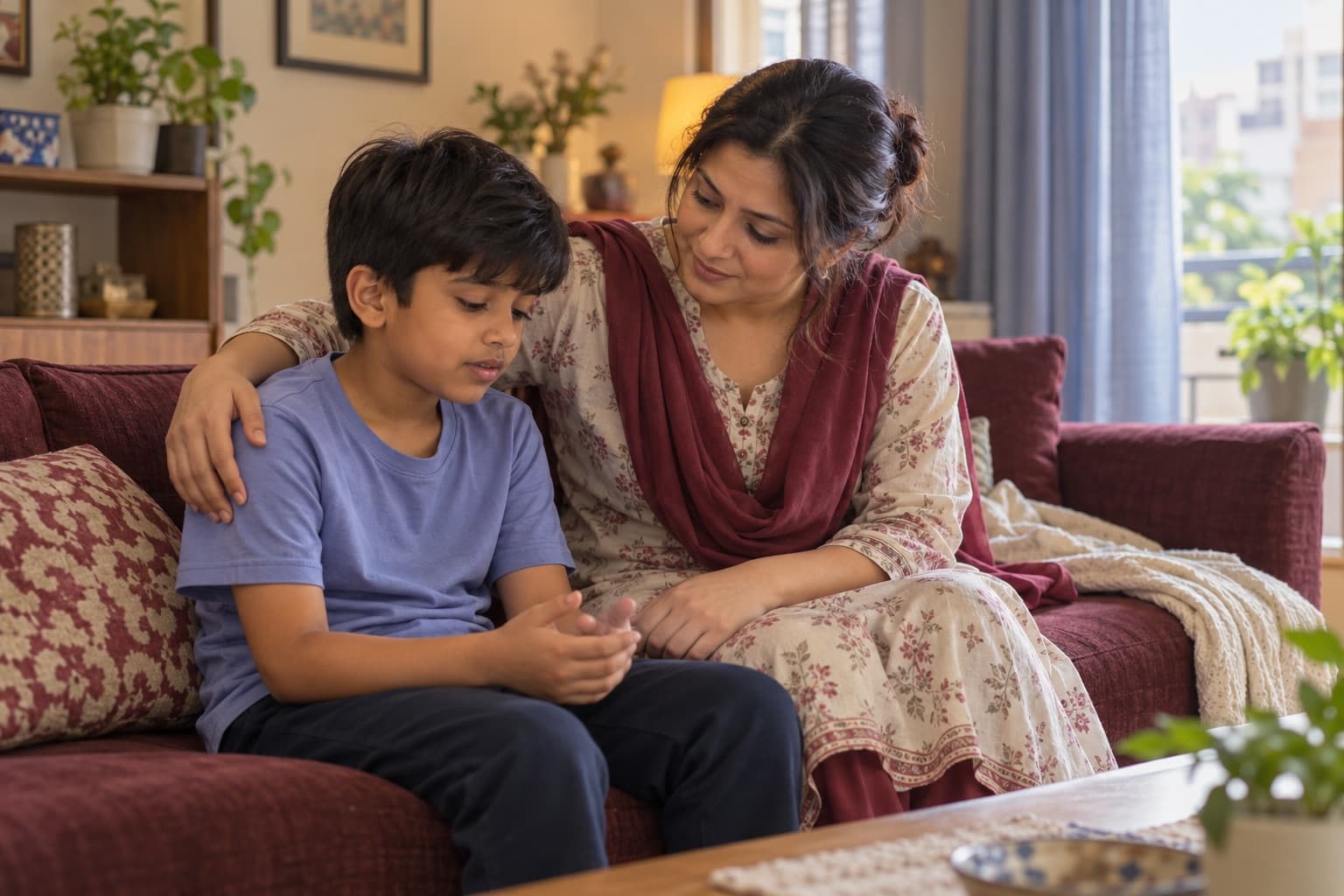
- Comfort and wait: a hug or sitting close, very few words, and no arguing, explaining or fixing while the feeling peaks.
- Hold the limit kindly. Accepting the feeling doesn't mean changing the answer: the park is still finished for today.
- Once calm, solve it together: what happened, what helped and what you could both try next time.
What you might say
- You're really upset. I'm here. I'll sit with you.
- You wanted to stay longer. That's hard.
- You can be sad, and we still go home now.
- Let's breathe together, slow like a balloon.
- When you're ready, tell me what happened. I want to understand.
How to validate a child's feelings without giving in
To validate a feeling is to tell your child, “What you feel is real, and I'm with you.” It is not agreeing that they are right, or giving them what they want. Many everyday phrases brush a feeling aside without meaning to; small swaps often help.
| Instead of | Try |
|---|---|
| “Stop crying, it's nothing.” | “That really hurt. Come here.” |
| “Boys don't cry.” | “It's okay to cry. Crying lets the sadness out.” |
| “There's nothing to be scared of.” | “It feels scary. Let's look together.” |
| “You're being so dramatic.” | “This feels really big right now.” |
| “If you keep crying, no TV tonight.” | “You can be upset, and my answer is still no.” |
| “Say sorry right now!” | “Let's calm down first. Then we'll sort it out.” |
Teaching kids to name feelings in Bangla and English
Children who have words for feelings often need to show them less through crying or hitting. Many Bangladeshi children hear two languages, and either works; for feelings, the home language often feels closest. Start with a few words and add more as your child grows.
| Age | Feeling words | A child might say |
|---|---|---|
| 2–3 years | Happy, sad, angry, scared (khushi, mon kharap, raag, bhoy) | “I'm sad. Hug me.” |
| 4–5 years | Excited, worried, jealous, shy, proud | “I'm worried about the new class.” |
| 6–8 years | Disappointed, frustrated, left out, embarrassed, nervous | “Nobody let me play at tiffin time. I felt left out.” |
| 9–12 years | Hurt and sulky (obhiman), overwhelmed, guilty, lonely, mixed feelings | “I'm excited about the trip, but nervous too.” |
Emotional intelligence activities for kids
- Feelings faces: draw four to six faces on a sheet, stick it on the fridge, and let everyone point to how they feel at snack time or bedtime.
- Feelings weather: ask, “Sunny, cloudy, rainy or stormy inside today?” Even children who won't talk will often pick a weather.
- Story feelings: pause a story or cartoon and ask, “How do you think she felt? What could she do?” Children often say more about a character than about themselves.
- Your own words: say your feelings aloud in small ways: “I'm frustrated with this traffic. I'll put on a song.”
Calm-down tools for kids, starting with your own calm
Much of how to help a child with big emotions comes down to your own calm. Young children settle by borrowing an adult's calm: a slow voice, a steady face, a hand on the back. Notice what shortens your own temper, such as hunger, a long commute or a relative's comment, and plan a pause for those moments.
- Balloon breathing: breathe in slowly as if filling a balloon in your tummy, then let it out even more slowly. Little ones can blow on a tissue or a feather instead.
- Squeeze: a soft ball or cushion, both palms pressed hard together, or a tight hug.
- Cool water and counting: a glass of water, then five things you can see and four you can hear, to bring the mind back into the room.
- Move: ten jumps, a short walk with you, or dancing to one song.
- A quiet spot your child chooses, never a punishment; how to set up a calm-down corner explains it for small flats.
When you feel your own temper rising
- I'm feeling cross. I'm going to take three slow breaths before I talk.
- I need one minute in the kitchen. I'll be right back.
- I shouted earlier. I'm sorry. Let's try again.
Step away only when your child is safe. Children often learn more from watching you handle a feeling than from any talk about feelings. Shouting, threats or hitting may stop a moment but tend to make big feelings and behaviour worse over time; discipline without hitting has calm alternatives.
Big feelings in a Bangladeshi home: elders, guests and “boys don't cry”
In many Bangladeshi homes, several loving adults help raise a child, and that warmth is a strength. A few everyday habits are worth a second look:
- “Boys don't cry” and “good girls don't get angry”: every child needs permission to feel sad, scared and angry, and help to handle it. Being allowed to cry does not make a boy weak.
- Guests and relatives: when a child melts down in front of others, the pressure to hush them fast is real. Take your child to a quieter room; scolding or teasing in front of guests usually makes the feeling bigger. If your child hides or goes silent with guests instead, see helping a shy child.
- Grandparents and house help often soothe with sweets, the phone or a quick distraction, out of love. Agree two or three phrases everyone can use, such as “You're sad. I'm here.”
- Scare tactics: “the ghost will come” or “the police will take you” may stop crying for a minute, but can leave fears that last. Comfort usually works better; night-time fears are covered in child afraid of the dark.
- Marks and coaching: many tears are about results. Name the feeling before the marks: “You're disappointed. You worked so hard.”
- Shared rooms and small flats: a child who shares a room may have nowhere to be upset in peace. A chair by the window or a cushion in a corner can be theirs for a few minutes.
- Faith and family: many families also make a dua for their child's calm at bedtime, alongside these steps.
A 7-day plan to help your child with big feelings
Knowing how to help a child with big emotions is one thing; seeing what works for your child takes a week of notes. Write one line a day: the feeling, what came just before, how long it lasted and what helped.
- Day 1: change nothing. Just write your line for each big feeling, including the time of day.
- Day 2: look for the pattern, such as hunger after coaching or the switch from play to homework, and ease one trigger.
- Day 3: make a feelings chart together and teach three feeling words; use them about yourself too.
- Day 4: practise one calm-down tool while everyone is calm, such as balloon breathing, until it feels like a game.
- Day 5: at the next big feeling, use the steps above, from steadying yourself to holding the limit.
- Day 6: at bedtime or on a rickshaw ride, talk about one feeling from the day, theirs or yours.
- Day 7: compare with Day 1: how many storms, how long, how quickly your child calmed and what helped. Keep what worked and choose next week's step.
When are big emotions a sign your child needs more help?
Most big feelings ease as children grow. Talk to your child's doctor, a child psychologist or the school if you notice any of these:
Get help if
- Outbursts most days for several months, storms that keep getting longer and more frequent instead of easing, or hurting people or animals often.
- Feelings that stop everyday life for weeks: refusing school, not eating or sleeping properly, or no longer playing or seeing friends.
- Sad, irritable or tearful most days for two weeks or more, or no joy in things they used to love. Worries that take over are covered in anxiety in children.
- Your child hurts themselves or talks about wanting to die, even in anger: stay calm and stay close. Call 999 if they are in danger now; otherwise speak to a doctor the same day.
- A sudden change: a cheerful child turns fearful, clingy or withdrawn, or suddenly fears a person or place. Ask gently, believe what your child tells you, act the same day, and call 999 if they are in danger now.
- You feel you cannot cope, or fear you might hurt your child: talk to a doctor soon, and call 999 if anyone is in danger now.
Big feelings often follow a pattern that is easier to see over a week or two. ParentMind helps you note what happens each day, see patterns and get guidance: how ParentMind works.
Questions parents ask
Is it normal for a child to have big emotions?
Yes. Big emotions are a normal part of childhood, because the skills to calm a feeling develop slowly, right into the teens. Storms are often worse when a child is tired, hungry or facing a change. Look closer if outbursts happen most days for months, stop everyday life, or grow worse instead of easing.
What is emotion coaching?
Emotion coaching is a way of helping a child through a feeling instead of stopping it. You notice the feeling, name it, accept it as real and, once your child is calm, solve the problem together. Limits on behaviour stay. Over time, many children learn to name and handle feelings themselves after being guided through them many times.
How can I validate my child's feelings without giving in?
Say the feeling and the limit together: “You're sad the park is over, and it's time to go home.” Validating means accepting that the feeling is real, not that your child gets their way. Keep your words short and follow through kindly. Children often settle faster when they feel understood, even when the answer stays no.
Is it okay to let my child cry?
Yes. Crying is a healthy way for feelings to come out, for boys and girls alike. Stay close, offer comfort and let the tears run their course; you don't need to fix anything while your child cries. If crying happens most days for two weeks or more, or comes with low mood or worry, talk to your child's doctor.
Do feelings charts help kids?
Often, yes. A feelings chart, a sheet of drawn faces on the fridge, lets children show what they feel before they have the words. Point to it at calm times, such as snack time or bedtime, and use it for your own feelings too. Start with four faces and add more, in Bangla or English, as your child grows.
When do children learn to manage their emotions?
Gradually, across childhood and the teenage years rather than at one age. Toddlers need an adult to calm them; many school-age children can use a tool like slow breathing with a reminder; preteens and teenagers manage more alone but still have hard days. Each time you guide your child through a feeling, you help build the skill.
When should I worry about my child's emotions?
When feelings take over everyday life or last. Talk to a doctor if outbursts fill most days for months, sadness or irritability fills most days for two weeks or more, or feelings stop school, eating or sleep for weeks. If your child hurts themselves or talks about it, stay calm and close: call 999 if they are in danger now, otherwise speak to a doctor the same day.
This article is general information, not medical advice. For health worries, talk to a doctor; if someone is in danger, contact your local emergency number.