Child afraid of the dark, ghosts and nightmares? How to help (ages 2–10)
Quick answer
A child afraid of the dark has one of the most common childhood fears, usually from about 2 to 8, as imagination outruns the sense of what's real. Take it seriously without feeding it: a dim night light, one calm room check, a steady routine and small brave steps. Get help if fear disrupts sleep or daily life for weeks.
 By the ParentMind team12 min read
Listen to this article
16 min listen · Read by your device's voice
At a glance
- Who it is for
- Parents of children aged 2–10 who are scared of the dark, monsters, ghosts or bad dreams
- Key takeaways
- Most childhood fears come and go with age; fears of the dark, monsters and ghosts peak in the preschool years.
- Take the fear seriously and never mock it, but don't feed it: one calm room check, not nightly monster hunts.
- Small brave steps, practised in the daytime and at bedtime, often shrink a fear faster than avoiding the dark altogether.
- Keep scary threats and stories away from children, including 'the ghost will come if you don't sleep'.
Your child was fine all day, but at lights-out they cling to you: there's something under the bed, a shape by the cupboard, a noise in the corridor. A child afraid of the dark is one of the most common worries parents raise, and for most children it is a normal stage that passes with time and calm support.
Fear is how a growing mind practises staying safe. Below: why children get scared at night, normal fears by age, what to do at bedtime, gentle brave steps, nightmares, ghost and jinn stories in a Bangladeshi home, a 7-day plan, and the signs that a fear needs more help.
Why is my child scared at night?
Children are often more afraid at night because the dark hides the familiar and gives imagination room to fill the gaps. From about 2, a child can picture things that aren't there, but can't yet be sure they aren't real. Other things often add to it:
- Being apart from you: bedtime is a small separation, and the dark makes it feel bigger.
- Scary things seen or heard: a video, a cartoon villain, the news, an older cousin's story.
- Being overtired, which tends to make every worry bigger.
- Change and stress: a new sibling, a new school, a move, illness or tension at home.
- Sudden darkness: a power cut at bedtime can make a cosy room strange in a second.
- Temperament: some children are simply more cautious, and feel everything more strongly.
Common fears by age: what's normal from 2 to 10
| Age | Common fears | What tends to help |
|---|---|---|
| 2–3 years | Loud noises (thunder, the pressure cooker, the blender), being apart from parents, strangers, the first fears of the dark | Closeness, a calm voice, a warning before a noise, a comfort toy |
| 3–6 years | The dark, monsters, ghosts, masks and costumes, animals such as dogs, being alone in a room | A dim night light, one room check, simple facts, play that puts them in charge |
| 7–10 years | Ghost and jinn stories from friends or relatives, burglars, getting hurt or ill, a parent dying, storms, things seen on screens, school | Listening, honest answers, a plan ('what we'd do if…'), less scary content, enough sleep |
Kids afraid of monsters at 4 and of burglars at 9 are both on track: most of these fears fade as children grow. A fear deserves more attention when it is very intense, lasts for months or stops your child doing ordinary things; for worry that goes beyond the dark, see anxiety in children.
Child afraid of the dark at bedtime? What to do in the moment
These steps help most children who are scared to sleep in the dark feel safe enough to settle:
- Stay calm and close. Your calm voice tells your child the room is safe more clearly than any argument.
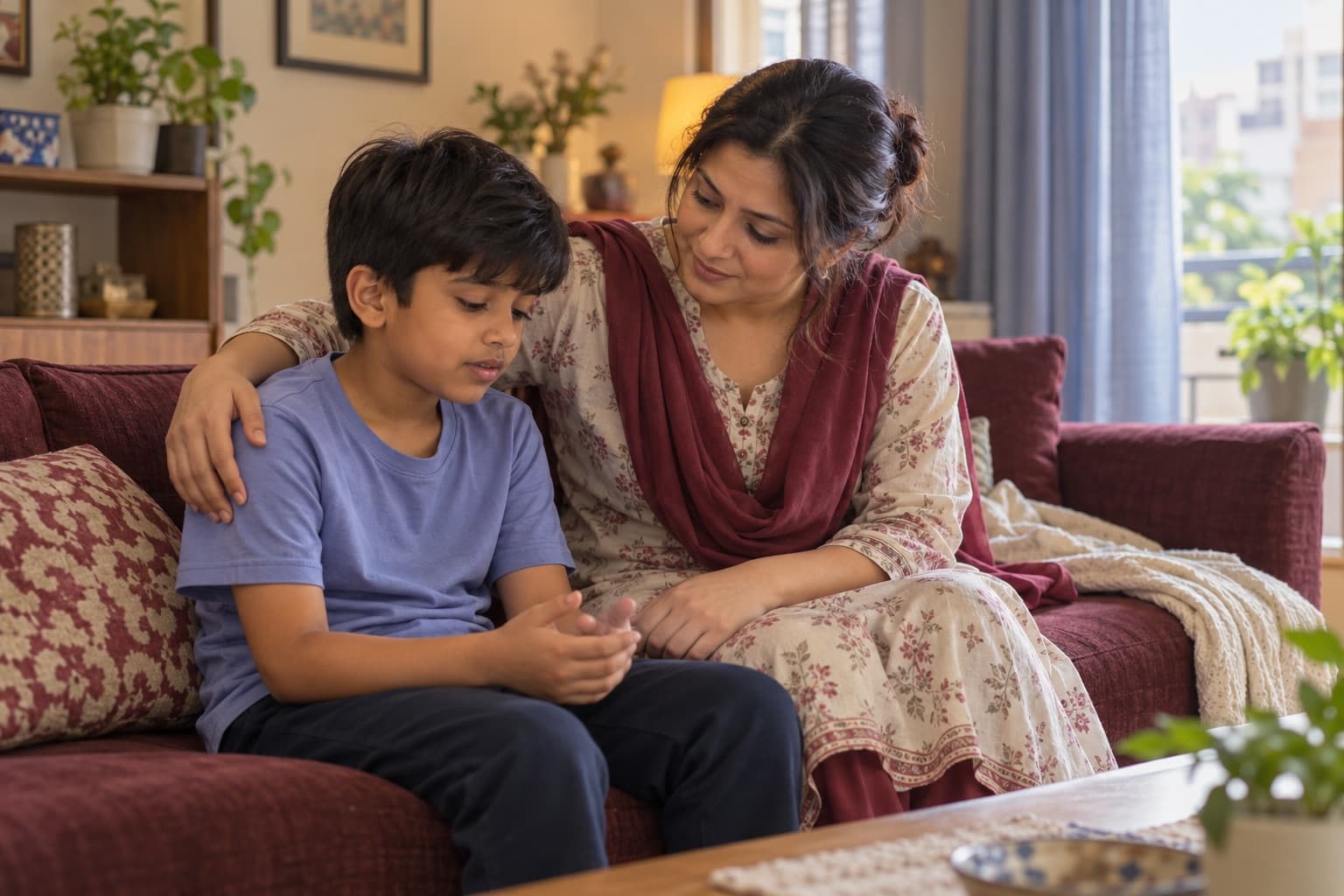
- Take the fear seriously: 'You're scared of the dark. That feels horrible.' Never laugh at it or call your child a coward.
- Check the room once, together, with the light on, then say it is safe. Avoid nightly monster hunts, which can make the monster feel real.
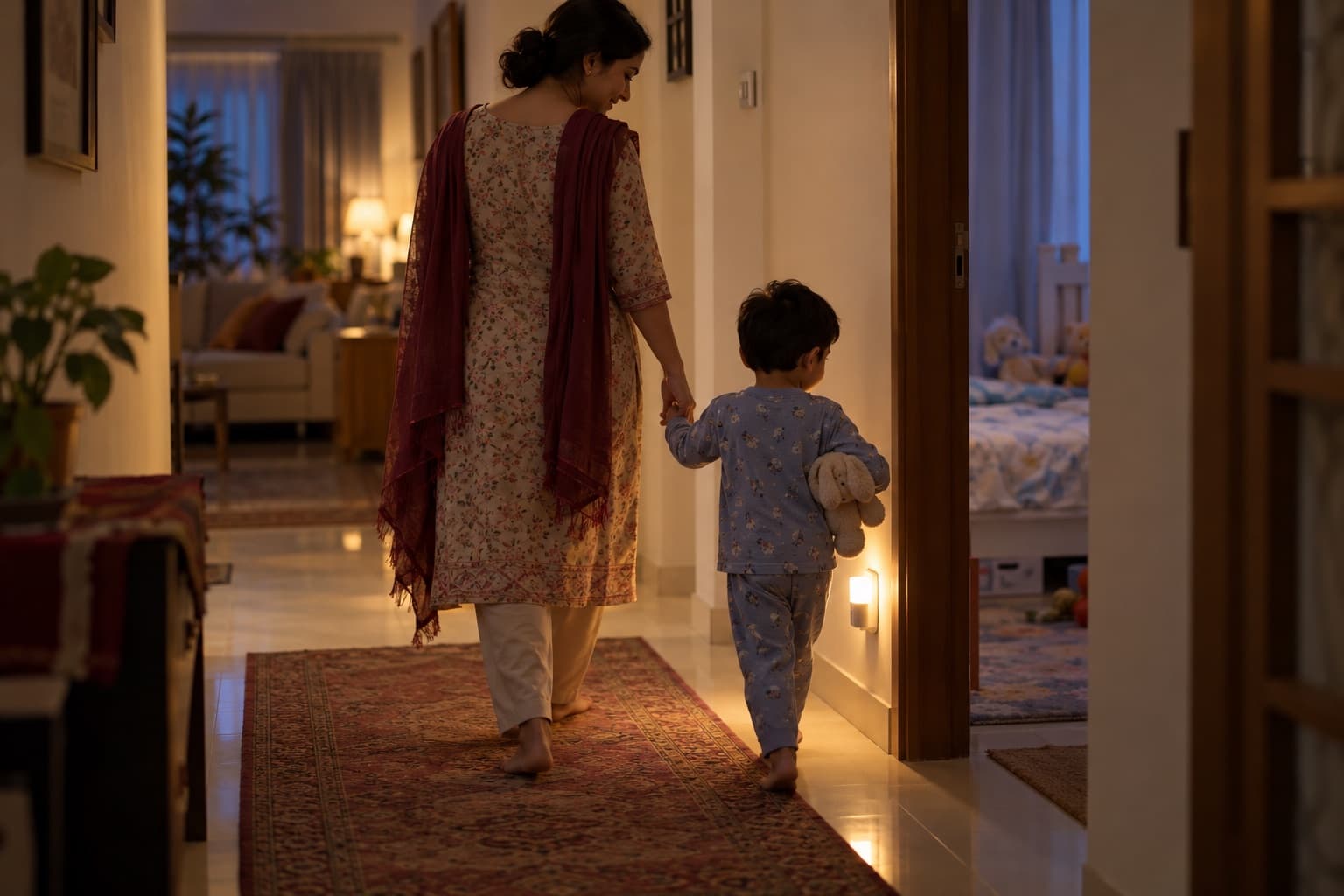
- Leave a dim, warm night light on, or the door ajar with the corridor light on. Avoid bright white or blue light.
- Give them something to hold: a comfort toy, or a small, child-safe torch they can switch on themselves.
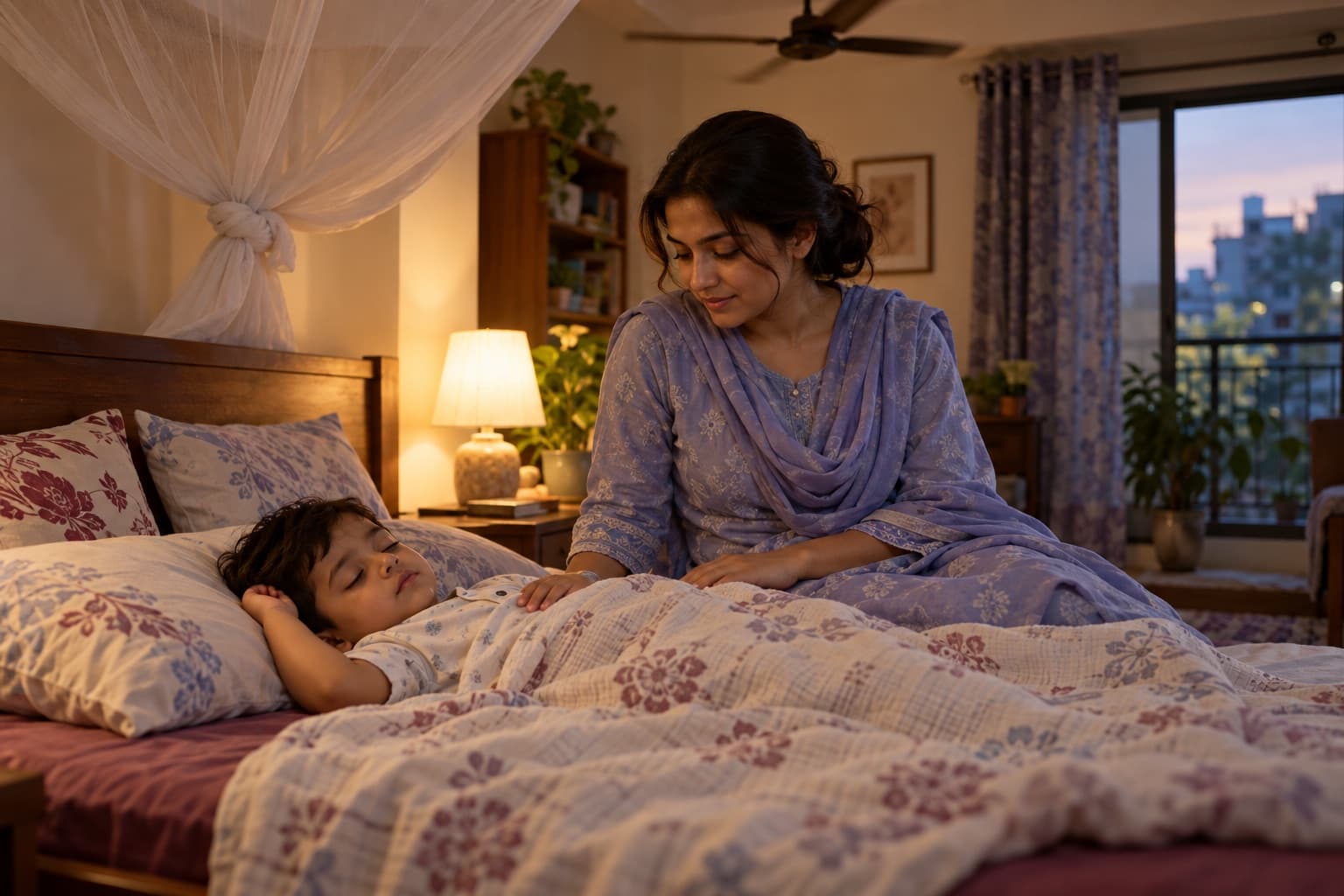
- Use the same short goodnight every night, then check back: 'I'll come and peek at you in five minutes.' Keep the promise, and stretch the gap slowly.
- If they come to your bed in the night, walk them back calmly with few words, as often as it takes. If you share a room, stay close and keep the routine the same.
What you might say
- You're safe. I'm right here, and I'll check on you soon.
- Lots of children feel scared of the dark. It's a feeling, and feelings pass.
- Let's look together with the light on. See, it's your school bag and your chair.
- Ghosts in stories are made up to make the story exciting. In our home, you are safe.
- Your torch is right here. You can switch it on whenever you like.
- You were brave tonight. You stayed in your bed with the night light on.
If the battle is more about not wanting to go to sleep than about fear, see when a toddler won't sleep.
How to help a child with fears: small brave steps
For a child afraid of the dark, avoiding it brings relief tonight, but the fear usually stays or grows, because they never find out they can cope. Facing it in small, planned steps, a 'brave ladder', tends to shrink it. Let your child choose the next step, and praise the effort, not just the result. Naming the feeling helps too; see big feelings in children.
- Play with the dark in the daytime: torch hide-and-seek, shadow animals on the wall, a 'treasure hunt' for a toy in a dim room.
- At bedtime, sit beside the bed with the lights dimmed until they fall asleep.
- Over several nights, move your chair to the middle of the room, then to the doorway.
- Step out and check back at set times: every two minutes at first, then every five.
- Let your child switch off the main light themselves, with the night light on.
- Celebrate each step in the morning: a sticker, a hug, or telling Dadu all about it.
Nightmares in children: what to do when they wake up scared
Nightmares are bad dreams that wake a child up frightened, usually later in the night. They often start between about 3 and 6, and most children have one now and then through the school years. Unlike a night terror, your child is awake, wants you and can often tell you about it; if your child screams but doesn't seem awake, see night terrors in toddlers.
- Go to them quickly, and comfort and reassure: 'It was a dream. You're awake now, and you're safe.'
- Keep the talk short at night: a sip of water, a cuddle, the night light on.
- Talk about it in the daytime if your child wants to. Some children like to draw the dream and give it a new, funny ending.
- Look at the days before: scary videos, late nights, stress or a change at home often sit behind a run of nightmares.
- Protect sleep: an overtired child tends to have more bad dreams, and a calm bedtime routine helps many children sleep more deeply.
In a Bangladeshi home: ghost and jinn stories, scare tactics and power cuts
For a child afraid of the dark in a Bangladeshi home, the fears often have a local flavour. Many Bangladeshi children grow up hearing ghost stories from cousins and grandparents, and for many families belief in jinn is part of their faith. You don't need to argue about belief to help a scared child. Whatever your family believes, a frightened child needs the same things: a calm adult, a safe room and no frightening threats.
- Scare tactics: 'the ghost will catch you', 'the jinn will take you', 'the chheledhora will come' or 'the police will take you' can make a child obey or sleep tonight and leave a fear that lasts for years. Calm, clear limits do the same job without the fear.
- Stories from relatives: grandparents and cousins usually tell them with love, the way they heard them as children. Ask kindly to keep scary stories for the daytime and for older children, and never to use them as a threat.
- Faith at bedtime: if a dua or a few words of prayer are part of your family's night, many children find it a calm, comforting ritual. For questions of belief, families follow their own scholars; this page is about feelings and sleep.
- Power cuts: load-shedding at bedtime can bring a sudden, total dark. Keep a charged lamp or torch by the bed, never a candle, show your child where it is, and practise 'the lights went out' as a game in the daytime.
- Shared beds and rooms: many children sleep beside a parent, grandparent or sibling, and that's fine. The same steps still help: a dim light, the same routine and calm words. If you plan to move a child to their own bed, go slowly, and not during a frightened phase.
- Mocking and comparing: 'A big boy like you, scared?' or 'Your cousin isn't scared' tends to teach children to hide the fear, not to lose it.
A 7-day plan for a braver bedtime
- Day 1: Notice. Write down what your child fears, when it starts, what helps, how long they take to fall asleep, and any scary videos or stories that day. Change nothing yet.
- Day 2: Clear the evening: nothing scary in the last couple of hours before bed, and a kind word with anyone who tells ghost stories.
- Day 3: Set up the room together: the night light, the comfort toy, the torch, one calm room check.
- Day 4: Play one dark game in the daytime, such as torch hide-and-seek or shadow animals.
- Day 5: Choose the first step on the brave ladder together, and start it at bedtime.
- Day 6: Keep the same routine and the same words. Praise every brave try the next morning.
- Day 7: Compare with Day 1: how long it took to fall asleep, how many call-outs, how scared your child felt on a scale they choose. Keep what helped and pick the next step.
When is a child's fear a reason to get help?
Get help if
- Fear stops your child sleeping most nights for more than a few weeks, despite a steady routine.
- Fear spreads into the day: your child won't be alone in any room, avoids school or friends, or panics with a racing heart, shaking or trouble breathing.
- Nightmares come most nights for weeks, or keep replaying something frightening that really happened.
- A new, strong fear starts suddenly, after a frightening event or around one person or place: ask gently, without putting words in their mouth, believe the child, keep them away from that person and act the same day; call 999 if they are in danger now. If your child tells you someone has hurt them, report it to the local police station (thana).
- Your child is awake but seems confused, or sees or hears things that aren't there: call 999 now if this comes with a fever, a stiff neck or unusual drowsiness, or after a fall or a knock to the head. Otherwise, see a doctor the same day.
- The fear is getting in the way of family life, or weeks of broken nights have worn you out; a doctor or counsellor can help you both.
With time, steady routines and patient steps, a child afraid of the dark usually becomes a braver sleeper. ParentMind helps you note what happens each night, such as what came before a hard night and what helped, so patterns are easier to see; see how ParentMind works.
Questions parents ask
At what age are children afraid of the dark?
Fear of the dark usually appears from about 2 or 3, as imagination develops, and is most common in the preschool years. Many children grow out of it by about 8 to 10, though some older children, and plenty of adults, still prefer a little light. It is a normal part of development unless it is extreme or stops ordinary life.
Should I leave a night light on for my child?
Yes, if it helps your child feel safe. A small, dim, warm-coloured light placed low is usually enough and rarely gets in the way of sleep. Avoid bright white or blue light, and keep screens out of the bedroom. Later, many children like to choose a night to try without it, which can be a proud, brave step.
What do I say to a child afraid of ghosts?
Listen first, then answer simply and calmly: 'Ghosts in stories are made up to make the story exciting. You're safe here, and I'm close by.' Don't tease, and don't add details that make the ghost more vivid. Keep scary stories and videos away from bedtime, and ask relatives not to use ghosts as a threat.
Is it okay to scare a child into sleeping or behaving?
It's best avoided. Threats like 'the ghost will come' or 'the police will take you' may work for a night, but they can plant fears that last for years and teach a child that adults' words aren't true. Calm, clear limits work without the fear: 'Lights off now. I'll check on you in five minutes.'
Should I let my scared child sleep in my bed?
Many Bangladeshi families share a bed or room, and that's fine. If your child usually sleeps alone, letting them in on a rough night is a kind choice, but if it becomes every night the fear can grow, because they never learn their own bed is safe. Comfort them, walk them back calmly, and use small brave steps.
Why has my child suddenly become scared of everything?
A sudden rise in fears often follows a change or stress: a new school, a new sibling, illness, a frightening video, tension at home or a scary event. Ask gently what's on their mind and keep routines steady. If the fear started around one person or place, or after something happened, believe the child, act the same day, and call 999 if they are in danger.
This article is general information, not medical advice. For health worries, talk to a doctor; if someone is in danger, contact your local emergency number.