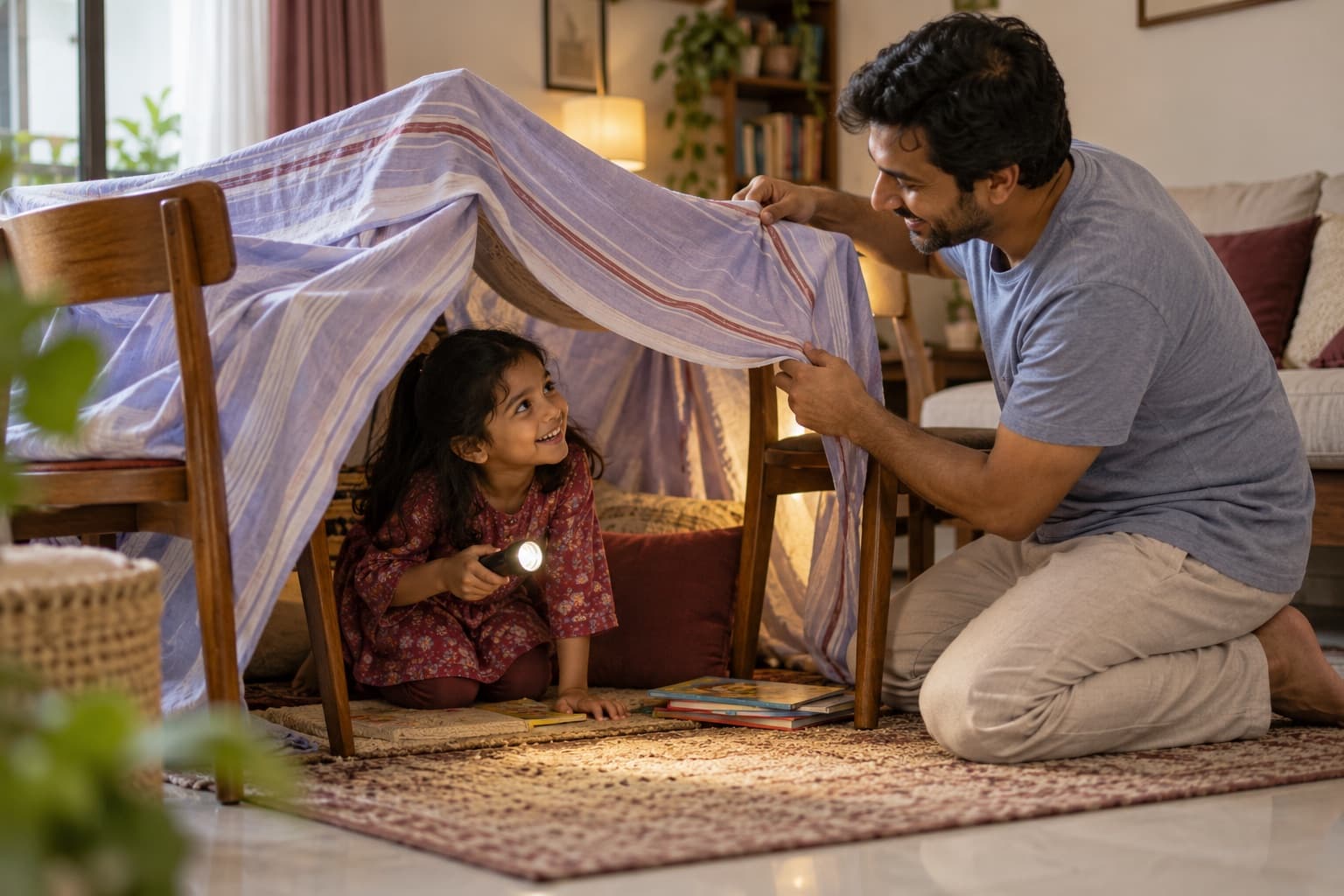
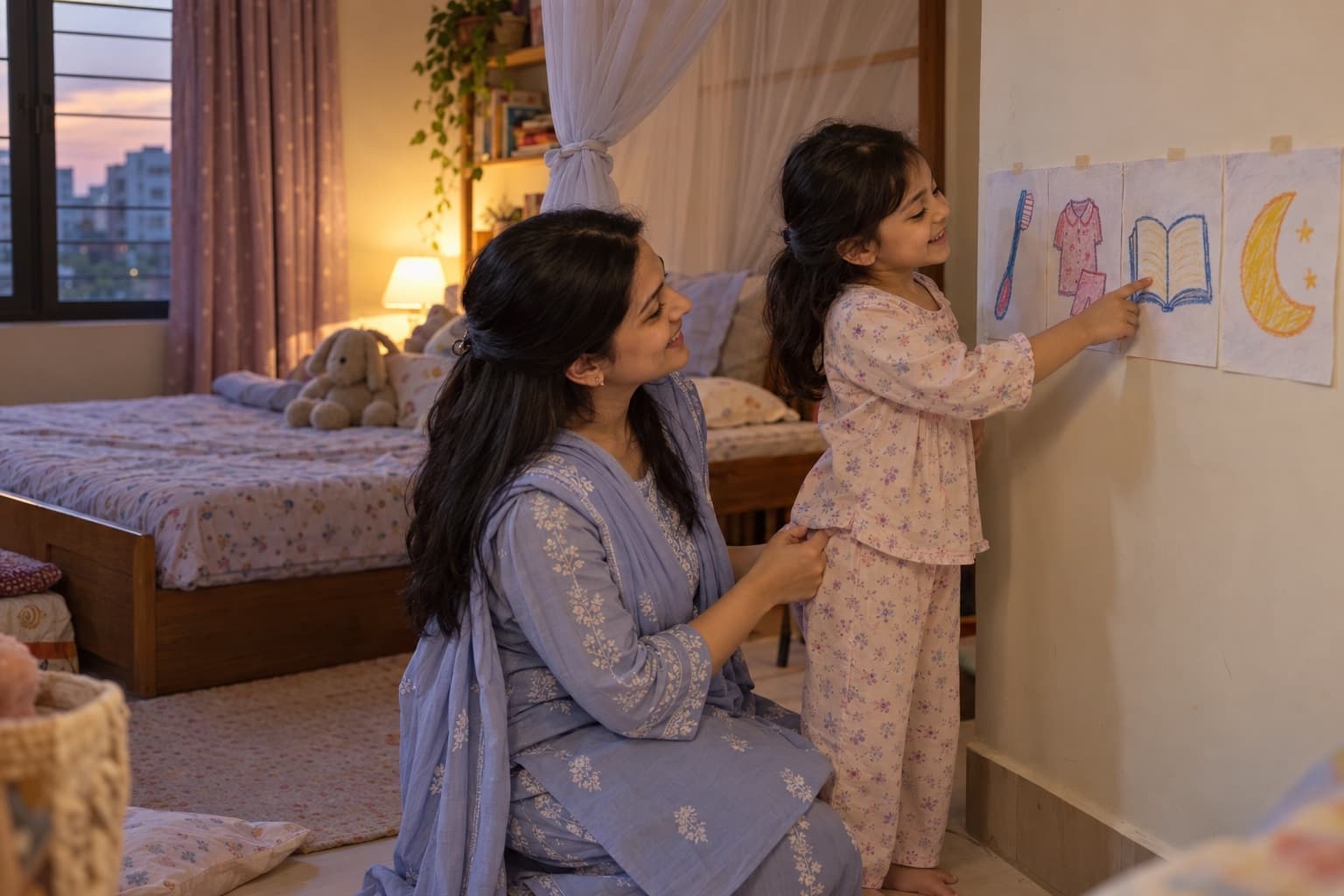
How to get kids to read: a reading habit in Bangla and English
Quick answer
How to get kids to read comes down to pleasure, not pressure: read aloud every day in Bangla and English, let children choose books they enjoy, keep books within reach and let them see you read. Start with 10–15 minutes a day. Ask for an eye and hearing check if reading stays very hard after several months of help.
 By the ParentMind team11 min read
Listen to this article
15 min listen · Read by your device's voice
At a glance
- Who it is for
- Parents of children aged 3–14 who want them to enjoy books, in Bangla, English or both
- Key takeaways
- Reading aloud every day, even after children can read alone, is one of the most helpful things you can do to build a reader.
- Children read more when they choose: comics, cricket, animals and ghost stories all count.
- A low shelf or basket of books, a set daily time and a parent who reads matter more than an expensive collection.
- Keep screens out of the hour before bed, and let a bedtime story fill that time.
If you are wondering how to get kids to read when phones, homework and coaching fill every evening, you are asking one of the most useful questions in parenting. Many children who say they hate reading simply have not found the right book, the right time or the right person to read with.
A reading habit is built in small, warm moments: a story at bedtime, a comic on the sofa, a book bought at the boimela. It rarely comes from being told to read. The good news is that it can start at any age, from 3 to 14.
Below: why some children avoid books, eight steps that build the habit, reading aloud in Bangla and English, books by age, a home book corner and the book fair, phones versus books, a 7-day plan and when to get help.
Why doesn't my child like reading?
A child who doesn't like reading is usually reacting to how reading feels, not to books themselves. Reading for fun can grow vocabulary, imagination and concentration, and it often makes school reading easier too, but only if it feels like a pleasure.
- Books feel like more school: if every book comes with questions, a summary or a moral to learn, reading becomes homework.
- The book is too hard: a child who stumbles on many words on every page soon decides they are bad at reading.
- Screens are easier: videos and games give quick rewards, and a book needs a few quiet minutes to pull a child in.
- No books at hand: if story books live in a locked cupboard or high on a shelf, they are easy to forget.
- No one to copy: children who never see an adult read for pleasure may not see the point.
How to get kids to read: 8 steps that build the habit
- Read aloud every day, at bedtime or after lunch, and keep going after your child can read alone.
- Let them choose. Comics, jokes, cricket, animals, science facts and ghost stories suited to their age all count as reading.
- Keep books within reach: a low shelf or a basket in the room where your child spends time, with covers facing out.
- Read where they can see you: a novel, a newspaper or a book of poems, not only your phone.
- Set a small daily time, about 10–15 minutes at first, at the same point in the day.
- Talk, don't test. Ask 'What do you think happens next?' rather than 'What did you learn?'
- Start easy. Books a little below their level build speed and confidence; harder books can be read together.
- Make books special: visit a library or the boimela, and give books as gifts on birthdays and Eid.
What you might say
- You choose tonight's book.
- What do you think happens next?
- Shall we read a page each? You start.
- I'm reading my book too. Come and sit with me.
- That word is tricky. Let's sound it out together.
- Not enjoying it? That's fine. Let's find one you like.
Reading aloud to kids in Bangla and English
Reading aloud is the heart of how to get kids to read. Children can understand stories well above the level they can read alone, so listening builds the words and love of stories that their own reading grows into.
- Use both languages. Read a Bangla book one night and an English one the next, or tell an English story again in Bangla.
- Give the home language a place. English-medium children often read little Bangla; rhymes, folk tales and Bangla picture books at home keep it alive.
- Make it lively: do the voices, pause before the exciting part, and let your child turn the pages.
- Ask grandparents to tell the stories they grew up with. A grandmother's folk tale counts as much as a printed book.
- Keep reading aloud to older children. A chapter a night of a longer book is something many 9- to 12-year-olds still enjoy.
For how two languages grow together at home, see raising a bilingual child in Bangla and English, and for a calm wind-down with a story, a children's bedtime routine.
Choosing books by age: what to read from 3 to 14
| Age | Books that often work | Reading aloud |
|---|---|---|
| 3–4 years | Board books and picture books, rhymes, books about animals, family and everyday life | Every day; let them point, name and turn the pages |
| 5–6 years | Picture books with more story, alphabet and rhyming books, simple first readers in Bangla and English | Every day; let them read a word or a line |
| 7–8 years | Short chapter books with pictures, funny stories, comics, simple books about space, animals or the body | Most days; take turns, a page each |
| 9–11 years | Longer stories, adventure and mystery, folk tales and myths, science and nature books, graphic novels | A few times a week; a chapter at bedtime |
| 12–14 years | Novels, biographies, poetry, and books on their interests, such as cricket, coding, history or cooking | Still welcome; read the same book and talk about it |
A home book corner, libraries and the boimela
- A book corner: a mat or cushion, good daylight or a lamp, and a low shelf or basket. A rechargeable lamp keeps it usable during load-shedding.
- Rotate books: put a few away and bring them back a month later, and they feel new again.
- Libraries: school libraries, neighbourhood libraries and reading rooms let a child try many books without buying them.
- The boimela: the February book fair in Dhaka has a children's corner, and many towns hold smaller fairs. Let your child choose a book or two with their own small budget.
- Second-hand and swaps: second-hand bookshops and a book swap with cousins or neighbours keep new stories coming at little cost.
- A book in the bag: traffic jams and waiting rooms become reading time when a small book travels with your child.
Phones vs books: how to make room for reading
Phones and books compete for the same quiet minutes, so the habit grows when those minutes are protected. For children aged 2–5, screens are best kept to at most 1 hour a day of good-quality content, ideally watched together. From 6, there is no fixed number, but consistent limits should protect sleep, at least 60 minutes of active play, homework and family time, with no screens in the hour before bed and devices out of the bedroom at night; see screen time by age.
- Let the bedtime story fill the screen-free hour before sleep.
- Keep a book where the phone usually goes: by the bed, on the dining table, in the car.
- Audio stories count as stories, but paper books work best at bedtime because they keep the screen away.
- Reading on a phone easily drifts to other apps; for younger children, paper books are usually easier to stay with.
- Do not use the phone as the reward for reading; it tells a child the phone is the real treat.
For quiet, screen-free ideas that sit well beside a book, see screen-free activities for kids.
Reading in a Bangladeshi home: story books, textbooks and 'out-books'
Many Bangladeshi parents and grandparents grew up hearing that story books, or 'out-books', distract from real study. Reading outside the syllabus usually helps rather than harms schoolwork, because a child who reads for fun often reads faster and understands more.
- Talk to elders kindly: 'Story books help with reading for exams too.' Invite them to read or tell a story themselves.
- Keep 10 minutes in exam season. A short story at bedtime can calm a child before a test rather than steal study time.
- After coaching, a light book is a better wind-down than a phone, even for five minutes.
- Friday family time can include a trip to a bookshop or library, or a family reading hour after lunch.
- Small flats and shared rooms: a basket of books in the corner of a shared bedroom works as well as a whole bookcase.
In a busy Bangladeshi home, how to get kids to read often comes down to one protected slot a day. If study itself is the battle, how to motivate your child to study covers that side.
A 7-day plan to start a reading habit
Write one line each day: what was read, for how long, who chose it and how your child seemed.
- Day 1: gather 10 books your child can reach, including comics and books in both languages.
- Day 2: choose a daily reading time, such as straight after dinner or in bed before lights out.
- Day 3: read aloud for 10–15 minutes and let your child pick the book.
- Day 4: read your own book beside your child for a few minutes, with phones away.
- Day 5: read a story in the other language, or ask a grandparent to tell one.
- Day 6: visit a library or bookshop, or swap books with a cousin.
- Day 7: compare with Day 1. Did your child ask for a story or pick up a book alone? Keep the time slot and add one new book next week.
When is trouble with reading a reason to get help?
Reading develops at very different speeds, and children learning Bangla and English at once may take longer in one script. These signs are worth raising with the teacher and a doctor.
Talk to the teacher or a doctor if
- Letters and sounds are still very hard after several months of steady help, or reading stays well behind classmates in both languages.
- Your child squints, holds books very close, rubs their eyes or gets headaches after reading: ask for an eye test.
- Your child often doesn't respond when called, mishears words or speaks much less clearly than others their age: ask for a hearing check.
- Reading brings tears, stomach aches or refusal to go to school most weeks, for a few weeks in a row.
- Your child calls themselves stupid most days, or seems low for two weeks or more.
A reading habit grows a few minutes at a time, and it is easy to forget how far your child has come. ParentMind helps you note what happens each day, see patterns and get guidance: how ParentMind works.
Questions parents ask
At what age should a child start reading books?
You can share books from babyhood: pointing at pictures and hearing rhymes count. Many children start reading simple words at about 5 to 7, but reading develops at very different speeds, especially in two languages. Keep reading aloud whatever the age, and let your child read alone at their own pace.
How many minutes a day should my child read?
There is no fixed number. About 10–15 minutes a day of reading for fun is a good start for younger children, and many older children happily read for longer once the habit is set. A short, regular time works better than a long session once a week, and reading aloud together counts.
My child doesn't like reading. What should I do?
Find out what is in the way: books that are too hard, no time without screens, or reading that feels like a test. Let your child choose books on their own interests, including comics and fact books, read aloud together, and keep sessions short and pleasant. Drop the questions afterwards. Most reluctant readers warm up when reading stops feeling like homework.
Should I keep reading aloud once my child can read alone?
Yes. Children can understand stories well above the level they can read themselves, so reading aloud keeps building words and a love of stories. It is also a close, calm time together. Many 9- to 12-year-olds still enjoy a chapter at bedtime, and taking turns, a page each, works well for children who are still building speed.
Is reading on a phone or tablet as good as a book?
It can be, for an older child reading a real book on a screen, but phones make it easy to drift to games and videos. Paper books are usually easier for younger children to stay with, and they keep screens out of the hour before bed. Audio stories count too, as long as they do not replace reading together.
Should my child read in Bangla or English first?
Both can grow together. Many families read stories in the language they speak most at home and follow the school for the language of first reading lessons. Reading aloud in Bangla keeps the home language strong, even for English-medium children, and reading for fun in English helps Bangla-medium children feel at ease with it.
This article is general information, not medical advice. For health worries, talk to a doctor; if someone is in danger, contact your local emergency number.