Screen-free activities for kids: 50 easy ideas for a small flat
Quick answer
Screen-free activities for kids at home can be simple: drawing, building with cushions or boxes, pretend cooking, ludo and carrom, dancing, helping in the kitchen, and stories by torchlight when the power goes. Choose ideas that fit your child's age and your space, keep a basket ready before screen time ends, and let a little boredom spark play.
 By the ParentMind team12 min read
Listen to this article
16 min listen · Read by your device's voice
At a glance
- Who it is for
- Parents of children aged 2–12 in flats with little space, on rainy days or during load-shedding
- Key takeaways
- Plan the swap before the screen goes off: a ready basket of simple things works better than a list in your head.
- Most of the best ideas cost nothing: cushions, pots, boxes, paper, a ball and your time.
- Safety first: water only in a shallow basin with an adult right beside, rooftops only with high walls and an adult, and small parts away from under-3s.
- A little boredom is fine; children often find their best play after a few restless minutes.
Screen-free activities for kids are what you need at five o'clock on a rainy afternoon, when the power has gone and your child has already asked for the phone three times. You don't need a garden, a craft shop or endless energy. A small flat and a few ordinary things are enough.
Below are 50 ideas sorted by age, with what you need and where they work, plus ideas for rainy days, load-shedding evenings and quiet time. There is also a way to bring grandparents and house help on board, so the phone isn't the only answer when you're busy.
How to make screen-free time work in a small flat
A list of ideas only helps if the first step is easy. These habits make screen-free time more likely on a busy day:
- Make a play basket for the hardest time of day, such as while you cook or after school.
- Plan the swap before the screen ends, so the next thing is ready the moment it goes off.
- Start with your child for five minutes, then step back and let them carry on.
- Rotate toys: put half away and swap them each week, so old things feel new.
- Allow some mess in one place: an old bedsheet or mat on the floor marks the play spot.
- Keep the same screen-free times each day, such as after school, before dinner and the hour before bed.
What you might say
- The phone is resting now. Let's choose something from the basket.
- You choose: drawing or building?
- I'll start with you, then I need to cook. Call me to see what you've made.
- Bored is okay. Bored is when ideas come.
Screen-free activities for kids aged 2–4
Toddlers and young preschoolers like to fill, empty, bang, climb and copy you. Stay within sight, and keep anything small enough to fit through a toilet-roll tube away from children under 3, because they still put things in their mouths. For more on playing with this age, see toddler play at home.
| Idea | You need | Where |
|---|---|---|
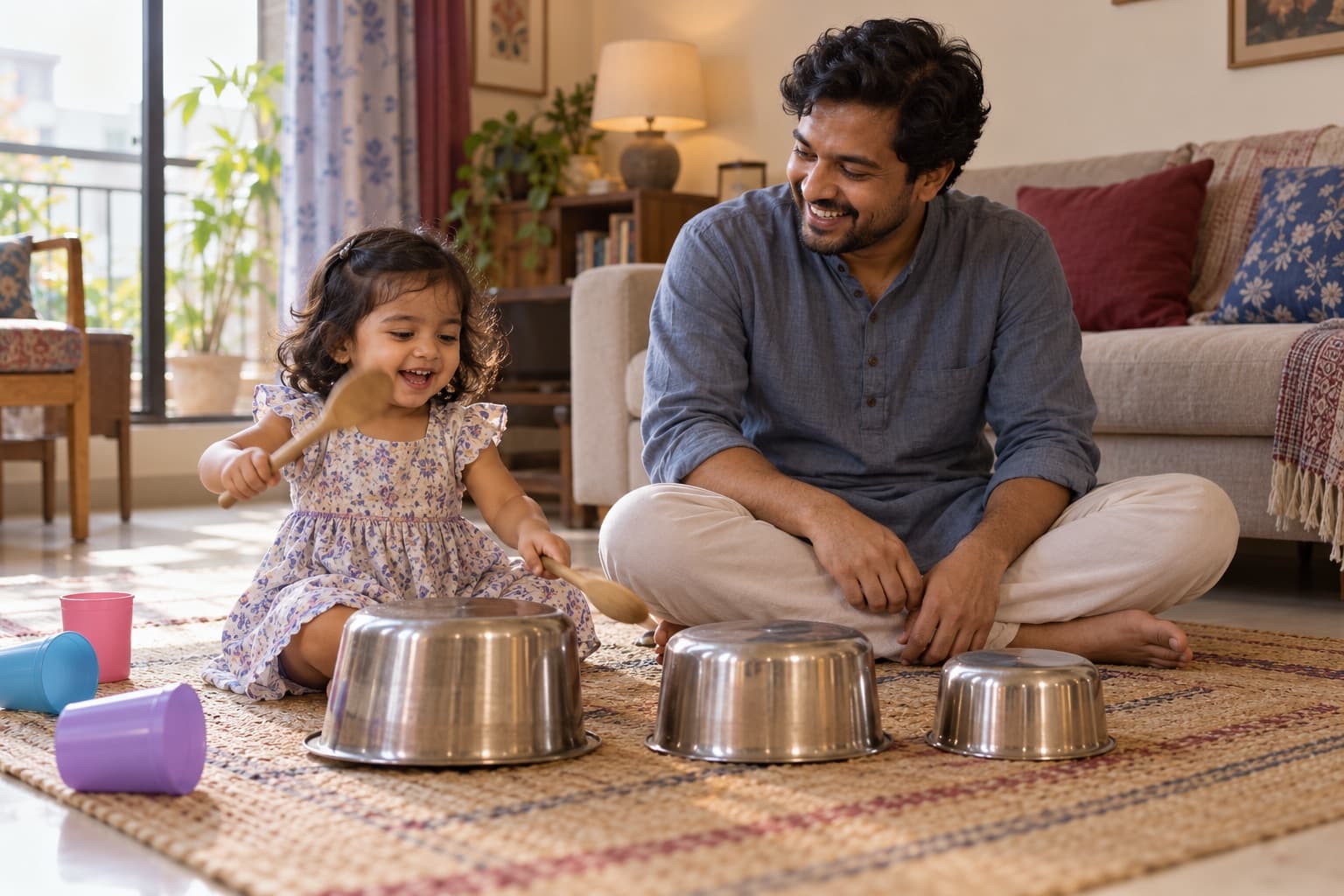
| Pots-and-spoons band | Steel pots, lids and a wooden spoon | Kitchen floor, near you |
| Water pouring | A shallow basin with a little water and plastic cups; an adult right beside, never a bucket | Indoors on a towel, with you |
| Atta dough | Flour and water with a drop of oil, to roll and squash | Table or mat |
| Posting box | A shoebox with a slot, and old cards or cardboard squares to post | Floor |
| Cushion mountain | Sofa cushions on the floor to climb and roll on | Living room |
| Sock matching | A pile of clean socks to pair by colour | Bed or floor |
| Peekaboo and hide-the-toy | An orna or scarf and a favourite toy | Anywhere |
| Little helper | Washing potatoes in a bowl, wiping the table, carrying spoons | Kitchen, with you, away from the stove |
| Big drawing | Crayons on old newspaper or the back of a calendar | Floor |
| Rhymes with actions | Bangla and English rhymes, with clapping | Anywhere |
| Picture-book hunt | A picture book and “Where is the cat?” | Bed or mat |
| Ball rolling | A soft ball rolled to the end and back | Corridor |
| Box car | A big cardboard box to sit in and be pushed | Floor |
| Stacking cups | Plastic cups or small steel bowls to stack and knock down | Floor |
Screen-free activities for kids aged 5–8
From about 5, children enjoy rules, pretend worlds and real jobs. Many of these work for two children of different ages, with the older one in charge.
| Idea | You need | Where |
|---|---|---|
| Draw your day, then tell it | Paper, pencils and crayons | Table |
| Ludo, snakes and ladders | A board and dice | Floor or table |
| Bedsheet tent | A bedsheet over two chairs, with a torch and books inside | Living room |
| Treasure hunt | Picture clues for non-readers, word clues for readers | The whole flat |
| Shop game | Old packets, paper money and a toy scale | A corner of a room |
| Paper boats and planes | Old newspaper or exercise-book pages | Indoors |
| Simple cooking | Fruit chaat, buttering bread, rolling a roti | Kitchen, with you |
| Hopscotch (kutkut) | Masking tape on the floor, or chalk on the roof | Corridor, or a rooftop with high, safe walls and an adult |
| Statue dance | Songs you sing together; everyone freezes when the singing stops | Living room |
| Kanamachi (blind man's buff) | A soft blindfold and a cleared room, with an adult watching | A cleared living room |
| Box building | Cardboard boxes and tape; scissors only with you | Floor |
| Real jobs | Folding clothes, laying the table, watering plants | Around the flat |
| Shadow puppets | A torch, your hands and a bare wall | Any room, in the evening |
| Homemade jigsaw | An old calendar picture cut into big pieces | Table |
Screen-free activities for kids aged 9–12
Older children want challenge, skill and a bit of independence. Ideas that feel grown-up, with real tools and real results, compete best with a screen.
| Idea | You need | Where |
|---|---|---|
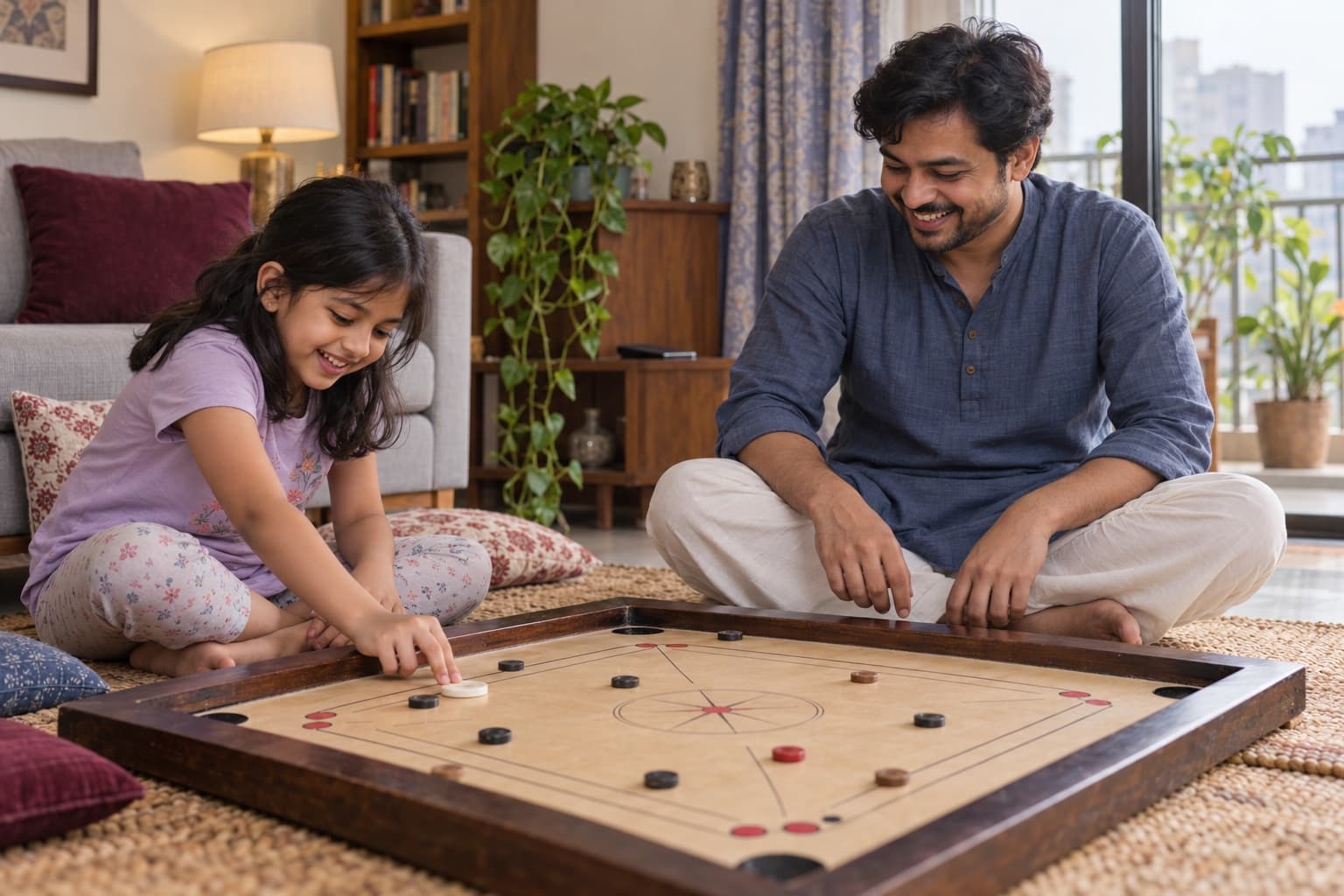
| Carrom or chess tournament | Boards and a family score sheet | Living room |
| Badminton, football or skipping | Badminton bats, a ball or a rope | A rooftop with high, safe walls, with an adult up there too |
| Cook a dish from start to finish | Egg bhaji, a sandwich or lemon sherbet | Kitchen, with an adult nearby |
| A book series or comics | Books from school, relatives or a library | A reading corner |
| Make a comic or a family newspaper | Paper, pens and a stapler | Table |
| Balcony garden | Pots of chilli, mint or coriander to water each day | Balcony |
| Learn a craft | Origami paper, wool for knitting, or embroidery thread | Anywhere |
| Kitchen science | What floats and what sinks, a paper bridge, a straw rocket | Table |
| Cardboard ball run | Empty toilet-roll tubes, tape and a ping-pong ball | A wall or a door |
| Bazar planner | Write the list and add up the prices with you | Table |
| Teach a younger sibling or cousin | Any game or rhyme they know well | Anywhere |
| Family quiz night | Questions written by your child | Living room |
Rainy days and load-shedding evenings: ideas with no power
When the power and the Wi-Fi go, the evening can still be the best part of the day. Use a torch or a rechargeable lamp rather than candles where small children play, and keep the rooftop for dry days.
- Stories by torchlight: take turns adding one line each to a made-up story.
- Riddles and tongue-twisters, especially the ones grandparents grew up with.
- Antakshari: one person sings a line, and the next starts a new song with its last letter (ages 7 and up).
- Name-place-animal-thing for children who can write: pick a letter and race to fill every column.
- Paper hand fans for a hot evening: fold them, decorate them and test them on the whole family.
- Paper boats in the rain: watch the rain from a window, then float the boats in a shallow basin, with an adult right beside younger children.
Quiet activities for toddlers and tired afternoons
Sometimes you need twenty quiet minutes more than a game. Quiet play still happens within sight: never leave a young child alone, or alone with a baby.
- A quiet basket used only at quiet time: board books, a soft toy, a small notebook and crayons.
- Threading big pasta tubes or empty cotton reels onto a shoelace, for children over 3 who no longer put things in their mouths.
- Sound hunt: lie down together and name every sound you can hear, from the pressure cooker to the crows.
- A sorting tray of big lids, spoons and blocks to sort by colour or size.
In a Bangladeshi home: grandparents, house help, rooftops and siblings
In many Bangladeshi homes several adults look after a child, and space is tight. A few small agreements make screen-free time easier for everyone:
- Grandparents are often the best playmates. Ask them to teach the games and rhymes of their own childhood, like kanamachi, ludo and old riddles.
- House help who mind a child while cooking need easy options. Give them the play basket and a short list of three activities, and agree when the phone may and may not come out.
- Rooftops: only with high, solid walls and an adult up there too, and never in rain or storms. If you can, keep the roof door locked when it isn't in use.
- Balconies are not play spaces for young children. Keep chairs, stools and boxes away from the railing or grille, so nothing becomes a step to climb.
- Siblings of different ages: give the older one a role, such as shopkeeper, referee or teacher, and choose games with no small parts when a toddler is around.
- Ramadan afternoons: children can help set up iftar by squeezing lemons for sherbet, arranging dates and laying out plates.
- Fridays: one screen-free outing or game each week, chosen together, gives everyone something to look forward to.
A 7-day plan for more screen-free time
Pick one change, note what happens each day and compare after a week. For how much screen time suits each age, see screen time by age.
- Day 1: Note when your child asks for a screen and what is going on: bored, tired, waiting or hungry.
- Day 2: Make a play basket for the hardest time of day, with four or five things from the tables above.
- Day 3: Tell everyone who looks after your child about the plan, and show them the basket.
- Day 4: Start. Offer the swap before the screen ends, and play together for the first five minutes.
- Day 5: Add one active idea: a dance, the cushion mountain or the rooftop with an adult.
- Day 6: Let a grandparent, an older sibling or your house help lead one activity.
- Day 7: Look back. Which ideas lasted longest? Were there fewer requests for the phone? Swap the basket and keep going.
When is it more than boredom? Signs to get help
Most children who cry for the phone simply need time and a steady routine. Talk to your child's doctor if you notice any of the first three, and act at once on the last two:
When to get help
- For weeks, your child shows no interest in any play, people or food, only screens, or seems low most days.
- Outbursts when screens end are long or violent most days, despite a steady routine; see screen addiction in kids.
- A toddler rarely plays with you, rarely responds to their name, or has very few words: ask for a development check, whatever their screen time.
- Your child is choking and can't breathe, cough or cry: call 999 and start choking first aid if you know it.
- After a fall from a height or a hard knock to the head, call 999 if your child is drowsy, vomits or isn't acting like themselves.
ParentMind helps you note what happens each day, such as screen time, play and mood, and see the pattern after a week. See how ParentMind works.
Questions parents ask
What can I do with a bored child without a phone?
Offer two choices rather than a list: “Drawing or building?” Keep a basket of simple things ready, start with your child for a few minutes, then step back. It's fine to let boredom sit for a while; many children invent their own game within minutes once they know the phone isn't coming.
How do I keep my toddler busy while I cook?
Give your toddler a low cupboard or basket of safe pots, lids and spoons, in sight of the kitchen but away from the stove, or a little job like washing potatoes in a bowl. Talk to them as you cook. Keep knives, hot pans and the gas out of reach, and never leave a young child alone in the kitchen.
What can kids do during load-shedding?
Turn the dark into the game: stories by torchlight, shadow puppets on the wall, riddles, antakshari for older children, or name-place-animal-thing for those who can write. Use a torch or a rechargeable lamp rather than candles near small children, and keep a small box of these things ready for the next power cut.
Is it okay for children to be bored?
Yes, a little boredom is normal and often useful. It gives children the push to invent, explore and play on their own, and it builds patience. You don't need to fill every minute. The aim is a day with some free time in it, not one where a screen fills every gap.
What are good indoor activities for kids in a small apartment?
Choose games that move the body in a small space: a cushion obstacle course, statue dance, hopscotch on masking tape, bowling with plastic bottles and a soft ball down the corridor, or climbing the stairs together. Mix them with calm ones like drawing, building and board games, so energy has somewhere to go.
How much screen-free time should children have?
Most of the day. Child-health guidance suggests no screens under 18 months except video calls with family, and at most 1 hour a day of good-quality content from 2 to 5. Children aged 3–4 need at least 180 minutes of activity a day and, from 5, at least 60 minutes of moderate-to-vigorous activity, plus screen-free meals and a screen-free hour before bed.
This article is general information, not medical advice. For health worries, talk to a doctor; if someone is in danger, contact your local emergency number.