Toddler play at home: simple games and homemade toys for ages 1–6
Quick answer
Toddler play at home needs no special toys: pots, boxes, cushions, water in a shallow basin with you beside, and your attention. Follow your child's lead for 10–15 minutes at a time, a few times a day, describe what they do, and let them repeat. Keep anything that fits inside a toilet-roll tube away from under-3s.
 By the ParentMind team11 min read
Listen to this article
15 min listen · Read by your device's voice
At a glance
- Who it is for
- Parents of children aged 1–6 who want simple ways to play at home
- Key takeaways
- Play is how young children practise moving, talking, thinking and getting along; short spells of your full attention matter more than toys.
- Follow your child's lead: watch, copy, describe what they do and wait, rather than quizzing them.
- Pots, boxes, cushions, old clothes and paper make some of the best toys; keep small parts away from under-3s.
- Play in whichever language you speak most warmly, Bangla, English or both; rhymes and songs count.
Toddler play can feel like one more job at the end of a long day, or you might not be sure how to play with a 2-year-old at all. Many parents feel this way, especially if no one sat on the floor and played with them as children. The good news: young children don't need you to be fun or creative. They need you to be there.
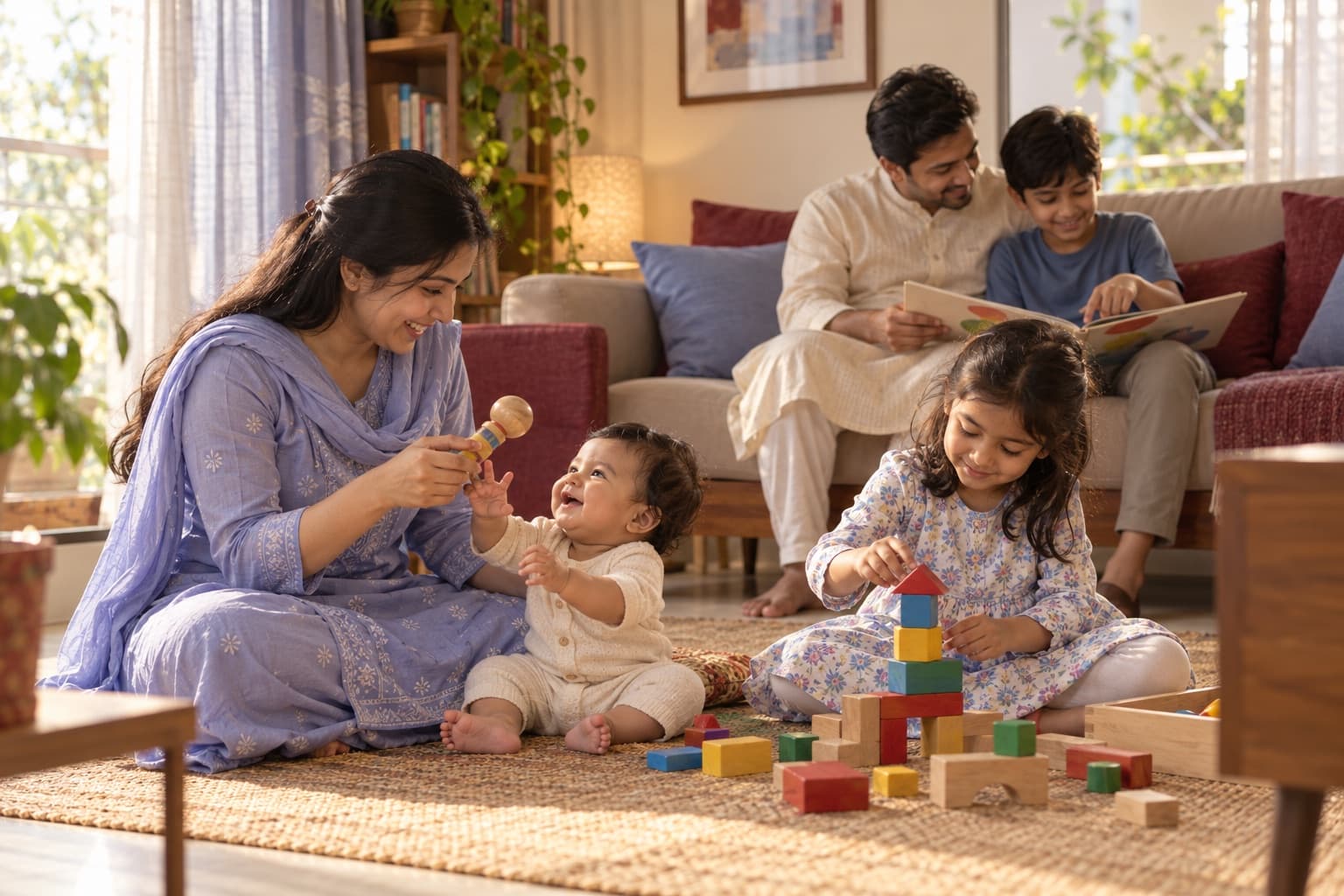
A few minutes of play, a few times a day, with pots, boxes and your full attention, can do a great deal. This page covers why play matters, toddler play by age, how to follow your child's lead, toys from household things, playing in Bangla and English, safety, and how long to play.
Why does play matter so much for young children?
Play is how young children learn: it's their work, not a break from it. Learning through play happens in every area at once:
- Body: climbing cushions, pouring water and stacking cups build balance and careful hands.
- Words: naming things as you play gives a child many chances to hear words and try them.
- Thinking: dropping a spoon again and again is an experiment in cause and effect.
- Feelings: pretend play lets children practise being brave, gentle or cross in a safe way.
- Getting along: taking turns, sharing a ball and losing a game are skills learned slowly, through practice.
Child-development experts often describe play as the engine of early learning. For what to expect at each stage, see child development by age.
Toddler play by age: games for 1 to 6 years
Children move through these stages at their own pace, so treat the ages as rough. Choose games from your child's row and the one before; repeating easy games builds confidence.
| Age | What they are learning | Games to try |
|---|---|---|
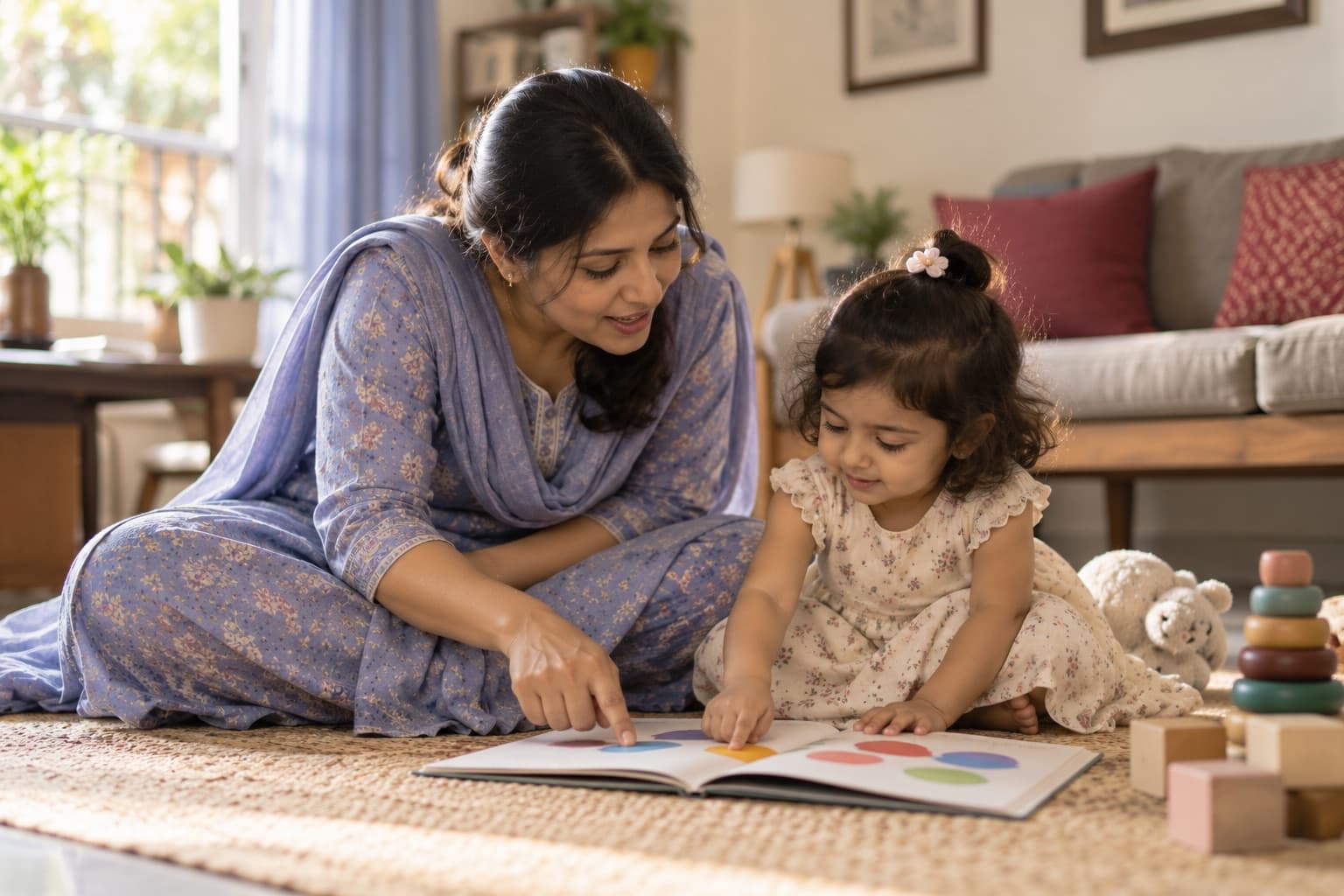
| 1–2 years | Walking, filling and emptying, first words, and that hidden things still exist | Peekaboo, pots and spoons, rolling a ball, stacking cups, a box of things to take out and put back, picture books |
| 2–3 years | Running, climbing, copying adults, joining words | Pretend cooking (rannabati), sweeping with a small broom, sorting by colour, simple puzzles, action songs, pouring water in a shallow basin with you beside |
| 3–4 years | Pretend play with stories, drawing, jumping, first turn-taking | Doctor or shop with a teddy, a cushion obstacle course, atta dough, drawing, hide and seek in the flat (never inside a trunk or a cupboard) |
| 4–6 years | Rules, counting, longer stories, friendships | Ludo and snakes and ladders, hopscotch on tape, a treasure hunt, building with boxes, cutting with child scissors, making up stories together |
How to play with your toddler: follow their lead
If you're not sure how to play, you're not alone. The simplest way is to let your child lead for ten minutes while you join in:
- Put your phone away and get down to your child's level, on the floor or a mat.
- Watch for a minute. What is your child interested in right now?
- Join in by copying: if they bang a pot, bang one too.
- Describe what they are doing, like a friendly commentator: “You put the spoon in. Bang, bang!”
- Wait. Pause for a few seconds so your child can answer, choose or show you something.
- Add one small new idea, such as a tower to knock down, then follow again.
- Let them repeat the same game many times; repetition is how young children learn.
- Warn before it ends: “Two more times, then we wash hands for lunch.”
What you might say while you play
- You're building a tall tower! Up, up, up.
- Uh-oh, it fell! Again?
- Is teddy hungry? What is he eating today?
- Your turn, then my turn.
- Where did the ball go? There it is!
DIY toys with household items: homemade toys that cost nothing
The best toys for young children are often open-ended: things that can be a drum today and a hat tomorrow. Look around your kitchen and cupboards:
- Steel pots, lids and a wooden spoon: a drum set, or a kitchen for pretend cooking.
- A big cardboard box: a car, a house or a boat; cut a door and a window.
- A shaker: an empty plastic bottle with a little rice inside, the lid glued and taped shut. Check it each time, and throw it away if it cracks.
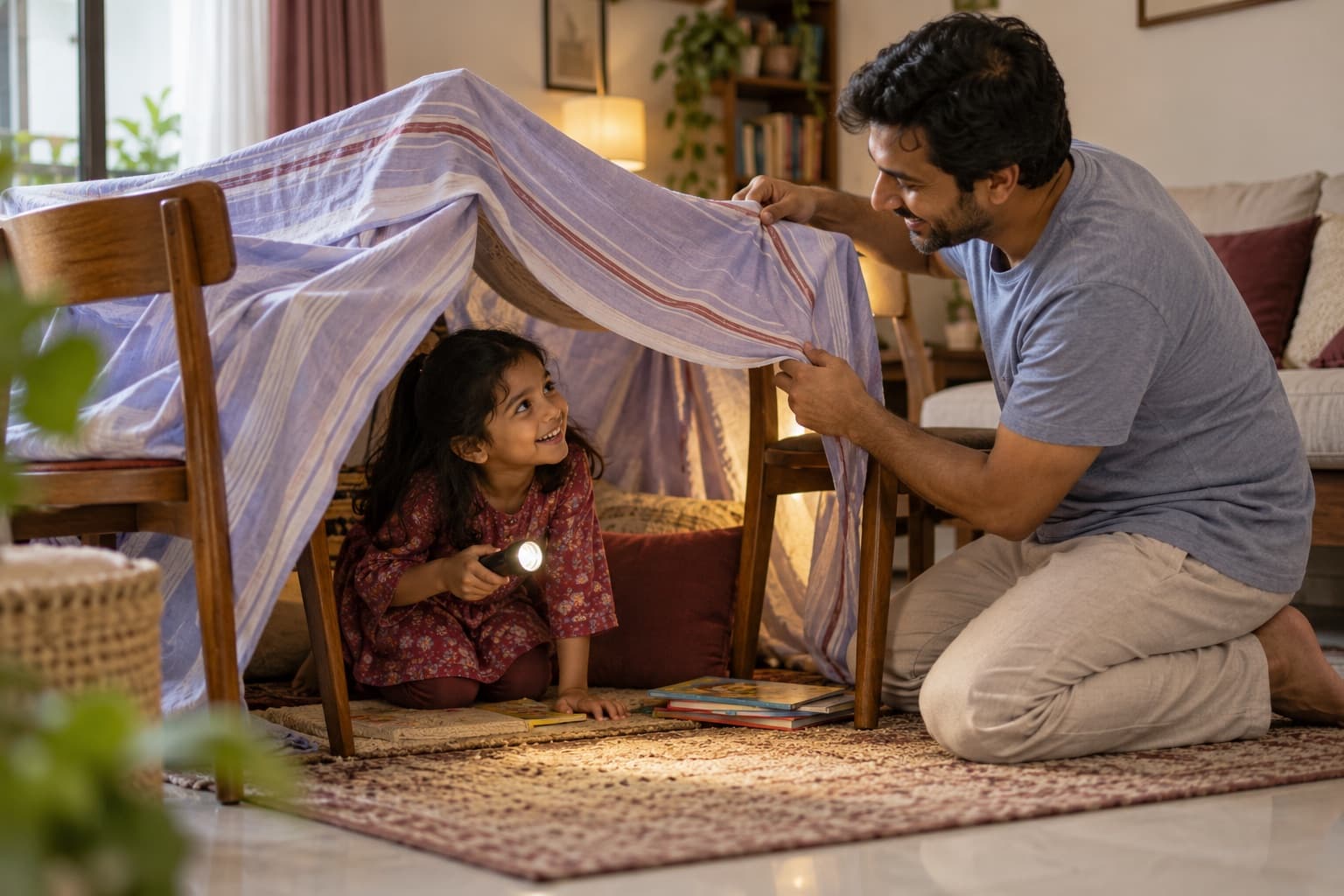
- An old orna or bedsheet: peekaboo, or a tent over two chairs.
- Toilet-roll tubes: binoculars, or a tunnel to roll a ball through.
- Plastic cups and small steel bowls: towers to build and knock down.
- A dress-up bag: old kurtas, hats, bags and scarves, with nothing tied around the neck.
- Paper: crumpled into balls to throw into a basket, or folded into boats.
- Atta dough: flour and water with a drop of oil, for rolling, squashing and making rotis for teddy.
- Plastic bottles as skittles, knocked down with a soft ball in the corridor.
In a Bangladeshi home: Bangla, English and many playmates
Bangla, English or both?
Play in the language you speak most warmly. Many Bangladeshi children hear Bangla at home, English from cartoons or school preparation, and a dialect from grandparents; two or more languages don't cause late talking. Naming things in both languages is fine, but don't turn play into an English vocabulary test.
Grandparents' games and rhymes
Grandparents often know games and rhymes that need nothing at all: clapping rhymes such as “Ay ay chandmama” or “Agdum bagdum”, finger games, lullabies and stories from their own childhood. Ask them to teach these; they keep a family's words alive and give children patient playmates.
When house help mind your child
If house help look after your child for long hours, show them two or three easy games and the toy basket, and ask them to talk and sing as they work. Cooking while minding a toddler is hard for anyone, so a ready basket helps more than instructions.
Small flats and shared rooms
A corner with a mat can be the play spot, rolled away at night. Corridors are good for rolling balls, and climbing the stairs slowly, hand in hand, counts as active play. For older siblings and rainy days, see screen-free activities for kids.
Is it safe? Small parts, choking and other play safety
Young children explore with their mouths and climb before they understand danger. A few rules keep play safer:
- Small parts: if it fits inside a toilet-roll tube, keep it away from children under 3. That includes coins, bottle caps, beads, marbles, buttons, dried beans and pen lids.
- Button batteries and magnets: keep remotes, watches and musical cards out of reach, with battery covers screwed shut.
- Balloons: burst or uninflated pieces can choke a small child, so pick up the pieces at once.
- Water: only a shallow basin with an adult right beside, never a bucket, and empty it straight after.
- Cords and bags: no long strings or ribbons on toys, curtain cords tied up high, and plastic bags out of reach.
- Climbing: cushions on the floor rather than the edge of the bed, and chairs and stools away from windows, balcony railings and grilles.
- Supervision: never leave a young child alone, or alone with a baby.
If your child is choking and can't breathe, cough or cry, call 999 and start choking first aid if you know it.
How long should you play with your child each day?
There is no exact number, and toddler play works best in short, frequent spells. Many families aim for a few spells of 10–15 minutes of full attention through the day, plus plenty of time when the child plays nearby on their own. A 1-year-old may stay with one thing for only a minute or two; by 5, many children play at something they love for much longer.
Active play matters too: children aged 3–4 need at least 180 minutes of activity a day, spread out, and from 5, at least 60 minutes of moderate-to-vigorous activity. Screen time is separate: none under 18 months except video calls with family, only good-quality content with an adult at 18–24 months, and at most 1 hour a day from 2 to 5; see screen time by age.
A 7-day play plan
Add one small change each day, note what your child enjoyed and how long it lasted, and compare after a week.
- Day 1: Watch your child play for ten minutes. Note what they reach for first.
- Day 2: Ten minutes of following their lead, with your phone in another room.
- Day 3: Make one homemade toy together, such as a box car or a shaker.
- Day 4: Sing one rhyme in Bangla and one in English, with actions.
- Day 5: Invite a grandparent or an older sibling to lead a game.
- Day 6: Set up a play corner, and put half the toys away for next week.
- Day 7: Look back. Which game lasted longest? Did you notice new words or skills? Keep what worked.
When to get help: play and development signs to check
Children develop at different speeds, and most differences are normal. Talk to your child's doctor if you notice any of the first three; the last two are emergencies:
When to get help
- Play worries: little interest in people or in playing with others, rarely points to show you things, or doesn't respond to their name.
- Your child loses skills they had, such as words, walking or play, at any age: talk to a doctor soon, and the same day if it happens suddenly.
- Hearing or sight worries: your child often seems not to hear you, or holds things very close to see them.
- Choking: if your child can't breathe, cough or cry, call 999 and start choking first aid if you know it.
- A swallowed button battery or magnet: go to hospital straight away, even if your child seems well, and call 999 if they have trouble breathing.
ParentMind helps you note what happens each day, such as play, sleep and new words, and see patterns over a week or two. See how ParentMind works.
Questions parents ask
What games can I play with my 2 year old?
Two-year-olds love games that copy real life and let them move: pretend cooking with small pots, sweeping with a little broom, pouring water in a shallow basin with you right beside, rolling a ball, stacking cups, sorting socks by colour and action songs. Keep games short, repeat favourites, and follow your child's lead rather than steering.
What if I don't know how to play with my child?
Many parents feel this way, and it's easy to learn. Sit on the floor, put your phone away and copy what your child does. Describe it out loud, wait, and add one small idea. You don't need to be fun or creative; ten minutes of calm attention, a few times a day, is often what young children want most.
Is it okay for my toddler to play alone?
Yes. Short spells of playing alone are healthy and build concentration, as long as you are nearby and the space is safe. Many toddlers manage a few minutes at first, and often longer by 3 or 4. Start by playing together, then step back a little. Stay within sight: never leave a young child alone, or alone with a baby.
What are the best toys for toddlers?
Simple, open-ended things usually beat expensive toys: blocks or cups to stack, a ball, a big box, pots and spoons, picture books, dough, crayons and a few dress-up clothes. They can be used in many ways, so they grow with your child. For under-3s, check that nothing fits inside a toilet-roll tube.
Should I play with my child in Bangla or English?
Either, or both. Use the language you speak most naturally and warmly, because rich, playful talk matters more than which language it is in. Children can learn two or more languages from the start. If English matters for school, add English rhymes and books as part of play, not as drills or tests.
Do toddlers need educational toys or flashcards?
No. Young children learn most from everyday play and conversation: naming things, sorting, counting the stairs and pretend games. Flashcards and drills can make learning feel like a test, and many children lose interest. If your child enjoys a picture-card game, play it lightly and stop while it's still fun.
This article is general information, not medical advice. For health worries, talk to a doctor; if someone is in danger, contact your local emergency number.