Child can't sit still? What's normal and what helps a very active child
Quick answer
If your child can't sit still, they are usually healthy and energetic: lots of movement is normal at 2–7. Children aged 3–4 need at least 180 minutes of activity a day; from 5, at least 60 minutes of moderate-to-vigorous activity. Move first, then sit, in short tasks. Struggles at home and school for many months need a doctor's view.
 By the ParentMind team12 min read
Listen to this article
16 min listen · Read by your device's voice
At a glance
- Who it is for
- Parents of children aged 2–10 who run, climb and wriggle all day, and struggle to sit for meals, stories or homework
- Key takeaways
- Most very active children are healthy: high energy is normal from 2 to about 7, and sitting still is a skill that grows slowly.
- Children aged 3–4 need at least 180 minutes of activity a day, and 5–17-year-olds at least 60 minutes of moderate-to-vigorous activity; very active children often need more.
- Move first, then sit: active play before meals and homework, short tasks and movement breaks often make sitting easier.
- Make the flat safe for a climber: balcony doors locked, furniture away from windows and grilles, and the roof only with an adult.
Your child can't sit still: they run instead of walking, climb the sofa, wriggle through every meal and bounce through homework. Living with that much energy is tiring, and relatives may call your child naughty. The reassuring news is that most very active children are healthy, and lots of movement is normal, especially from 2 to about 7.
Below: what is normal at each age, how much activity children need, what helps day to day, the difference between very active and something more, keeping a climber safe at home, school and coaching, and a 7-day plan.
Why can't my child sit still? What's normal by age
Young children learn through movement, and the self-control needed to sit still grows slowly through the early school years. Here is a rough guide to how long children can usually sit for an adult-led task, such as a meal, a story or homework; most manage longer for something they love.
| Age | What is common | Sitting for an adult-led task |
|---|---|---|
| 2–3 years | Running, climbing everything, little sense of danger, moving from toy to toy | A few minutes at a time |
| 4–5 years | Jumping, spinning, wriggling at meals, interrupting, finding waiting hard | About 5–10 minutes |
| 6–7 years | Fidgeting, rocking on chairs, needing breaks, still very physical in play | About 10–15 minutes |
| 8–10 years | More control at school, energy let out after school, fidgeting while thinking | About 20 minutes |
Energy also rises and falls through the day. An energetic child often gets more wound up, not sleepy, when overtired, so check how much sleep children need. Long sitting at school or coaching, too little outdoor play, excitement, stress or a new baby in the family can all make a child more restless, and a child always moving at the dinner table may simply have had a day of sitting.
How much activity does a very active child need?
Many children who seem unable to sit still simply have not moved enough, so the first answer is often more movement. Child-health guidance sets clear minimums:
- Under 3: plenty of active play spread through the day, such as crawling, walking, climbing and dancing.
- 3–4 years: at least 180 minutes of activity a day, spread across the day, including some energetic play.
- 5–17 years: at least 60 minutes of moderate-to-vigorous activity a day, the kind that makes them breathe harder, such as running, cycling, skipping or football.
These are minimums, and a very active child often needs more. In a flat it adds up from small pieces: a dance before breakfast, stairs climbed together, the roof with an adult in the late afternoon, a park on Friday. How to keep kids active in a small apartment has many more ideas, and toddler play at home suits the youngest.
What to do when your child can't sit still: 7 things that often help
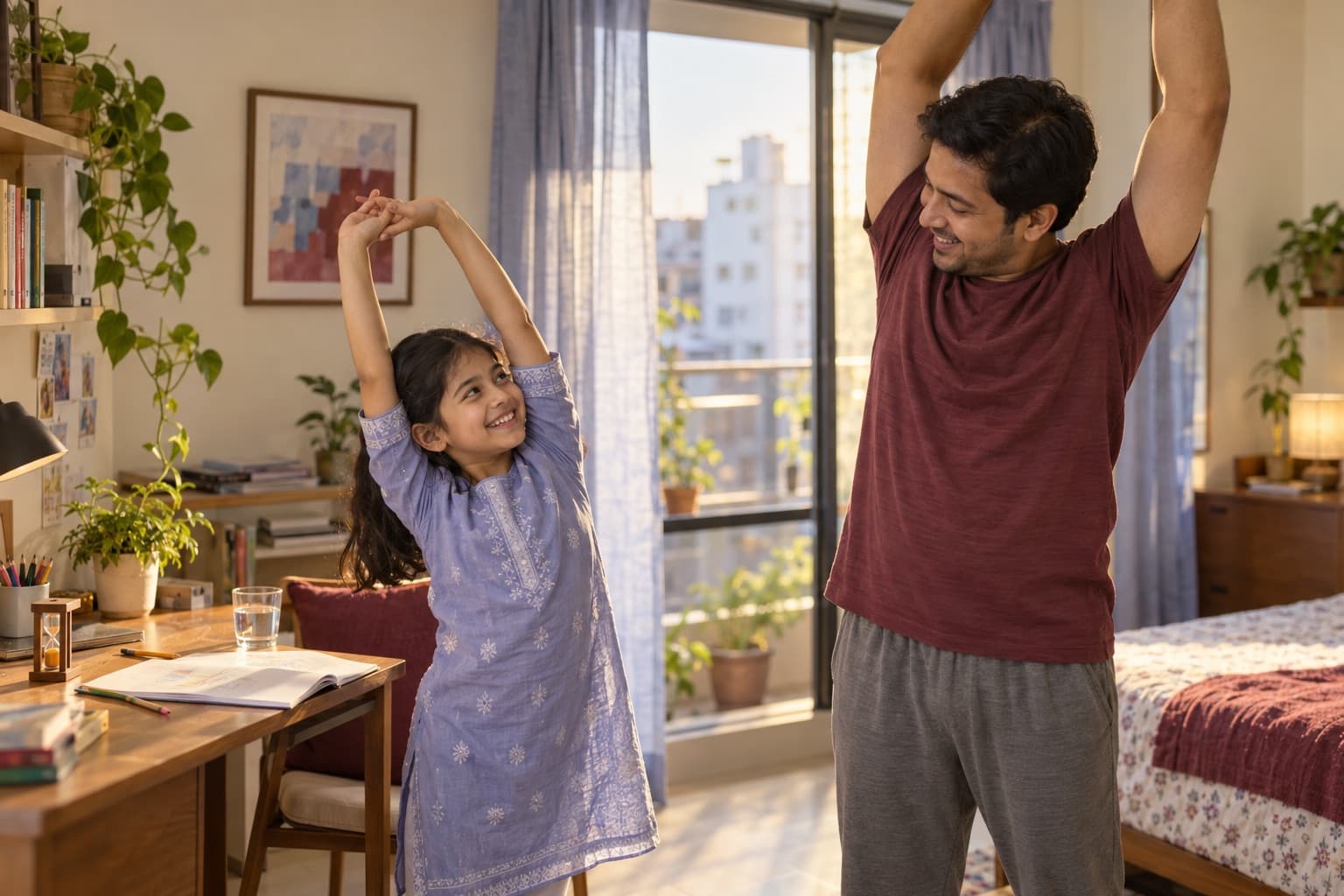
- Move first, then sit. Ten minutes of running, jumping or dancing before a meal, homework or coaching often buys a calmer sit.
- Keep tasks short, with movement breaks: short blocks to match the table above, a timer, then a stretch or ten star jumps. Child can't concentrate on studying has study blocks by age.
- Give the body a job while the mind works: a soft ball to squeeze during stories, standing at the table to draw, or sitting on a floor cushion.
- Give one instruction at a time, close up: get to eye level, say it simply, and ask them to say it back.
- Hand out helpful jobs: carrying the shopping, wiping the table, watering plants or fetching things burns energy and builds pride.
- Keep a steady rhythm: regular times for meals, active play, screens and sleep, and a warning before changes.
- Practise calm in play: statue games, slow-motion races and 'breathe like a sleeping lion' turn stillness into a game. Notice it when it happens.
What you might say
- Your body has so much energy! Let's do ten jumps, then shoes on.
- Feet on the floor and sit on your chair properly, then we'll eat.
- Walking feet inside. Running is for the roof with Abbu.
- First one page of homework, then five minutes of dancing.
- Can you be a statue until I count to ten?
- You sat for the whole story. Your body worked hard to be still!
Movement is not misbehaviour. Give energy a safe place to go, and stillness gets easier.
Is my child hyperactive, or just very active?
Parents often call a very energetic child a hyperactive child. Only a doctor or a child-development professional can assess whether something more is going on, and they look at many things over time. These rough differences can help you decide when to ask:
| Usually just high energy | Worth asking a doctor about |
|---|---|
| Calmer after active play, or when absorbed in something they love | Rarely calmer, even after lots of play, for many months |
| Busy at home, but manages at school or nursery | Struggles at home and at school, and teachers raise it too |
| Sits a little longer as the months go by | No change as they grow, or it gets harder |
| Bumps and scrapes like other children | Frequent injuries from not noticing danger |
| Makes and keeps friends | Often left out because of rough play or not waiting for a turn |
If your child can't sit still anywhere and several things in the second column fit, talk to your doctor or the school; the section on getting help below has more detail. Don't label your child yourself, and ask relatives not to either: words like 'naughty' or 'little monkey' tend to stick.
How do you keep a very active child safe at home?
Energetic children climb higher, run faster and notice danger later. Make the flat safe rather than trying to hold them still:
- Balconies are not play spaces for young children. Keep balcony doors locked, and move chairs, stools, boxes and beds away from windows, railings and grilles, so nothing becomes a step to climb.
- Fit window locks or grilles wherever a child could reach an open window.
- Stairs: hold hands on the stairs, and keep the main door shut so a young child can't slip out to the landing or stairwell alone.
- The roof is for play only with an adult right beside your child.
- Fix tall shelves, cupboards and the TV to the wall, so a climbing child can't pull them over.
- Keep medicines, cleaning liquids and mosquito repellents high and locked, and buckets empty.
- Never leave a young child alone, or alone with a baby.
After a fall from a height or a hard knock to the head, call 999 if your child is drowsy, vomits or isn't acting like themselves.
In a Bangladeshi home: small flats, school, coaching and many adults
Small flats and the neighbours below
Many Dhaka families have little outdoor space, heavy traffic and long rainy spells, and an active child can seem too big for the flat. A thick mat or rug for jumping, set times for loud play and a friendly word with the neighbours below often ease the noise worries. The roof, the building corridor and a Friday park or field help whenever an adult can go along.
At school and in coaching
School and coaching ask young children to sit for long stretches. Talk to the teacher kindly and ask for movement jobs, such as handing out books or cleaning the board, a seat near the front and short breaks. Plan movement between school and coaching rather than more sitting, and keep homework in short blocks. Teachers often notice an active boy at school first; very active girls are easier to overlook, and the same ideas help them.
Grandparents, house help and the phone
Grandparents may worry about falls or call the child naughty, and house help may be asked to keep the child still. Share the plan: active play in safe places, then calm activities. Handing over the phone is the quickest way to keep an energetic child still, but many parents find evenings get harder after long screen time. For children aged 2–5, keep it to at most 1 hour a day of good-quality content, and none in the hour before bed.
A 7-day plan when your child can't sit still
- Day 1: Notice. Note when your child is most restless, what came just before, how much active play they had and how they slept. Change nothing yet.
- Day 2: Add up the day's active play and compare it with the minimums above. Plan one extra active slot.
- Day 3: Try 'move first, then sit' before one meal or homework session.
- Day 4: Split one sitting task into short blocks with movement breaks, and use a timer.
- Day 5: Walk through the flat as a climber would: balcony door, windows, furniture, stairs and medicines. Fix one thing.
- Day 6: Share the plan with grandparents, house help and the teacher, and agree the words you will all use.
- Day 7: Compare with Day 1: restless times, active minutes, sleep and how sitting went. Keep what helped.
When to get help for a very active child
Most very active children settle a little more each year. Talk to your child's doctor, or ask the school about an assessment, if you notice any of these:
Get help if
- Your child is very hard to manage both at home and at school or nursery for many months, even after these changes, and it causes real problems with learning, friendships or family life. A doctor, or the school, can help arrange an assessment.
- Frequent injuries: your child often gets hurt, or keeps running into danger such as roads, heights or water, even after you have explained and practised.
- Sleep problems: loud snoring most nights, pauses in breathing during sleep, very restless sleep, or great difficulty settling most nights for weeks. Poor sleep can make children more restless by day.
- Speech, understanding, play or friendships are clearly behind other children of the same age: ask for a development check. Child development stages shows what is typical.
- A sudden change: a settled child becomes restless, irritable or unable to calm down, along with poor sleep, new fears or not wanting to go to school. Ask gently, believe what your child tells you, act the same day, and call 999 if they are in danger now.
- You are so worn out that you fear you might hurt your child: make sure your child is safe, with another adult if you can, step away for a few minutes and get help the same day. Call 999 if anyone is in danger.
If your child can't sit still, more movement, shorter tasks and a safe flat often help more than any scolding. ParentMind helps you note what happens each day, such as active minutes, sleep and restless times, so patterns are easier to see; see how ParentMind works.
Questions parents ask
Is it normal for a 3 year old to never sit still?
Yes. Most 3-year-olds move almost all day: running, climbing and moving from one thing to the next is how they learn. Sitting for a few minutes at a time is typical at this age. Children aged 3–4 need at least 180 minutes of activity a day, so plenty of active play usually makes calm moments easier, not harder.
How do I calm a hyperactive toddler?
Start with movement, not stillness: a run, a dance or an obstacle course often helps a toddler settle afterwards. Then slow things down with soft light, a quiet voice, a story, slow breathing or a cuddle. Keep naps and bedtime regular, because an overtired toddler often gets more wound up. Expect only a few minutes of calm at a time.
Does sugar make children hyperactive?
Sweets often get the blame, but the excitement of a party or Eid usually matters more than the sugar itself. Regular meals and snacks help keep energy steady through the day, and fewer sweets are better for teeth and health anyway. If your child seems very restless after one particular food, note it and mention it to your doctor.
My child's teacher says he can't sit still in class. What should I do?
Thank the teacher and ask exactly when it happens: long lessons, after lunch, or all day. Ask for movement jobs, short breaks and a seat near the front, and make sure your child gets active play before and after school. If the school sees it every day for many months and it affects learning or friendships, ask your doctor or the school about an assessment.
Do screens make children more restless?
Many parents notice their child is more wound up after long or fast-paced screen time, and screens late in the day can cut into sleep, which tends to make restlessness worse. For children aged 2–5, keep it to at most 1 hour a day of good-quality content, ideally watched together, and swap some screen time for active play.
Will my very active child calm down as they grow?
Usually, at least in part. The ability to sit, wait and plan grows a lot between about 4 and 10, so most very active children settle a little each year, even if they stay energetic people. Plenty of movement, good sleep and short tasks help along the way. If there is no change over many months, talk to your doctor.
This article is general information, not medical advice. For health worries, talk to a doctor; if someone is in danger, contact your local emergency number.