How to keep kids active in a small apartment: 30+ ideas for city flats
Quick answer
How to keep kids active in a small apartment: plan short bursts of movement through the day, such as a cushion obstacle course, dancing, skipping, stairs with an adult and rooftop games only with high walls and an adult. Children aged 3–4 need at least 180 minutes of activity a day; 5–17-year-olds, at least 60 minutes of moderate-to-vigorous activity.
 By the ParentMind team13 min read
Listen to this article
17 min listen · Read by your device's voice
At a glance
- Who it is for
- Parents of children aged 3–15 who live in a flat with little or no outdoor space
- Key takeaways
- Children aged 3–4 need at least 180 minutes of activity a day, and 5–17-year-olds at least 60 minutes of moderate-to-vigorous activity; short bursts add up.
- One cleared room can hold obstacle courses, dancing, animal walks and skipping; the stairs work too, with an adult.
- Rooftop play only with high, solid walls and an adult up there; no balcony play for young children; no kites from rooftops.
- In the heat, play early or late with water and shade; in the monsoon, move a short circuit indoors.
Wondering how to keep kids active in a small apartment? It is one of the most common questions of city life: no garden, no playground nearby, a busy road outside, and a child bouncing off the sofa by evening. A flat is not the end of active play. Most of the movement children need can happen in short bursts, at home and close by.
Below: activity needs by age, more than 30 ideas sorted by space, stairs and rooftop safety, rain and heat, cycling and road safety, and a 7-day plan.
How much physical activity do children need each day?
Children need movement every day, and most child-health guidance gives clear targets that don't have to happen all at once:
| Age | Daily target | In a flat, it might look like |
|---|---|---|
| 3–4 years | At least 180 minutes of activity a day, spread through the day, some of it energetic | Many short spells: dancing, climbing over cushions, chasing bubbles, walking the stairs with you |
| 5–12 years | At least 60 minutes of moderate-to-vigorous activity a day | Three spells of about 20 minutes: an obstacle course, skipping, rooftop badminton with an adult |
| 13–15 years | At least 60 minutes of moderate-to-vigorous activity a day | A home workout, skipping, dance, sport at school, cycling in a park |
Moderate means breathing harder but still able to talk; vigorous means puffing too hard to say more than a few words. Play that makes muscles and bones work hard, like jumping, climbing and skipping, is good on several days a week. Long stretches of sitting at study or screens are worth breaking up too; screen time by age has the limits.
Daily movement often helps children sleep better, settle to study and manage big feelings, and it builds strong bones and muscles. In a flat it just takes more planning than in a village courtyard or a big field.
Active games for small spaces: 30+ ideas for a flat
When parents ask how to keep kids active in a small apartment, the answer usually starts with one cleared corner. Clear a space, move anything sharp or made of glass, and pick two or three ideas for this week. Most need nothing but cushions, a ball, tape or a rope. The ages are rough, and younger children need an adult close by for all of them.
In the living room or bedroom
| Idea | How | Ages |
|---|---|---|
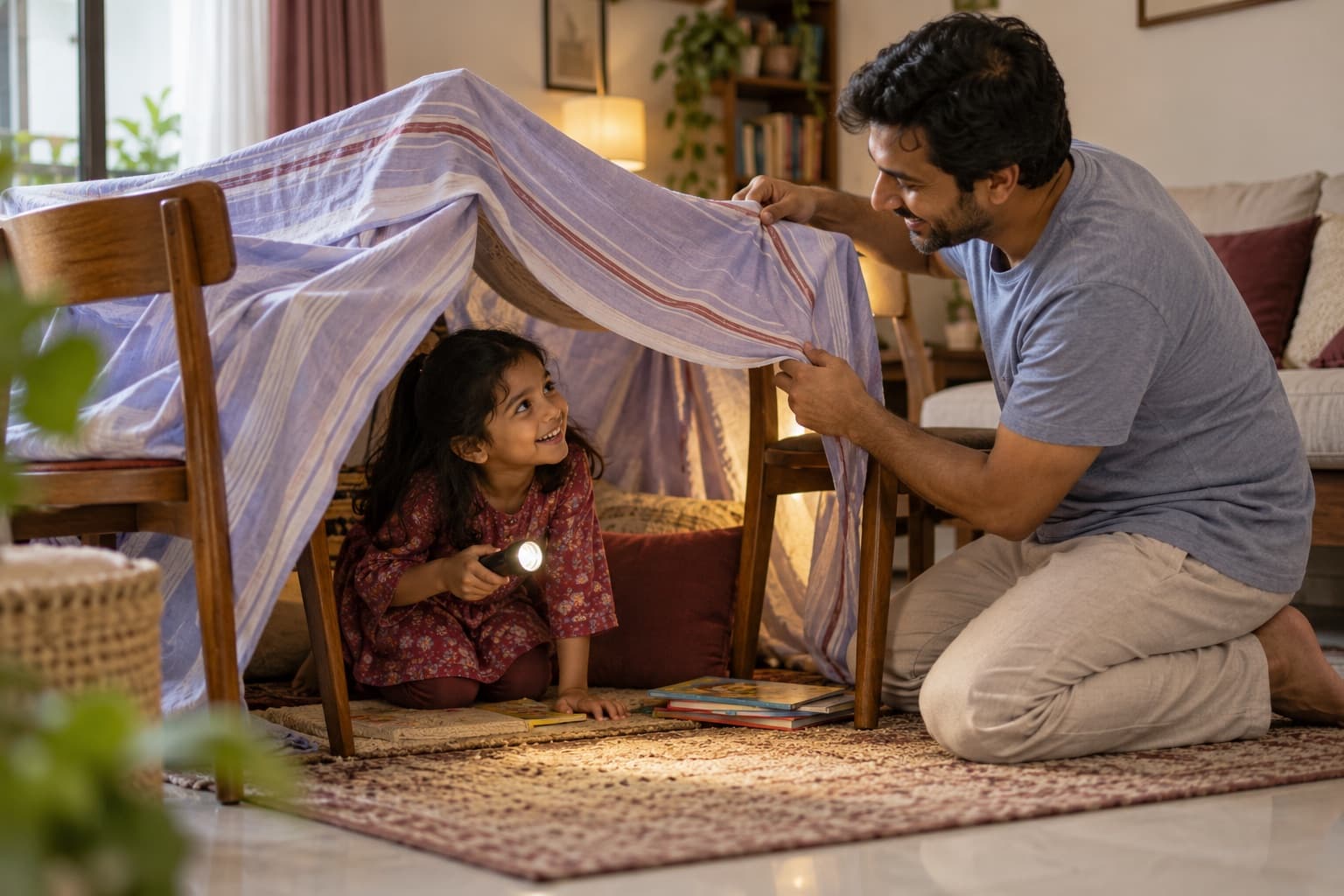
| Cushion obstacle course | Crawl under the table, over cushions and through a bedsheet tunnel, then hop to the door | 3+ |
| Freeze dance | Dance to songs; everyone freezes when the music stops | 3+ |
| Animal walks | Bear crawl, frog jumps, crab walk, and standing on one leg like a heron | 3+ |
| Sock basketball | Throw rolled-up socks into a bucket or laundry basket, then race to collect them | 3+ |
| Tidy-up race | Put the toys back before a song ends | 3+ |
| “The king says” | Move only when the leader says “The king says jump!” or “The king says hop!” | 4+ |
| Balloon keep-up | Keep a balloon in the air with hands, heads and knees; an adult nearby, and burst pieces picked up at once | 4+ |
| Floor is lava | Step from cushion to cushion on the floor, never on beds or sofas near windows | 4+ |
| Ekka-dokka (hopscotch) with tape | Mark squares on the floor with masking tape and hop through | 4+ |
| Animal yoga | Hold tree, cat and snake poses while breathing slowly; good for calming down after a busy game | 4+ |
| Rumal chor | Sit in a circle; one child drops a handkerchief behind someone, who jumps up to chase them round | 5+ |
| Star jumps and wall push-ups | Count them together; older children can add a plank or squats | 6+ |
On the stairs, in a corridor, around the building
- Stair climbing with an adult: up and down a few floors together, holding the rail and counting the steps.
- Corridor bowling: plastic bottles as skittles and a soft ball, when no one is walking through.
- Skipping in a wide corridor or the ground-floor lobby at a quiet hour, away from glass, the stairs and the parking area.
- Sponge-ball football in a long passage, with a soft goal at each end.
- Carrying the shopping up together by the stairs, a light bag each.
- Sweeping and mopping races: chores done briskly count as movement too.
- Walking with an adult for short errands nearby, instead of taking a rickshaw.
On the rooftop: only with high, solid walls and an adult up there too
- Badminton in the early morning or late afternoon, when the wind is low.
- Skipping, and hula hoops.
- Chalk kutkut (hopscotch) and hopping races.
- Chor-police and other chasing games, away from water tanks, pipes and the edges.
- Soft-ball cricket or catch; if the ball goes over the wall, fetch it by the stairs, never by leaning over.
- Walking laps with a grandparent while the children race from corner to corner.
Outside: parks, fields and quiet lanes
- A family walk or run around a nearby park or lake path, early in the morning or late in the afternoon.
- A school field at weekends or after school, if the school allows it: football, cricket, running races.
- Traditional field games with cousins, such as gollachut, bouchi, dariabandha, ha-du-du and kanamachi, with an adult watching.
- Cycling in a park, a closed courtyard or a quiet lane, with a helmet and an adult.
- Swimming lessons with a trained instructor, where there is a pool: great exercise and a life-saving skill. Near any water, an adult watches every moment.
- Kites in an open field or park, away from power lines; never from a rooftop.
- A sport, dance or martial-arts class, if your budget and timetable allow.
What you might say
- Before the tablet, let's do the obstacle course twice. Ready, steady, go!
- Can you be a frog all the way to the kitchen?
- Let's count the steps up to our floor. Hold the rail; I'm right behind you.
- You pick the song, I'll pick the moves.
- It's too hot for the roof now. We'll go up later, when the sun is lower.
- You're puffing! That means your heart and legs are working hard.
Stairs, rooftops and balconies: how to keep active play safe
Active play in a building comes with a few real risks. These rules keep it safer:
- Stairs: young children always with an adult, holding the rail, in good light and on dry steps, and walking down, never running.
- Rooftops: only with high, solid walls and an adult up there too. Never in rain, storms or lightning; never near water tanks, open edges or loose railings. Lock the roof door when it isn't in use.
- No kites from rooftops: a child watching the sky can step backwards towards the edge. Kites belong in an open field, away from power lines.
- Balconies are not play spaces for young children. Keep chairs, stools and boxes away from railings and grilles, so nothing becomes a step.
- Indoors: move glass tables, pad sharp corners, fix tall shelves and the TV to the wall so they can't tip, and keep window grilles locked.
- Lifts, generator rooms and the building's parking area are not play spaces; a reversing car may not see a child.
- Never leave a young child alone, or alone with a baby, during active play.
How can children stay active in the monsoon and the heat?
Rainy-day physical activities
In the monsoon, move the plan indoors. A simple 10-minute circuit suits most ages: a minute each of star jumps, frog jumps, bear crawl, skipping on the spot and wall push-ups, then repeat. Put on music, take turns being the coach, and finish with animal yoga to calm down.
Heat and sun
- Play outside or on the roof in the early morning or late afternoon, not in the midday sun.
- Give water before, during and after play, and more on humid days.
- Dress children in light, loose cotton and a cap, and take breaks in the shade.
- Watch for heat exhaustion: headache, dizziness, feeling sick, heavy tiredness or very hot skin. Stop, move to a cool place, give water and cool the skin with a damp cloth.
- If your child becomes confused, faints or isn't acting normally in the heat, call 999 and keep cooling them while you wait.
How can children cycle and walk safely in the city?
Cycling and walking are some of the best everyday exercise, and city roads make them riskier. In general terms:
- A helmet that fits, on every ride, and brakes checked often.
- Young children cycle only in a park, a closed courtyard or a quiet lane with an adult, never among buses, rickshaws and CNGs.
- Older children ride on busy roads only once they know the road rules, can judge traffic and have practised the route with you.
- Be seen: bright clothes, and lights and reflectors after dusk.
- On foot, hold young children's hands near traffic, use crossings and foot overbridges, and stop, look and listen before crossing.
- Phones and earphones go away while crossing a road, for adults too.
How to keep kids active in a small apartment in Dhaka and other cities
In Dhaka and other cities, many children have no field nearby and long days of school and coaching. A few small agreements at home help:
- Neighbours downstairs. Put a thick mat or rug where children jump, keep loud games to the daytime, and stop by early evening.
- Grandparents who worry about sweat, colds or falls. Start with gentle games they can join, like ball rolling or walking laps on the roof, and explain that sweating after play is normal.
- Girls and boys alike. Both need running, jumping, ball games and cycling; make sure daughters get the same chances as sons.
- House help who mind children. Share the safe list: which games, which places, and that the roof and stairs always mean an adult alongside.
- Coaching-heavy days. Fit 10-minute bursts between school, coaching and homework; walking to coaching, where it is close and safe, counts too.
- Ramadan. Active play often moves to the cooler hours, and children who are fasting do better with gentle games.
For quieter, screen-free ideas for the same small flat, see screen-free activities for kids; for toddlers, see toddler play at home.
A 7-day plan to get your child moving more
Add one change at a time, note how active your child was, how they slept and their mood, and compare after a week.
- Day 1: Note roughly how many minutes your child was really moving, and when.
- Day 2: Clear one play space, and move anything sharp, glass or easy to tip.
- Day 3: Add one 10-minute burst at a fixed time, such as dancing before school.
- Day 4: Try the stairs together, or the rooftop with an adult, in the cool of the late afternoon.
- Day 5: Build the obstacle course with your child, and let them design the route.
- Day 6: Plan a weekend outing to a park or field, and invite cousins or neighbours.
- Day 7: Compare with Day 1: minutes moving, sleep and mood. Keep what worked, and add one more burst next week.
When to talk to a doctor about activity
Most children love to move once they have the space and the company. Talk to your child's doctor if you notice any of these:
When to get help
- Your child gets breathless much sooner than other children, wheezes or coughs with exercise, or has chest pain during activity. If they faint or collapse, call 999.
- Pain in one joint or limb, a limp or swelling that lasts more than a few days. With a fever, see a doctor the same day.
- Your child is much clumsier than others the same age, falls very often, or loses skills they had, like running or climbing.
- After a fall or a knock to the head, your child is drowsy, vomits or isn't acting normally: call 999.
- Your child is on the go so much that it causes problems at home and at school for several months; see a very active child for what helps and when to ask for a check.
ParentMind helps you note activity, sleep and mood each day and see patterns over a week or two. See how ParentMind works.
Questions parents ask
How can I keep my child active indoors?
Plan short bursts rather than one long session: an obstacle course, freeze dance, animal walks, sock basketball, skipping in a corridor and the stairs with an adult. Keep one safe space clear and a basket with a ball, a rope and tape ready. A few bursts of 10–20 minutes a day add up.
How much should a 5 year old play every day?
From age 5, most child-health guidance suggests at least 60 minutes of moderate-to-vigorous activity a day: play that makes them breathe harder, like running, jumping, skipping or dancing. It can be split into short spells. Younger children, at 3–4, need at least 180 minutes of activity a day. For other milestones, see child development by age.
Is it safe for children to play on the rooftop?
It can be, with the right roof and an adult. Children should play on a rooftop only when it has high, solid walls all round and an adult is up there too, never in rain, storms or lightning. Keep them away from water tanks and edges, fly kites in a park instead, and lock the roof door when it isn't in use.
What can I do if there is no playground near my home?
Use what you have: a cleared room, the stairs with an adult, a corridor at quiet times and a rooftop with high walls and an adult. Once a week, look further afield: a park, a lake path, a school field on a holiday or a relative's courtyard. Many families find that a fixed weekly outing stops it slipping.
How do I get my child moving instead of watching screens?
Make movement the easy, fun option at the times screens usually appear: a dance or the obstacle course before the tablet, not after it. Join in for the first few minutes, offer two choices, and keep it short and silly. Agree screen times in advance, so the end of play is not a fight about the phone.
Does housework count as exercise for kids?
Some of it does, when it gets them moving briskly: sweeping, mopping, carrying light shopping up the stairs or a tidy-up race. It builds responsibility too. Mix it with play, though, because running, jumping and ball games give children the harder effort their hearts, muscles and bones need.
This article is general information, not medical advice. For health worries, talk to a doctor; if someone is in danger, contact your local emergency number.