Routine after school holidays: back on track after Eid and long breaks
Quick answer
A routine after school holidays usually comes back best in small steps: a few days before school restarts, bring wake-up and bedtime earlier by about 15–30 minutes every day or two. Cut back evening screens, pack the bag early and keep the first week light. Near ponds and rivers, keep young children within an adult's arm's reach.
 By the ParentMind team12 min read
Listen to this article
16 min listen · Read by your device's voice
At a glance
- Who it is for
- Parents of children aged 4–16 coming back from Eid, Puja, winter or summer holidays, or a trip to the village
- Key takeaways
- Long holidays shift sleep later; moving wake-up and bedtime earlier in small steps over a few days is usually easier than one sudden early night.
- Holiday screens can be a little looser, but keep a daily limit, no screens in the hour before bed and devices out of the bedroom at night.
- Near water, young children need an adult within arm's reach every time: ponds, rivers, ditches and even buckets.
- Expect a wobbly first week back; a child who still refuses school after a week or two, or seems frightened, needs a closer look.
Getting the routine after school holidays back can feel harder than the holiday was fun. After Eid, a winter break or weeks in the village, bedtime has drifted to midnight, mornings start at ten and the tablet has become part of the family. Then school opens on Sunday.
This is normal, and it usually settles within a week or two. Children adjust most easily when the change is gradual and starts a few days before school, rather than with one early night and a hard morning.
Below: why holidays shift routines, how to get sleep back, screens in the holidays, staying safe in the village, what each Bangladeshi break changes, the first week back, a 7-day plan and when to get help.
Why is the routine after school holidays so hard to get back?
A child's body clock follows the day it lives. A week of late nights with cousins and slow mornings moves it later, and it does not jump back overnight. Common reasons the holiday routine drifts:
- Late evenings: guests, family dinners, Eid visits and cousins who stay up talking and playing.
- No fixed wake-up: without the school van, mornings start later every day.
- More screens: cartoons, games and cousins' phones, often late into the night.
- Travel days: long bus, train or launch journeys, new beds and noisy houses.
- Food: sweets, rich meals and snacks at odd hours, and less water than usual.
How to get sleep back on track after Eid and long breaks
Sleep is the part to fix first, because tired children find everything else harder. Start a few days before school opens; after a long break, a week ahead gives you more room.
- Choose the school-day wake-up time, and work back to the bedtime your child needs (see the table).
- Move wake-up earlier first, by about 15–30 minutes every day or two. Bedtime tends to follow once mornings start earlier.
- Open the curtains or step outside soon after waking. Morning daylight and breakfast at a set time help reset the body clock.
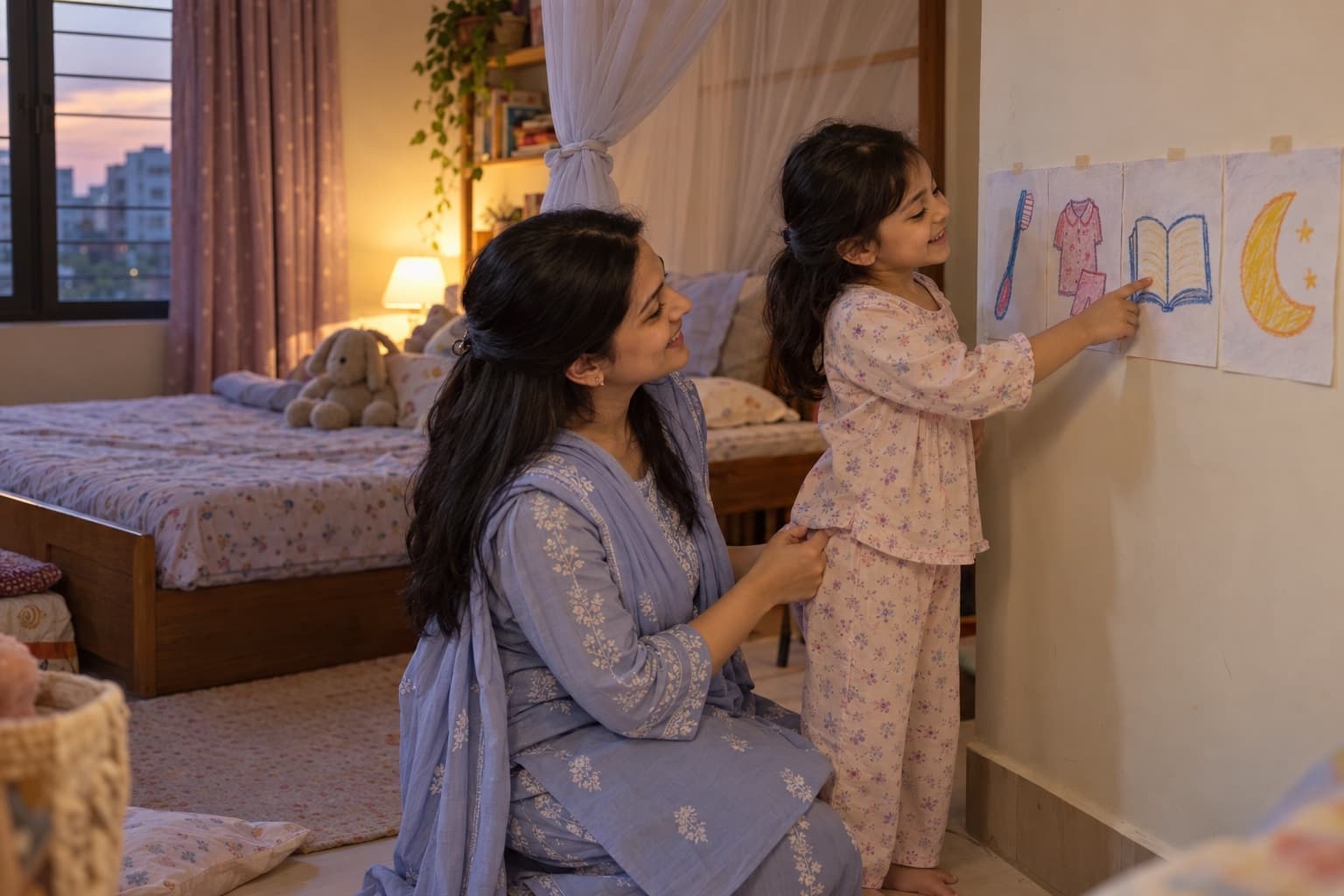
- Bring back the bedtime routine: bath or wash, pyjamas, a story or a dua, lights out at the same time each night.
- Screens off an hour before bed, and devices out of the bedroom at night.
- Avoid long naps late in the afternoon, which can push bedtime later again.
| Age | Sleep in 24 hours | Asleep by |
|---|---|---|
| 3–5 years | 10–13 hours, naps included | 8:30 pm |
| 6–12 years | 9–12 hours | 9:30 pm |
| 13–18 years | 8–10 hours | 10:30 pm |
These are the latest times, and many children do better asleep earlier. For the wind-down itself, see a calm bedtime routine; the free school-day planner works out the times for your child's age.
Screen time in the holidays: looser, not limitless
Holidays can include more screens, but the age limits still apply: none under 18 months except video calls with family, at most 1 hour a day of good-quality content at ages 2–5, and consistent limits from 6 that protect sleep, active play and family time.
- Outside first: agree that screens come after outdoor play or a visit, not first thing in the morning.
- Cousins' phones and game marathons: the same family rule applies in every house, so tell the cousins' parents kindly.
- Long journeys: a film on the bus or launch is fine; stop an hour before bedtime.
- The last three or four days: bring screens back to school-week limits, so the first week is not a fight.
- Plenty to do: for ideas that need no screen and little space, see screen-free activities for kids.
Visiting the village home safely: water, roads and rooftops
A holiday at the village home (gramer bari) is one of the joys of a Bangladeshi childhood. It also brings dangers a city child may not know. Busy times, such as cooking for guests, getting ready for Eid prayers or the qurbani, are when a small child can slip away unnoticed.
Water: an adult within arm's reach
- Young children near any water, whether a pond, river, canal, ditch, bucket or drum, need an adult within arm's reach, watching and not on the phone.
- Name one adult as the water watcher whenever children are near water, and hand over by name: “You're watching them now.”
- Never leave a young child alone, or alone with a baby, and an older cousin is not a substitute for an adult near water.
- Empty buckets after use, cover water drums, and keep the path to the pond ghat closed off or watched. A small child can drown in very little water.
- Bathing in a pond or river: only with an adult in the water beside young children. Older children who can swim still go with an adult.
- On boats, launches and trawlers, every child wears a life jacket and stays seated, not leaning over the side.
- Swimming lessons with a trusted adult help older children, but they never replace watching.
Roads and travel
- Village roads often have fast buses, motorbikes and auto-rickshaws and no footpath. Hold young children's hands, and keep play well away from the road.
- At crowded bus stands, stations and launch ghats, keep children beside you, agree a meeting spot, and put a card with your phone number in their pocket.
- In a car, children sit in the back with a seat belt or a car seat that fits, never on a lap in the front.
Rooftops, balconies and Eid days
- Rooftops, including moon-sighting on Chand Raat and kite flying, only with an adult. No balcony play for young children.
- Keep children well away from firecrackers.
- On Eid-ul-Adha, keep young children back from the animals and the knives. Whether children watch the qurbani is a family choice; prepare them for what they will see, and wash hands after touching animals or raw meat.
Eid, Puja, winter and summer: what each break changes
Bangladesh's school breaks are not all alike, and each one tends to unsettle a different part of the routine. Check your school's calendar for the dates.
| Break | What tends to change | What helps |
|---|---|---|
| Eid-ul-Fitr, after Ramadan | Sleep shifted late after a month of iftar and sehri; sweets and visiting | Start moving wake-up earlier in the last days of the break; normal meals and water |
| Eid-ul-Adha | Meat-heavy meals, animals at home, late family evenings | Lighter meals with vegetables and water; a quiet last day at home |
| Puja, Christmas or Buddha Purnima holidays | Evenings out, late nights, visits to relatives | The same steps: earlier mornings a few days before school |
| Winter break after annual exams | A long break, then a new class, new books and sometimes a new school | Talk about the new class; a visit or meeting a classmate before day one |
| Summer or monsoon break | Heat, rain, more time indoors and on screens | Active games indoors, and screen limits kept |
| A stay at the village home | Different beds, more people, noise and new dangers | A familiar pillow or book from home, and the same bedtime routine |
The first week back at school: what helps
Even with a good plan, the routine after school holidays takes a week or so to feel normal again. Keep that first week simple and a little quieter than usual.
- The night before: bag packed, uniform ironed, shoes and tiffin box ready, and the school-night bedtime.
- The morning: wake a little earlier than you need to, so there is time for breakfast without rushing.
- At the gate: a short, warm goodbye, the same one each day.
- After school: a snack and some rest before any homework or coaching.
- Evenings: keep visits and late outings for the weekend in this first week.
- Ask about the good parts of the day first, and save bigger talks for a calm moment.
What you might say
- Holidays are hard to leave. Tomorrow our school mornings start again.
- Let's pack your bag together tonight, so the morning is easy.
- Who are you looking forward to seeing at school?
- You don't have to feel ready. We'll take it one morning at a time.
- If anything at school is worrying you, you can tell me.
A child who still dreads school after the first week or two may be worried about something specific, such as a friendship, a teacher or bullying; see school anxiety.
A 7-day plan from the last days of the holiday to the first school week
A routine after school holidays is easiest to rebuild in the last days of the break. Start about five days before school opens, and write one line each day: when your child fell asleep, when they woke and how the day went.
- Day 1 (five days before school): note the current bedtime and wake-up, and choose the school-night targets.
- Day 2: wake 15–30 minutes earlier, open the curtains and have breakfast at a set time.
- Day 3: move bedtime earlier too, with screens off an hour before.
- Day 4: one short reading or homework block at school time, and check any holiday homework.
- Day 5: try on the uniform, pack the bag and plan the first tiffin together.
- Day 6 (the night before school): the school-night bedtime and the usual routine.
- Day 7 (the first school day): a short goodbye, then rest and a chat after school. Compare your notes with Day 1.
When to get help, and when to act at once
Act soon if
- A child pulled from water: if they are not breathing normally, call 999 and start rescue breaths if you know how. If they seem fine, still see a doctor the same day, and call 999 if breathing trouble, a lot of coughing or drowsiness follows.
- Fever, vomiting or diarrhoea after travel, especially in a young child who is drinking little or weeing much less: see a doctor the same day.
- School refused for more than a week or two after the break, or stomach aches on most school mornings: talk to the teacher and a doctor.
- Sleep still far off after two or three weeks of a steady routine, or loud snoring with pauses in breathing: talk to a doctor.
- A sudden change after the holiday, such as fear of one person or place, or your child telling you someone hurt them: believe your child, act the same day, report any abuse at your local police station (thana), and call 999 if they are in danger.
Routines come back a few minutes at a time, and the progress is easy to miss. ParentMind helps you note what happens each day, see patterns and get guidance: how ParentMind works.
Questions parents ask
How long does it take a child to get back to routine after the holidays?
Usually a few days to a week or two. Younger children and longer breaks tend to take longer, and starting a few days before school helps. Expect some tiredness and grumpiness in the first week. If sleep or school mornings are still very hard after two or three weeks, look at what else is going on.
How do I fix my child's sleep schedule after a long break?
Move the wake-up time earlier first, by about 15–30 minutes every day or two, and open the curtains soon after waking. Bedtime usually follows. Bring back the bedtime routine, keep screens off for the hour before bed and avoid late-afternoon naps. Start a few days before school, or a week before after a very long break.
Should children study during the school holidays?
A little, lightly. A short reading or homework session on some days keeps the habit alive, and finishing holiday homework early avoids a last-minute rush. Most of a holiday, though, is for rest, play and family. For exam-year students, agree a lighter study plan together rather than a full school-day timetable.
How can I keep kids busy during the school break without screens?
Mix active play with small jobs and family time: outdoor games, cycling, helping in the kitchen, visiting relatives, drawing, building things, reading and board games such as ludo or carrom. Give older children a small project of their own. A loose daily plan, with screens after outdoor time, keeps the days from drifting.
My child doesn't want to go back to school after the holiday. What should I do?
It is common, especially after a long or happy break. Name the feeling, keep the routine moving and use a short, steady goodbye. Ask at a calm time whether anything at school is worrying them. If refusal lasts more than a week or two, or your child seems frightened, talk to the teacher.
How do I keep my child safe near ponds in the village?
Keep young children within an adult's arm's reach whenever they are near water, and name one adult as the watcher. Never leave a young child with only an older cousin near a pond. Empty buckets, cover drums, use life jackets on boats, and remember that swimming lessons help older children but never replace watching.
This article is general information, not medical advice. For health worries, talk to a doctor; if someone is in danger, contact your local emergency number.