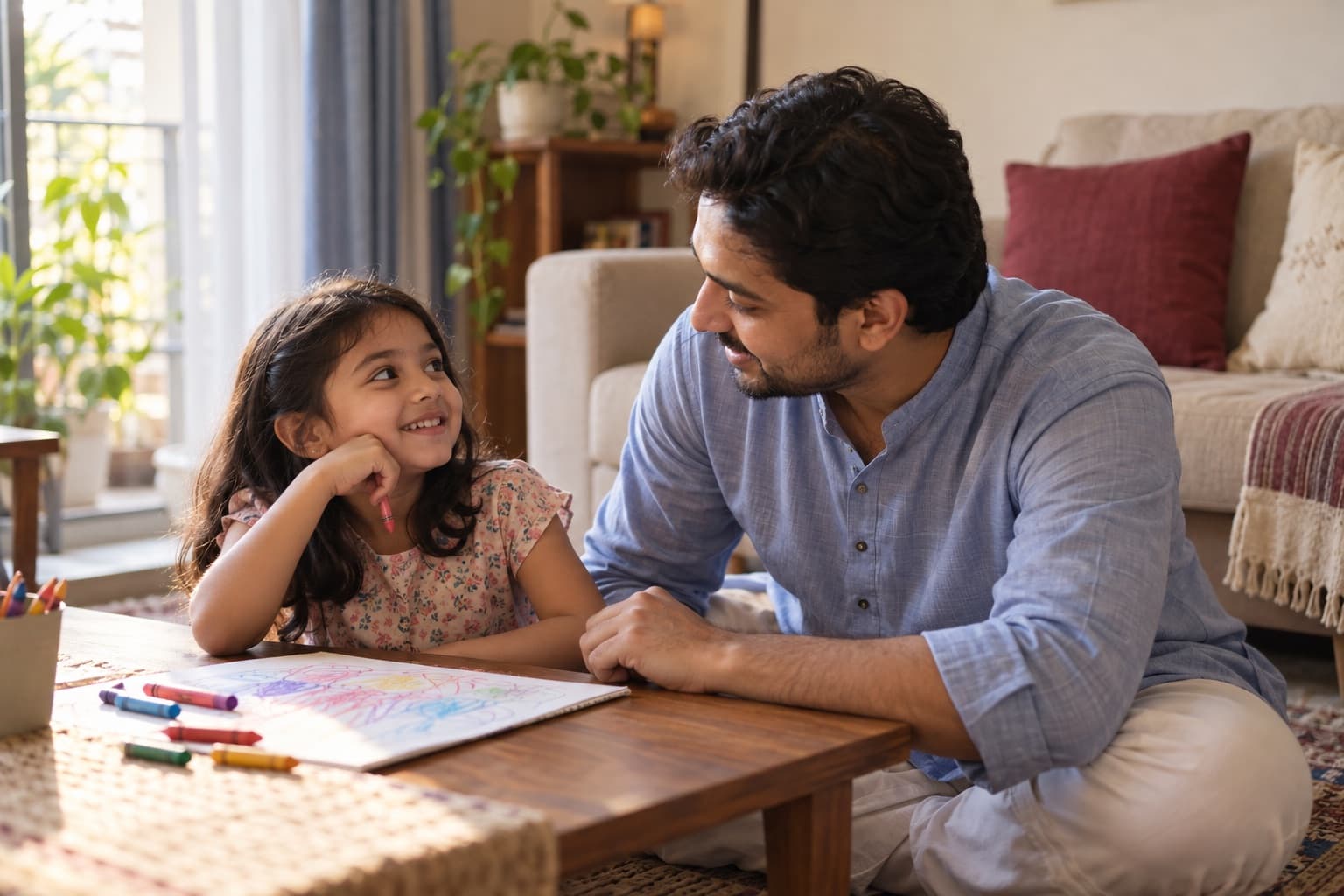
How to stop yelling at your kids, and how to repair when you do
Quick answer
How to stop yelling at your kids: learn your warning signs, pause and breathe out before you speak, then get close and give one calm instruction. Plan for the hardest hours, usually tired evenings. When you do shout, repair with a short, honest sorry. If you feel you might hurt your child, step away and get help the same day.
 By the ParentMind team12 min read
Listen to this article
17 min listen · Read by your device's voice
At a glance
- Who it is for
- Any parent or carer who shouts more than they want to, with children of any age
- Key takeaways
- Yelling is usually a sign that you are overloaded, not that you are a bad parent, and it can change.
- The real work happens before the shout: learn your body's warning signs and have a pause plan ready.
- Closer and quieter often works better than louder: get to eye level and give one short instruction.
- After a shout, repair: name it, say sorry without 'but', and start again. Children learn from watching you put things right.
If you are searching for how to stop yelling at your kids, you probably know the pattern: you ask nicely, then again, then a third time, and then the shout comes out, louder than you meant. Afterwards you feel awful. Almost every parent yells sometimes, and most do it when they are tired, rushed or worried, not because they love their children less.
Shouting tends to work for a moment and cost a lot over time: children often stop hearing normal voices, shout back or become wary. This page is about you, not your child: your triggers, a pause plan, what to say instead, how to repair, and a 7-day plan.
Why do I lose my temper with my children?
Losing your temper with your children is rarely about one spilled glass. It usually builds through a full day: little sleep, a long commute, a list of jobs, money or exam worries, and then one more thing. Parents who yell tend to have a few predictable triggers, and knowing yours is the first step.
| Trigger | What it looks like | A small change |
|---|---|---|
| Tired or hungry | The hour after work or the school run, before dinner | Eat something and drink water before you walk in; expect less of that hour |
| Rushing | School mornings, leaving for a dawat | Start 15 minutes earlier; lay out clothes and bags the night before |
| Repeating yourself | The fourth 'Put your shoes on' | Ask once, up close; then help them do it instead of asking again |
| Feeling disrespected | Eye-rolling, 'No!', a slammed door | Tell yourself it's a skill they're still learning, not an insult; deal with it later, calmly |
| Your own childhood | Hearing your parents' words come out of your mouth | Notice it without blame, and choose one phrase you want to say instead |
A week of notes on when you shouted, and what came just before, often shows that most yelling happens at the same two or three moments: plan for those. If your child's own outbursts set off yours, how to help an angry child has tools for both of you.
How to stop yelling at your kids: a pause plan for the moment
Anger moves faster than good intentions, so this kind of parent anger management has to be simple enough to use with a hot face. Practise it on calm days, so it is there when you need it.
- Catch your early signs: a hot face, a tight jaw, clenched hands, a rising voice, the thought 'I can't take this'.
- Say it out loud: 'I'm getting angry. I need a moment.' Naming it slows you down, and shows your child what to do with anger.
- Close your mouth and breathe out slowly, longer than you breathe in, three times.
- Change your body: unclench your hands, sit down, or splash water on your face. A lower body often brings a lower voice.
- Step back only as far as safety allows. With an older child, the next room is fine. With a toddler or a baby, stay in the room: turn to the window, or hand over to another adult. Never leave a young child alone, or alone with a baby.
- Come back with one tool, not a lecture: one short instruction at eye level, a when-then, or a small consequence you decided earlier.
What to do instead of yelling: closer, quieter, fewer words
Much of how to stop yelling at your kids is swapping the shout for something that works better. Yelling is often a way of getting attention from a distance, and most of it can be said better up close, in fewer words.
| Instead of shouting | Try |
|---|---|
| 'How many times do I have to tell you?!' | Walk over, touch their shoulder: 'Shoes on now. I'll help.' |
| 'Stop fighting, both of you!' | Step between them: 'Hands off. You sit there, you sit here.' |
| 'You never listen!' | One calm word: 'Homework.' Or a when-then. |
| 'Turn that phone off NOW!' | A 5-minute warning, then: 'Time's up. Phone in my hand, please.' |
| 'Go to sleep this minute!' | Whisper: 'Lights off now. I'll sit with you for two minutes.' |
What you might say in the hot moment
- I need two minutes. Then we'll sort this out together.
- I'm not going to shout. I'll say it once: bag packed, now.
- I can see you're upset. I'm upset too. Let's both calm down first.
- (To your partner or another adult) I'm close to shouting. Can you take over for a few minutes?
If you mostly yell because your child doesn't listen, see how to get kids to listen; for calm, firm consequences instead of shouting, see positive discipline.
Yelling at toddlers, school-age children and teens
- Toddlers (1–3) mostly hear the fear in a shout, not the words. Move them or the object, and use three words: 'Gentle hands, please.'
- School-age children (4–12) often tune out a parent who yells a lot. Fewer, quieter words and a calm follow-through usually carry further.
- Teenagers tend to shout back. Say 'Let's talk when we're both calmer', leave the room, and come back to it the same day.
Tired evenings: how to make the hardest hours calmer
For many families, how to stop yelling at your kids comes down to the hours between about 6 and 9 in the evening: parents home from work and traffic, dinner to cook, homework to check, children tired and wound up. Small changes to that stretch often matter more than willpower.
- Arrive fed: a snack and a glass of water before you walk in, or before the school pick-up, takes the edge off.
- Take five minutes for yourself first: change your clothes, wash your face, pray or sit quietly with a cup of tea before homework or dinner.
- Give your child ten minutes of full attention when you arrive. Children who get you first are often easier later.
- Keep the evening the same most days: snack, homework, play, dinner, wash, bed. The school-day planner works back from wake-up time to a bedtime that fits.
- Lower the bar for the worst hour: a simple dinner, a messy room, one battle at a time.
How to apologise to a child after yelling
If you yell sometimes, you will slip again sometimes; what happens next matters most. A short, honest repair shows your child that people who love each other can put things right.
- Calm down first. Repair can wait ten minutes, or until bedtime; a rushed apology often turns into a second lecture.
- Go to your child, get to their level, and name what you did: 'I shouted at you.'
- Say sorry without 'but'. 'Sorry I shouted, but you…' puts the blame back on them. Their behaviour can be talked about later, separately.
- Make it clear that your shouting was not their fault, even if their behaviour needs work too.
- Say what you'll try next time, then reconnect: a hug, a story, finishing the homework together.
Words for repair
- I raised my voice at you. That wasn't okay, and I'm sorry.
- You didn't deserve to be shouted at. I was tired, and that's mine to handle.
- Next time I feel that cross, I'll say 'I need a minute' first.
- (To a teenager) I was out of line earlier. I'd like to hear your side, when you're ready.
Mom guilt after yelling: why blaming yourself doesn't help
Guilt after a shout is a sign that you care. But guilt that turns into 'I'm a terrible mother' or 'I'm ruining him' tends to make the next day harder: a parent who feels like a failure is often more tense, and quicker to snap. Fathers feel it too. Calm parenting doesn't mean never feeling angry; it means having a plan for when you do.
- Swap blame for responsibility: not 'I'm a bad parent' but 'I shouted, I'll repair, and I'll plan for tomorrow evening'.
- Count progress, not perfection: three shouts a day becoming one is real change.
- Give yourself the basics you would give your child: sleep, food, a little time alone, someone to talk to.
- Share the load: ask your partner or another family member to take one evening job, such as homework or bedtime; if you disagree about how, see two parents, one plan.
You don't have to be a parent who never shouts. Be a parent who repairs.
In a Bangladeshi home: elders, a full house and 'he only listens if I shout'
In many Bangladeshi homes, raised voices are part of ordinary life, and many of us grew up being shouted at by people who loved us. You may hear that a child only listens when you shout. Often the opposite happens: children who are shouted at a lot learn to wait for the shout.
- Elders watching: in a joint family, you may feel judged if you don't scold loudly. You can be firm and quiet at the same time; a calm 'I'll handle it' is enough. Talk privately later.
- When others shout at your child, such as an aunt, an older cousin or house help: gently agree one rule for the household. In this house, we don't shout at the children, and nobody hits.
- Load-shedding evenings: heat and darkness shorten everyone's temper. Keep a charged lamp and a hand fan ready, and swap homework for a quiet game or a story until the power is back.
A 7-day plan to yell less
- Day 1: Notice. Each time you shout or nearly shout, note the time, what came just before, and how tired, hungry or rushed you were. Change nothing yet.
- Day 2: Find your top two triggers in your notes, and choose one small change for each from the table above.
- Day 3: Practise the pause plan once while calm, and tell your child: 'When I'm getting angry, I'll say I need a minute.'
- Day 4: Walk over instead of calling out. Give every instruction up close, at eye level, in one sentence.
- Day 5: Plan the hardest hour: a snack before you walk in, five minutes for yourself, ten minutes for your child.
- Day 6: If you shouted this week, repair once using the steps above; if not, tell your child what you've been working on.
- Day 7: Compare with Day 1: how many shouts, at what times, how many pauses that worked. Keep what helped, and choose the next change.
When to get help for your anger
Yelling sometimes is part of ordinary family life. Get help for yourself, without shame, if:
When to get help
- You shout most days, even after a few weeks of really trying to stop.
- Shouting turns into name-calling, threats, throwing things, pushing or hitting, or once you start you can't stop.
- Your child seems afraid of you: they flinch, hide, go silent or stop telling you things.
- You feel low, numb, exhausted or on edge most days for two weeks or more, or your anger seems tied to old hurts, drinking or drugs. Talk to a doctor or counsellor.
- Shouting or violence between adults at home is frightening your children. If anyone is in danger, call 999.
- You feel you might hurt your child: step away now. First put your child somewhere safe: with another adult if you can, or a baby on their back in a cot, while you go to another room to calm down. Get help the same day, and call 999 if anyone is in danger.
Learning how to stop yelling at your kids is a skill, built one evening at a time, and slips are normal. ParentMind helps you note what happens each day and see patterns, such as which evenings are hardest and what came before them; see how ParentMind works.
Questions parents ask
Is yelling at kids harmful?
Occasional shouting in a warm home, followed by a repair, is unlikely to cause lasting harm. Frequent yelling, and shouting with insults, threats or name-calling, tends to make behaviour worse over time and can leave children anxious or quick to shout themselves. The pattern matters more than any single moment, so aim for fewer shouts and quick repairs.
I yell at my kids every day. Is it too late to change?
No, it is not too late. Many parents who yell daily find they shout far less within a few weeks once they know their triggers and have a pause plan. Note when it happens for a week, plan for the hardest hour, and repair each time you slip. Children of every age tend to respond to a parent who is visibly trying.
How do I apologise to my child after yelling?
Wait until you are calm, get down to their level and keep it short: 'I shouted at you. That wasn't okay, and I'm sorry.' Leave out the 'but'. Tell them it wasn't their fault, say what you'll try next time, then reconnect with a hug or by finishing the task together. Talk about their behaviour separately, later.
Will saying sorry to my child make me lose authority?
Usually not. A calm apology for how you spoke, not for the rule, often makes children more willing to listen, because it shows the rules apply to adults too. You can say sorry for shouting and still keep the limit: 'I'm sorry I yelled. Homework still needs doing, and I'll sit with you.'
What can I do instead of yelling when my child won't listen?
Get close instead of loud. Walk over, touch their shoulder, wait for eye contact and give one short instruction. If they don't move, help them start, or use a when-then: 'When the toys are away, then cartoons.' Follow through calmly. Quiet and close usually works better than repeating it from the kitchen.
What should I do if I hit my child in anger?
First make sure your child is safe and check for injuries; if they are hurt, or are a baby, have a doctor see them the same day. Once you are calm, repair: say what you did, that it was wrong and not their fault, and what you will do next time. If it has happened more than once, or you fear it will, get help for yourself the same day. Call 999 if anyone is in danger.
This article is general information, not medical advice. For health worries, talk to a doctor; if someone is in danger, contact your local emergency number.