Child afraid of failure? How to help with perfectionism and mistakes
Quick answer
A child afraid of failure often avoids trying, cries over small mistakes or must be first at everything, usually because mistakes feel dangerous rather than normal. Praise effort and strategy, share your own mistakes calmly, react to marks with curiosity rather than anger, and let small things go wrong. Get help if worry keeps them from trying for weeks.
 By the ParentMind team11 min read
Listen to this article
15 min listen · Read by your device's voice
At a glance
- Who it is for
- Parents of children aged about 5–15 who give up quickly, cry over mistakes, hate losing or redo work again and again
- Key takeaways
- Fear of failure often grows when mistakes feel dangerous: as if they bring anger, shame or less love.
- What helps most is usually everyday: praising effort and strategy, sharing your own mistakes and letting small things go wrong.
- Your first reaction to a mark or a mistake teaches more than any lecture; curiosity usually helps more than anger.
- Get help if worry keeps your child from trying for weeks, if tears come with almost every mistake for months, or if low mood lasts two weeks or more.
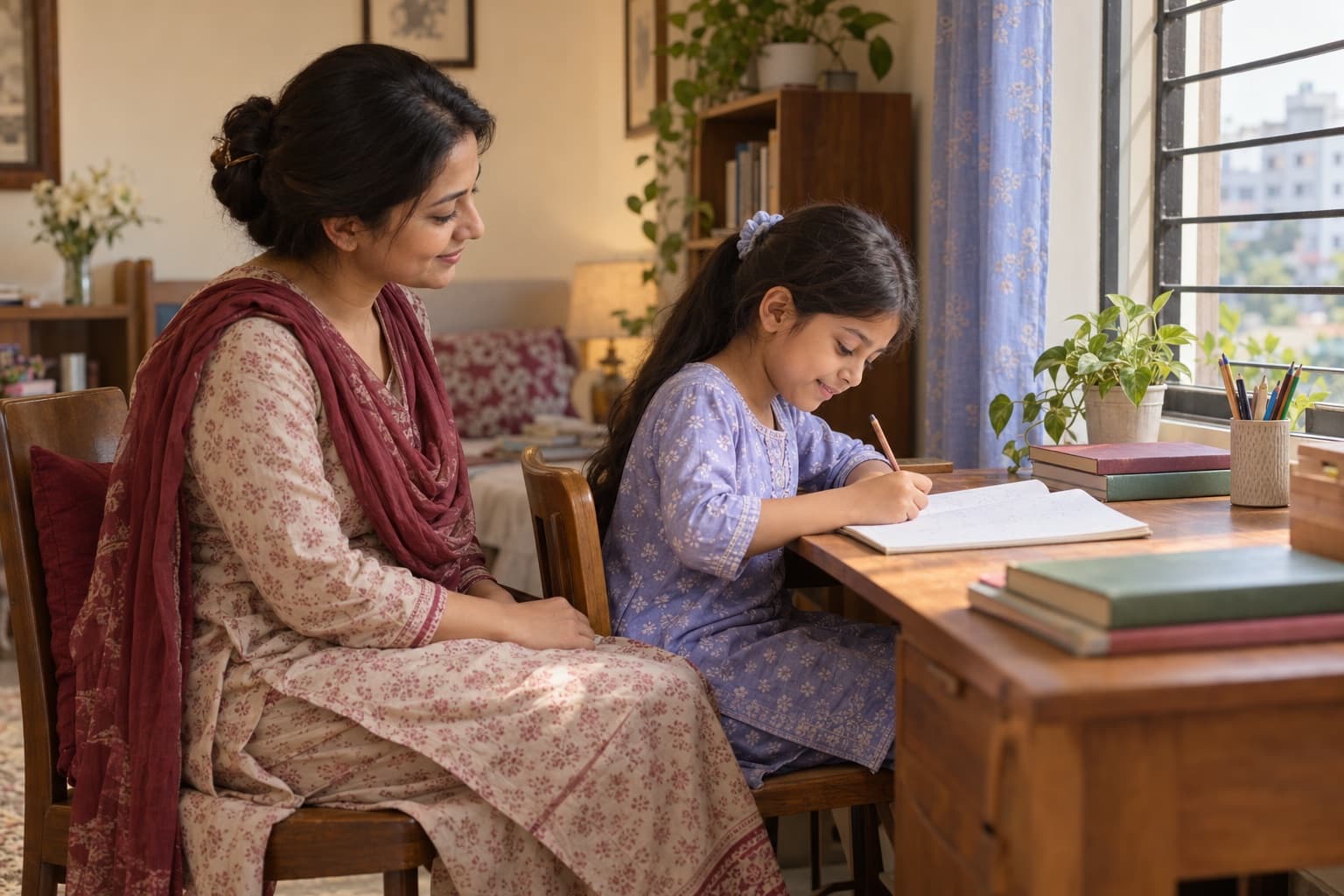
If your child tears up a drawing over one wobbly line, refuses to play a game they might lose, or sits frozen over homework because an answer might be wrong, you may have a child afraid of failure. It is common, especially in careful, sensitive children and in homes and schools where marks matter a lot. With calm, everyday changes, many children learn that mistakes can be survived.
Below: the signs, why it happens, what to say after a mistake, how to praise effort, making mistakes normal at home, your own reaction to marks, a Bangladeshi home, a 7-day plan and when to get help. If your child mainly says “I'm stupid” or avoids anything new, building a child's confidence covers that side.
Signs of a child afraid of failure
Fear of failure can look like laziness or stubbornness from the outside. Common signs include:
- Tears, anger or tearing up work over small mistakes, such as one wrong sum or a smudge.
- Erasing, redoing or checking again and again, so homework takes far longer than it should.
- Refusing to start, or putting things off, when success isn't certain.
- Hating to lose: quitting games, changing the rules, or getting very upset when not first.
- Choosing only things they are already good at, and hiding marks they are not proud of.
- Asking “Is this right?” again and again, or needing you to check everything.
| Area | Healthy high standards | Perfectionism |
|---|---|---|
| Mistakes | Part of learning: annoying, then forgotten | Proof of being bad or stupid, remembered for days |
| Effort | Works hard and feels good about it | Avoids the task, or overworks until exhausted |
| Results | Pleased with progress, even when not top | Never satisfied, even with full marks |
| Feedback | Can hear a correction | Crumbles, argues or hides the work |
| New things | Curious, willing to be a beginner | Avoids anything they might not do well |
Why are some children so afraid of making mistakes?
Fear of failure usually grows from a mix of temperament and experience, rather than one cause:
- Temperament: some children are naturally careful, sensitive or hard on themselves.
- Praise for being clever: “You're so smart” can make a child afraid of anything that might prove otherwise.
- Strong reactions to mistakes: sighs, scolding, laughter or punishment over marks can teach that mistakes are dangerous.
- Comparison with brothers, sisters, cousins or the class topper.
- Exam culture: class tests, roll numbers and coaching results can turn every task into a judgement.
- Copying adults: children notice when a parent is harsh about their own mistakes, and worry and perfectionism often go together.
| Age | What you might see | What often helps |
|---|---|---|
| 5–7 years | Tears over drawings or handwriting, quitting games, needing to be first | Playful practice, games where adults lose too, praise for trying |
| 8–11 years | Erasing and redoing homework, hiding marks, avoiding new sports or contests | A limit on redoing, effort praise, hearing about your mistakes |
| 12–15 years | Studying late into the night, harsh self-talk, avoiding anything they might not top | Listening without fixing, protecting sleep, separating marks from worth |
What to say when your child makes a mistake
The first minute after a mistake matters most. Try these steps in order:
- Pause your own reaction: take a breath before you speak, and keep your face soft.
- Name the feeling: “You're really upset that this went wrong.”
- Make it normal: “Everyone gets things wrong when they're learning.”
- Separate the mistake from your child: “This answer is wrong. That doesn't mean you're bad at maths.”
- Get curious together: “What happened here? What could we try next time?”
- Make the next step small: fix one line, try one more throw, start a fresh page.
- Later, notice the recovery: “You were upset, and you still tried again.”
What you might say
- Oops, a mistake. Good, now we know what to practise.
- You're upset, and that's okay. Mistakes are part of learning.
- It doesn't have to be perfect. Finished is good enough for today.
- I love you just the same, whatever the mark.
- What's one thing you learned from this?
How to praise effort, not just results
Effort praise helps a child afraid of failure see that trying is what counts. Be specific, and praise what your child can control; how to praise a child has many more examples.
- Praise the effort: “You kept going even when it got hard.”
- Praise the strategy: “You checked your answer a different way.”
- Praise the recovery: “You made a mistake and fixed it yourself.”
- Add “yet”: “You can't do long division yet.”
- Go easy on “You're so clever” or “You're a genius”; they can make the next mistake feel bigger.
This is what people mean by a growth mindset for kids: the belief that skills grow with practice. Posters on the wall matter less than how you respond on an ordinary evening when the homework goes wrong.
How to teach kids to handle mistakes at home
- Let your child lose at games sometimes. Ludo, carrom and cricket are safe practice for losing well, so don't always let them win.
- Set a limit on redoing: one draft, one check, then it's done. Use pencil, not pen, for first tries.
- Let small things go wrong: a lopsided sandwich or a forgotten book teaches more than being rescued.
- Try new things as a family where everyone is a beginner, such as a new recipe, a song or a sport.
- Make it a family rule that nobody laughs at anyone's mistakes, including brothers, sisters and cousins.
- Show your own recovery out loud: “I burnt the rice. Let's see what we can save.”
Marks, results and your own reaction
Children watch your face when you see a test paper. If marks bring silence, anger or comparison, a child can learn that their worth rises and falls with every result. A few habits help:
- Look before you speak, and find one thing to appreciate first, such as a hard question they got right.
- Ask about the learning, not the rank: “Which question are you proudest of? Which one was hard?”
- Never punish or shame a child for marks, and never compare them with the class topper or a cousin; see comparing your child with others.
- Separate marks from love out loud: “Marks tell us what to practise. They don't tell me who you are.”
- Notice your own fear: if your stomach drops at a low mark, that worry is real, but it is yours to manage, not your child's to carry.
If tests themselves bring tears or stomach aches, exam stress in children has a fuller plan.
In a Bangladeshi home: roll numbers, GPA 5 and relatives' questions
Many Bangladeshi parents push hard because they love hard and want a secure future for their child. Some everyday habits can still feed the fear of failure without anyone meaning to:
- Being first: coming first in class, roll number 1 or GPA 5 can become the only goal. Celebrate learning, effort and kindness out loud too.
- Relatives' questions: at Eid or a wedding, “How many marks did you get?” can feel like another exam. Agree a short, warm answer together: “He's working hard, and we're proud of him.”
- Red ink and read-out results: when a copy comes back covered in corrections, talk about what they mean without adding your own.
- The “good student” label: the child known as the clever one is often the most afraid of a single slip. Let them be ordinary sometimes.
- Competitions: recitation, drawing and quiz contests can be joyful. Praise taking part, and skip the post-mortem on the way home.
A 7-day plan to ease the fear of mistakes
Helping a child afraid of failure works best in small steps. Write one line a day: one mistake, how your child reacted, and how you reacted.
- Day 1: change nothing. Notice when the fear shows up: homework, games, drawing or tests.
- Day 2: share one of your own mistakes at dinner, and what you did next.
- Day 3: swap one “You're so clever” for an effort comment.
- Day 4: play a game your child might lose, and show how to lose well yourself first.
- Day 5: set a redo limit for homework: one draft, one check, done.
- Day 6: when a mark comes home, ask “Which question are you proudest of?” before anything else.
- Day 7: compare with Day 1. Fewer tears, or a quicker recovery? Keep what helped, and add one more change next week.
When to get help for perfectionism and fear of failure
Most children ease up with calm support over a few weeks. Talk to your child's doctor, the school or a child psychologist if you notice:
Get help if
- Worry about mistakes keeps your child from trying, such as starting homework, going to class or joining games, for several weeks, even with support.
- Tears or anger over almost every mistake for several months.
- Checking, redoing or erasing that your child can't stop even when they want to, or that takes hours most evenings.
- Stomach aches, headaches or poor sleep before tests on most school days for two weeks or more.
- Low mood most days for two weeks or more, or any talk of not wanting to live or of self-harm. For any such talk, stay calm and close: call 999 if your child is in danger now; otherwise speak to a doctor the same day.
- A sudden change, such as new fear of school or of one person: believe your child, act the same day, and call 999 if they are in danger now.
Learning to live with mistakes is slow, and it shows in small moments: a quicker recovery, a game finished after a loss. ParentMind helps you note what happens each day and spot patterns over time: how ParentMind works.
Questions parents ask
Why does my child cry when they make a mistake?
Often because the mistake feels much bigger to them than it is, as if it shows they are bad or might disappoint you. Sensitive, careful children and children under pressure about marks are more prone to it. Stay calm, name the feeling, call mistakes normal and help with one small next step. Tears over almost every mistake for months are worth raising with a doctor.
How do I help a perfectionist child?
Praise effort and strategy rather than results, share your own mistakes, and set limits on redoing work, such as one draft and one check. Let them lose at games sometimes, and let small things go wrong. Avoid comparisons and big reactions to marks. Many children ease up over a few weeks of steady, calm practice like this.
Is perfectionism in children a sign of anxiety?
It can be linked. Perfectionism and worry often go together, and some perfectionist children are anxious underneath. Wanting to do well is healthy. It becomes a concern when fear of mistakes keeps a child from trying for weeks, brings tears most days, or leads to checking they cannot stop; then talk to a doctor or the school.
My child hates losing. Should I let them win at games?
Not every time. Losing at ludo, carrom or cricket with you is safe practice for coping with failure. Show how to lose well yourself: “Oh, you got me. Good game.” With young children, mix games of luck and skill. If losing ends in a meltdown, stay calm, take a break and play again another day.
My child gives up easily. What should I do?
Make tasks smaller so success comes quickly, and praise sticking with it: “You kept going for five more minutes.” Sit nearby, but wait a little before helping. Remind them of times they kept trying and got there, like learning to ride a bicycle. If giving up comes with low mood most days for two weeks or more, talk to a doctor.
What is a growth mindset for kids?
A growth mindset is the belief that skills grow with practice rather than being fixed. Children who hold it tend to see mistakes as part of learning. You can encourage it by praising effort and strategy, adding the word “yet” and sharing how you learned hard things, far more than through slogans or posters.
This article is general information, not medical advice. For health worries, talk to a doctor; if someone is in danger, contact your local emergency number.