School morning routine for kids: calm mornings, out the door on time
Quick answer
A good school morning routine for kids starts the night before: bag packed, uniform out, enough sleep. Set the wake-up time from when you must leave, keep the morning to 5–6 steps in the same order, eat breakfast without screens and say goodbye calmly. Children aged 6–12 need 9–12 hours of sleep, so work bedtime back from the alarm.
 By the ParentMind team12 min read
Listen to this article
16 min listen · Read by your device's voice
At a glance
- Who it is for
- Parents of children aged 5–14 whose school mornings end in rushing, nagging or tears
- Key takeaways
- Most of a calm morning is made the night before: bag, uniform, shoes, tiffin plan and an early enough bedtime.
- Count back from the time you must leave to find the wake-up time, then count back from that to find bedtime.
- Five or six steps in the same order, on a chart your child can tick, work better than reminders shouted from the kitchen.
- A short, same-every-day goodbye at the gate helps most children walk in calmly.
If every school morning ends with shouting, a missed van and a child in tears, a steady school morning routine for kids can make the whole day calmer. Mornings are hard in most families with school-age children, especially with early shifts and long journeys through traffic.
Most morning battles come from a few fixable things: too little sleep, too many steps and decisions, and too little time. None of them is about a lazy child or a bad parent, and most families can change them within a week or two.
Below: why mornings fall apart, a night-before checklist, wake-up times worked back from sleep, a step-by-step routine with a sample timetable, breakfast, morning shifts, traffic and goodbyes, a 7-day plan and when to get help.
Why are school mornings so hard?
School mornings squeeze many tasks into a short, fixed window, often with a tired child and an adult who is also getting ready. A few causes come up again and again.
- Not enough sleep: a late bedtime makes a child slow, grumpy and hard to wake, and no morning plan can fully make up for it.
- Too many steps and decisions: which socks, which tiffin, where's the ID card. Every choice in the morning costs minutes.
- A child's pace: young children are slow at dressing and easily distracted, so a child slow to get ready for school is often just being their age.
- Screens: a cartoon or a phone in the morning makes every next step a fight to switch it off.
- The adult's rush: children pick up on stress, and a hurried, loud morning often makes them slower, not faster.
- Worry about school: morning meltdowns before school, tummy aches or dawdling can be a sign that something at school feels hard.
The night before: a school checklist that saves the morning
Ten or fifteen minutes after dinner can save the worst half hour of the morning, which makes it the first step of any school morning routine for kids. Do it at the same time each school night, and let your child do as much as their age allows.
- Bag: check tomorrow's class timetable together and pack the books, copies, pencil box and homework.
- Diary and notices: sign the school diary, and put any fees, forms or money for the van in the bag.
- Uniform: ironed and laid out with socks, belt, tie and ID card, plus a sweater in winter.
- Shoes and umbrella: clean shoes by the door, and an umbrella or raincoat in the rainy season.
- Tiffin and water: decide tomorrow's tiffin, prepare what you can, and wash and fill the water bottle.
- A wash and an early night: a bath or wash in the evening saves time, and devices stay out of the bedroom.
What time should kids wake up for school? Work back from sleep
Start from the time you must leave. Add the real travel time and a 10-minute buffer, then about 45–60 minutes to get ready; younger children often need the longer end. That gives the wake-up time, and the table below gives the latest time to be asleep.
| Age | Sleep in 24 hours | Wakes at 5:30 am | Wakes at 6:00 am | Wakes at 6:30 am | Wakes at 7:00 am |
|---|---|---|---|---|---|
| 5 years | 10–13 hours | Asleep by 7:30 pm | Asleep by 8:00 pm | Asleep by 8:30 pm | Asleep by 9:00 pm |
| 6–12 years | 9–12 hours | Asleep by 8:30 pm | Asleep by 9:00 pm | Asleep by 9:30 pm | Asleep by 10:00 pm |
| 13–14 years | 8–10 hours | Asleep by 9:30 pm | Asleep by 10:00 pm | Asleep by 10:30 pm | Asleep by 11:00 pm |
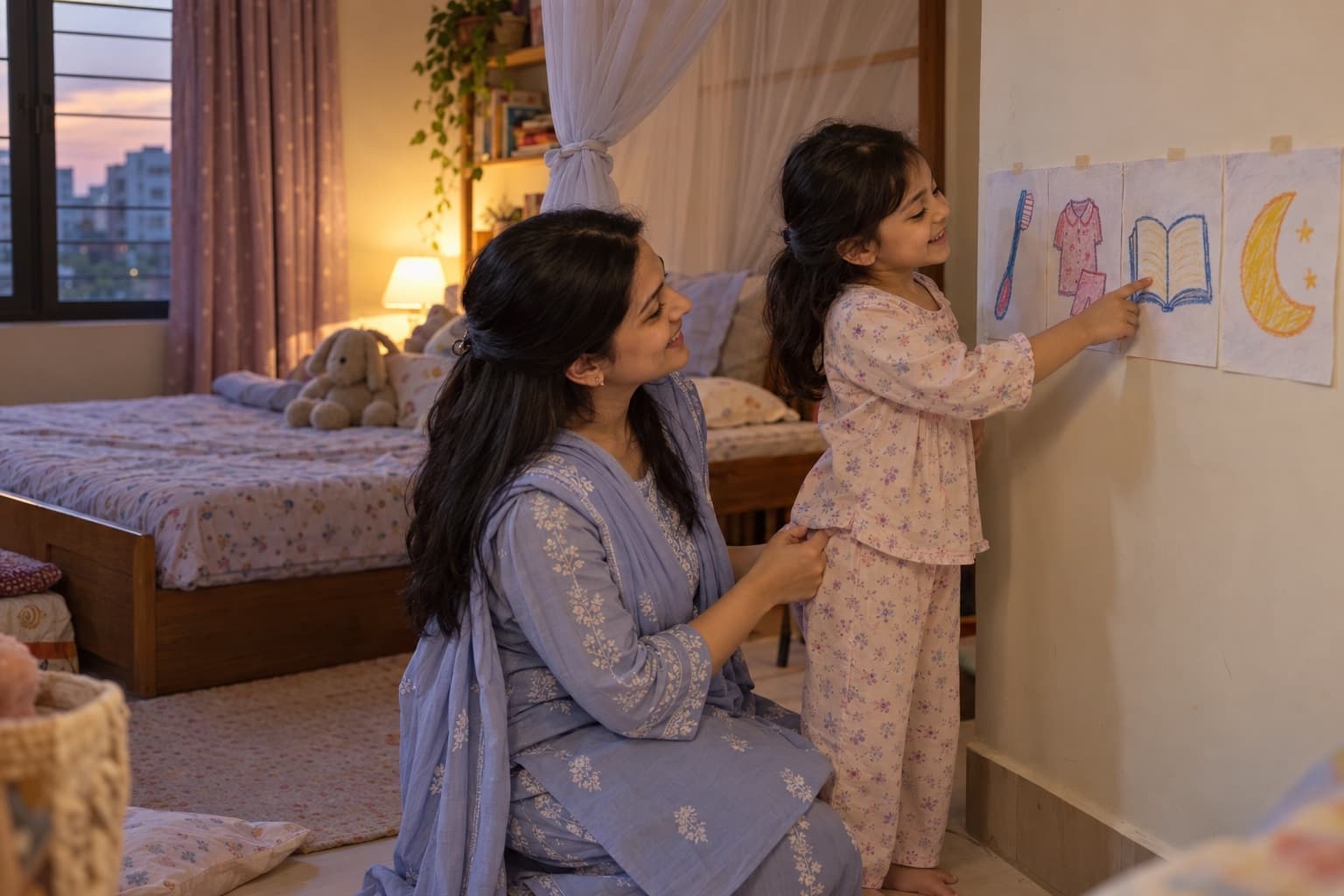
These are the latest times, not the ideal ones; many children, especially younger ones, do better asleep earlier. Start the wind-down about an hour before, with no screens; a children's bedtime routine shows how. For children aged 6 and over, the free school-day planner does these sums from your child's age and wake-up time.
How to build a school morning routine for kids, step by step
- Choose five or six steps in the same order every day, for example: toilet and wash, uniform, breakfast, teeth and hair, shoes and bag, goodbye.
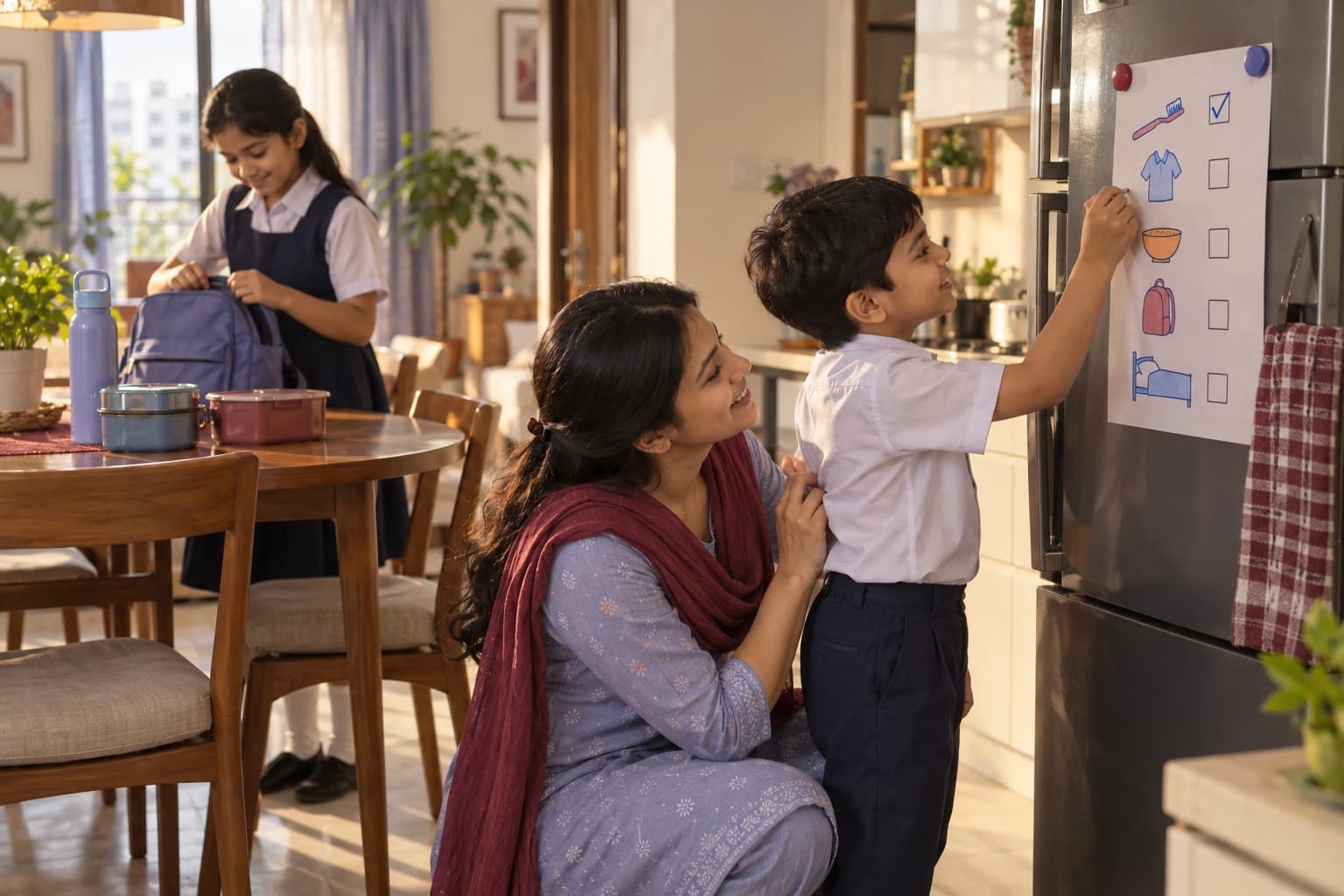
- Make a morning routine chart together: pictures for younger children, a short checklist for older ones, at your child's eye level.
- Get up 15 minutes before your child, so you are dressed and calm when they wake.
- Wake them gently: curtains open, lights on, a cuddle and a five-minute warning instead of a shout from the door.
- Keep screens off until everyone is ready to leave, or off for the whole morning.
- Use 'first, then' instead of nagging: 'First shoes, then you can choose the song for the ride.'
- Leave five spare minutes for the goodbye, so it never has to be rushed.
| Time | Your child | You |
|---|---|---|
| 5:45 am | Still asleep | Up and dressed, tiffin into the box |
| 6:00 am | Wake up, toilet, wash face | Curtains open, a cuddle, a five-minute warning |
| 6:10 am | Uniform on, laid out last night | Help with buttons or hair for younger ones |
| 6:20 am | Breakfast at the table, no screens | Sit and eat with them if you can |
| 6:40 am | Brush teeth, comb hair | Tiffin and water bottle into the bag |
| 6:50 am | Shoes and bag on, last tick on the chart | A quick check: ID card, diary, umbrella |
| 7:00 am | Out of the door | A hug and 'See you at half past twelve' |
For a day-shift school, the same steps simply move later, and the morning has room for play and homework; a daily routine for school children has full timetables for both shifts.
What you might say
- Morning, sweetheart. Curtains are open; up in five minutes.
- What's next on your chart?
- Uniform first, then breakfast.
- Ten minutes until shoes. You're doing well.
- Look, everything on your chart is ticked. Off we go.
- I'll be at the gate at half past twelve.
What your child can do alone, by age
- 5–7 years: follow a picture chart with you nearby, dress with a little help, choose between two breakfasts.
- 8–10 years: pack their own bag the night before, follow a written checklist, use a timer for each step.
- 11–14 years: set their own alarm clock, check the timetable, lay out their uniform and get ready largely alone.
Breakfast on a school morning: quick ideas that travel well
Breakfast is often the first thing a rushed morning drops. Small and simple still counts, and a child who isn't hungry at 6 am can eat a little at home and a bigger tiffin later.
- Ready in minutes: a banana and milk, bread with egg, chira or muri with yoghurt and fruit, or half a paratha with an egg.
- Made the night before: roti or suji kept covered, boiled eggs in the fridge, cut fruit in a box.
- Sit down to eat, without a cartoon or phone; eating with a screen on usually takes longer.
More ideas, and what to do about the child who is never hungry early, are in breakfast on busy school mornings.
Morning shifts, traffic and the school gate: school mornings in Bangladesh
A school morning routine for kids in Bangladesh has to fit things few routine charts mention: very early shifts, unpredictable traffic, rain and a full house.
- Morning shifts: when school starts around 7:00 or 7:30 am, bedtime has to move earlier too. In winter, children wake in the dark, so put lights on, open the curtains and lay out warm clothes the night before.
- Traffic and the school van: plan for the slow days, not the good ones, and have your child ready five minutes before the van or rickshaw is due.
- Use the ride: talk, sing or look out of the window together, and keep phones in the bag.
- Prayer times: in families who wake for Fajr, some children go back to sleep afterwards. Count their sleep from when they actually sleep, and keep the second waking gentle.
- Gas, power and house help: if gas or power is unreliable early, iron and prepare the night before, and share the chart with grandparents or house help who help in the mornings.
- Siblings on different shifts: let the day-shift child sleep on or help quietly, so the morning-shift child can get out calmly.
A calm goodbye at the school gate
Keep the goodbye short, warm and the same every day: a hug, a special handshake and 'See you at half past twelve'. Don't slip away while your child isn't looking, and don't stay longer because they cry; hand them to the teacher, smile and leave. Most children settle within minutes of the parent going.
A 7-day plan for calmer school mornings
Change one thing at a time and write one line each morning: when your child woke, when you left, and where the morning got stuck.
- Day 1: change nothing. Time each step of the morning and note where it slows down.
- Day 2: work out the wake-up time from the leaving time, and the latest bedtime from the table above.
- Day 3: start the night-before checklist after dinner.
- Day 4: make the morning chart together and put it up at eye level.
- Day 5: keep screens off until you leave, and get up 15 minutes before your child.
- Day 6: on the weekend, keep wake-up within about an hour of a school day.
- Day 7: compare with Day 1. Fewer reminders, an earlier start, a calmer goodbye? Keep what helped and change one more thing next week.
When is a hard morning a sign of something more?
A steady school morning routine for kids eases most morning battles within a couple of weeks. Some signs suggest something else is going on, such as a sleep problem or a worry about school.
Talk to the school or a doctor if
- Stomach aches, headaches, tears or refusal on most school mornings for a few weeks, which ease at weekends; see school anxiety.
- Your child is very hard to wake on most days despite enough hours in bed, falls asleep in class, or snores loudly with pauses in breathing.
- Goodbyes at the gate are still very hard after a month of a calm, steady goodbye routine.
- A sudden refusal to go, or fear of a van driver, a teacher or another child: believe your child, keep them away from that person and act the same day. Report abuse or an adult who hits your child to the local police station (thana), and call 999 if your child is in danger now.
- You find yourself shouting most mornings and feel close to losing control: take a breath, step back, and talk to someone you trust or a doctor about getting support.
Mornings get easier in small steps, and the change is easy to miss. ParentMind helps you note what happens each day, see patterns and get guidance: how ParentMind works.
Questions parents ask
Is 6 am too early for a child to wake up for school?
Not if bedtime is early enough. Children aged 6–12 need 9–12 hours of sleep, so a child who wakes at 6:00 am should be asleep by 9:00 pm at the latest, and a 5-year-old, who needs 10–13 hours, by 8:00 pm. Many morning-shift families wake around this time; the bedtime is what makes it work.
How long should a morning routine take for kids?
Many families find about 45 minutes to an hour from waking to leaving is enough, plus the travel time. Younger children often need the longer end because they dress slowly and get distracted. If your mornings take much longer, look for the step that drags, usually breakfast with a screen or hunting for lost things.
How can I get my child ready for school faster?
Move as much as you can to the night before: bag, uniform, shoes, tiffin plan and a bath. In the morning, keep five or six steps in the same order on a chart, keep screens off and get up a little before your child. Hurrying and nagging often slow children down; calm, short instructions usually work better.
My child does everything slowly in the morning. What helps?
First check sleep: a tired child is a slow child. Then shrink the steps, stay close for the hardest one, and use a timer or a song as a friendly race against the clock, not against a sibling. Praise the steps done ('Uniform on already!') more than you point out the ones left.
Is it okay for kids to watch cartoons before school?
It usually makes mornings harder. A screen pulls attention away from every step, and switching it off often starts an argument just when you need to leave. Many families keep screens off until everyone is ready, or off for the whole school morning. If you allow one, keep it short and make it the last step, after shoes.
Why does my child have meltdowns before school?
Usually because of tiredness, hunger or rushing, and sometimes worry about something at school. Check bedtime first, give breakfast before any argument, and keep the morning calm and predictable. If tears, tummy aches or refusal happen on most school mornings for a few weeks and ease at weekends, talk to the teacher about what feels hard.
This article is general information, not medical advice. For health worries, talk to a doctor; if someone is in danger, contact your local emergency number.