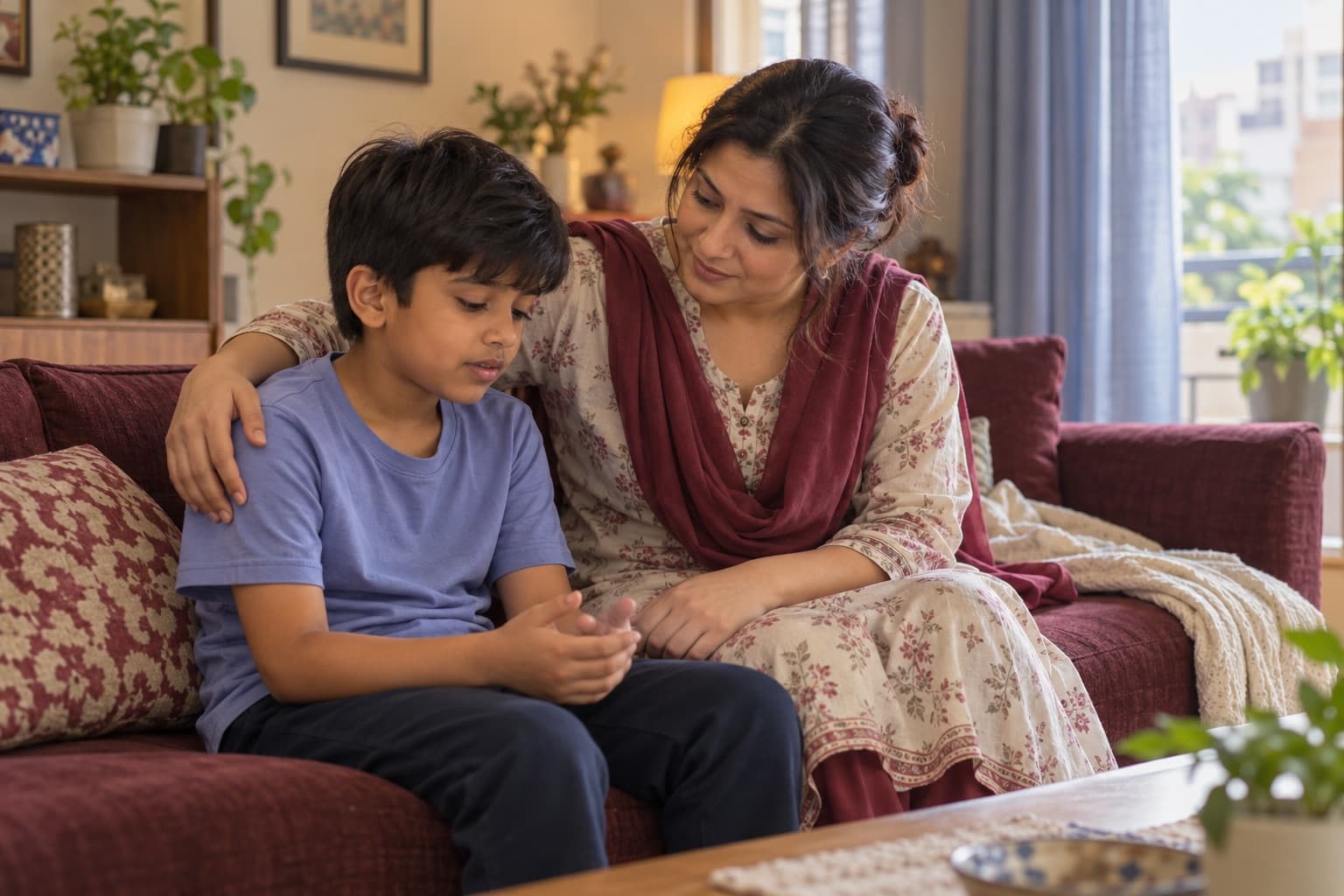
My child seems sad all the time: what to notice and when to get help
Quick answer
If your child seems sad all the time, notice how long it lasts and how much it changes daily life. Sadness lifting within days is usually ordinary; low mood most days for two weeks or more means a doctor soon. Self-harm talk: stay calm and close, call 999 if they are in danger now, otherwise a doctor the same day.
 By the ParentMind team12 min read
Listen to this article
16 min listen · Read by your device's voice
At a glance
- Who it is for
- Parents of children aged 5–16 who seem sad, quiet or withdrawn, have lost interest in play or friends, or say “nothing” is wrong
- Key takeaways
- Sadness is a normal feeling, and most low patches lift within days with comfort, routine and time with people who care.
- Low mood most days for two weeks or more, or a big change in sleep, food, school or friendships, means seeing a doctor soon.
- A calm, side-by-side chat, listening more than fixing, often helps a child say what is wrong.
- Any talk of not wanting to live or of self-harm: stay calm and close, call 999 if your child is in danger now, otherwise speak to a doctor the same day.
When your child seems sad all the time, every quiet evening can feel like a question. Maybe your 8-year-old no longer wants to play cricket downstairs, your 13-year-old stays in their room after coaching, or the answer to every question is “nothing”.
Sadness is a normal, healthy feeling, and most low patches pass with comfort and time. Sometimes, though, low mood lasts and starts to change a child's daily life, and then it needs a doctor's help. This page can't diagnose your child, but it can help you notice, talk and act at the right time.
Below: ordinary sadness or something more, signs by age, common causes, what to say, everyday things that help, grief and bullying, life in a Bangladeshi home, a 7-day plan and when to get help.
Ordinary sadness or low mood that lasts: how can you tell?
Every child feels sad sometimes, after a scolding, a lost match, a friend's unkind word or a bad mark. If your child seems sad all the time, the difference that matters is how long it lasts and how much it changes daily life.
| What to look at | Ordinary sadness | Low mood that needs a doctor soon |
|---|---|---|
| How long | Hours or a few days, then it lifts | Most days, for two weeks or more |
| Comfort and fun | Cheers up with comfort, a treat or a game | Little lifts it; no joy in things they used to love |
| Friends and family | Still wants company, at least some of the time | Pulls away from friends and family most of the time |
| Sleep, food and energy | Mostly as usual | Big changes: sleeping or eating much more or less, tired all the time |
| School and play | Copes, even on a bad day | Stops playing, falls behind or doesn't want to go to school |
Only a doctor can tell what is going on, and you don't need to be sure before you ask. Being worried is reason enough to talk to someone.
Signs of sadness in children at different ages
Children don't always say “I'm sad”; you may just notice they don't want to play, or have gone quiet. Low mood often shows in behaviour, and it looks different at each age:
- 5–8 years: clingy or tearful, more tantrums, tummy aches or headaches, playing less, or saying “nobody likes me”.
- 9–12 years: quiet, irritable or bored with everything, dropping hobbies, worrying about school, or saying “I'm stupid” or “what's the point?”
- Teenagers: long hours alone in their room, snapping at family, sleeping much more or less, dropping friends, or losing interest in looking after themselves.
Irritability is easy to miss: in many children and teens, low mood looks more like anger than tears. For a teen who mostly snaps, see teen mood swings and anger.
Why might my child seem sad or withdrawn?
A child who seems sad or withdrawn usually has more than one thing going on, and sometimes no clear cause at all. Common ones:
- A loss: a death in the family, a friend moving away, a pet dying, or a parent going abroad for work.
- Trouble with friends, or bullying at school, at coaching or online.
- Changes at home: a new baby, parents arguing, a move, or money worries the child picks up on.
- Pressure: exams, coaching, comparison with cousins, or feeling they never do well enough.
- Too little sleep, too little time outside and moving, or screens crowding out both.
- Worry that has gone on a long time; see anxiety in children.
- Illness, or feeling unwell for a while.
A sudden change, such as a cheerful child who becomes fearful, quiet or withdrawn, or who suddenly fears a person or place, can mean something is happening to them. Ask gently, believe what your child tells you, act the same day, and call 999 if they are in danger now.
How to talk to a sad child: what to say first
Many children find it easier to talk side by side than face to face. These steps often help a sad child open up:
- Choose a quiet, ordinary moment: a rickshaw ride, cooking together, or a few minutes at bedtime.
- Say what you've noticed, without judging: “You've seemed quiet this week.”
- Listen more than you talk. Let silences sit, and don't rush to fix it or cheer them up.
- Name and accept the feeling: “That sounds really hard.” Avoid “Don't be sad” or “Other children have it worse.”
- If you're worried, ask gently and directly whether they have thought about hurting themselves. Most child-health guidance says asking calmly does not put the idea in a child's head.
- End with a next step together: something small to try, or seeing the doctor together.
What you might say
- You've seemed a bit low lately. I'm here if you want to talk.
- You don't have to tell me everything. Even a little helps.
- That sounds really hard. Thank you for telling me.
- Nothing you tell me will make me love you less.
- Sometimes when people feel this low, they think about hurting themselves. Have you had thoughts like that?
- We'll work this out together.
Everyday things that help a sad child: routine, sleep, food and screens
Everyday routines can't replace a doctor when one is needed, but they often help a low child feel safer and a little better:
- Keep routines: school, meals and bedtime at roughly the same times, even when your child would rather stay in bed.
- Protect sleep: most 6- to 12-year-olds need 9–12 hours in 24 hours, and teenagers 8–10.
- Regular meals and nashta, even small ones; low mood often takes appetite away.
- Move every day: at least 60 minutes of active play or exercise for children from 5 to 17, outside in daylight if you can.
- Screens: none in the hour before bed, and devices out of the bedroom at night. Notice how your child seems after time online, especially on social media.
- Ten minutes of one-to-one time each day, doing something your child chooses, with no lectures.
- Small, doable plans: one friend over, a walk to buy jhalmuri, helping cook a favourite dish.
When grief or bullying is behind the sadness
Grief and bullying are two of the most common reasons a child becomes sad or withdrawn, and each needs its own kind of help:
- Grief: after a death, sadness can come in waves for months, mixed with normal play. Talk about the person, keep routines and let your child see that sadness is allowed; see how to talk to a child about death.
- Bullying: a child who suddenly dreads school, comes home quiet or hides their phone may be bullied. Believe your child and act the same day; see what to do if your child is bullied at school.
- Losing a friend: falling out with a best friend can hurt as much as a bigger loss. Take it seriously, and help your child find one small way to connect with others again.
In a Bangladeshi home: exams, elders and “what's there to be sad about?”
Some things around a child's low mood are especially common in Bangladeshi homes, and naming them makes them easier to handle:
- “What has a child got to be sad about?”: elders may wave away a child's feelings, out of love. Children feel low too, and being taken seriously helps.
- “Boys don't cry”: boys often show sadness as anger or silence instead. Let sons, as well as daughters, say they feel sad.
- Exams, coaching and rank: long days and constant comparison with cousins or classmates can wear a child down. Notice effort, not just marks.
- Little private space: in shared rooms and joint families, a child may have nowhere to be quiet. A few minutes alone, or a walk with one parent, can help.
- A parent working abroad: missing a father or mother who works in another country is a real loss. Regular calls and talking about them openly often help.
- Worry about what people will say: seeing a doctor about low mood is ordinary health care, like seeing one for a cough that won't go away, and it stays private.
- Comfort in hard times: many families find comfort in prayer or a dua. Whatever comforts your family, keep watching the signs below and see a doctor when they appear.
A 7-day plan for a child who seems low
A short note each evening shows the pattern more clearly than memory. Write one line: mood, sleep, food, play or friends, and anything that seemed to help. If you see a doctor, take the notes with you.
- Day 1: change nothing yet. Note mood, sleep, food and play.
- Day 2: spend 10 minutes side by side doing something your child chooses.
- Day 3: protect sleep: screens off an hour before bed, devices out of the bedroom.
- Day 4: get outside together for active play or a walk.
- Day 5: have a gentle talk using the lines above, and listen.
- Day 6: ask the class teacher how your child seems at school.
- Day 7: look back over the week. Lifting? Keep going. Still low most days, and close to two weeks in all? Book a doctor's visit.
When to get help if your child seems sad all the time
Talk to your child's doctor or a child psychologist soon if you notice any of these. You don't need to wait until you are sure:
Get help if
- Any talk of not wanting to live or of self-harm, or signs your child has hurt themselves: stay calm and close. Call 999 if your child is in danger now; otherwise speak to a doctor the same day.
- Low mood most days for two weeks or more: see a doctor soon.
- Withdrawn from family and friends, or no joy in things they used to love, for two weeks or more.
- Big changes in eating, weight or sleep, or not managing school, such as refusing to go or marks falling sharply.
- A sudden change with fear of a person or place, secrecy, or injuries or gifts you can't explain: believe your child, keep them away from anyone who may have hurt them, act the same day and report it at the local police station; call 999 if they are in danger now.
- Signs of drugs or alcohol: get help the same day.
Low moods are easier to see as a pattern than day by day. ParentMind helps you note what happens each day, see patterns and get guidance: how ParentMind works.
Questions parents ask
Is it normal for a child to be sad for no reason?
Sometimes, yes. Children can feel low because they're tired, unwell, hungry or stressed without being able to say why, and it usually passes within days. If the sadness lasts most days for two weeks or more, or your child stops enjoying things they used to love, talk to a doctor soon.
How long is too long for a child to be sad?
Low mood most days for two weeks or more is the usual sign to see a doctor soon, even if your child still has some good moments. Go sooner if it is changing sleep, eating, school or friendships a lot. Any talk of not wanting to live or of self-harm needs action the same day; call 999 if your child is in danger now.
Can young children be depressed, or is it just sadness?
Low mood that lasts can affect children of any age, though in young children it often looks different: more irritable, clingy or tearful, with tummy aches and less play. Only a doctor can say whether it is depression or something else. If it lasts most days for two weeks or more, see a doctor soon.
My teenager stays in their room all the time. Is that normal?
Often, yes: teenagers need more time alone. It's more worrying if they also drop friends, stop enjoying things, sleep or eat very differently, or seem low most days for two weeks or more. Keep short daily moments together and knock before entering; see when your teenager won't talk to you.
Can screen time make a child sad?
It can add to low mood when it cuts into sleep, play and family time, or brings unkind messages and comparison online. Keep screens out of the hour before bed and devices out of the bedroom at night, and notice how your child seems after time online. Screens are rarely the only cause, so look at the whole day.
Will asking about self-harm put the idea in my child's head?
Most child-health guidance says no: asking calmly and directly does not plant the idea, and many children feel relieved that someone noticed. Ask gently, listen and stay calm whatever the answer. If your child has had such thoughts, stay close: call 999 if they are in danger now; otherwise speak to a doctor the same day.
This article is general information, not medical advice. For health worries, talk to a doctor; if someone is in danger, contact your local emergency number.