Parent working abroad and children: staying close from far away
Quick answer
A parent working abroad and children at home can stay close with short video calls at a fixed time, simple honest explanations and a say in everyday decisions. Support the parent at home, who carries most of the load. Clinginess or shyness around homecomings and goodbyes is common; low mood for two weeks or more needs a doctor.
 By the ParentMind team13 min read
Listen to this article
17 min listen · Read by your device's voice
At a glance
- Who it is for
- Families with a father or mother working abroad: children aged 2–16, and the parent or grandparents raising them at home
- Key takeaways
- Short, regular video calls at a fixed time usually work better than long, rare ones, and ordinary moments count most.
- Tell children simply and honestly where the parent is, why, and when you will all talk next; never slip away while a child sleeps.
- The parent at home is doing two jobs: back their decisions on calls, share the hard parts, and make sure they get rest and support too.
- Shyness at homecomings and clinginess after goodbyes are common and often ease within a few weeks; low mood most days for two weeks or more needs a doctor.
Abbu calls from Riyadh after his shift, and your 4-year-old hides behind the sofa. Your 11-year-old asks for the third time this week when he is coming home. Life with a parent working abroad and children growing up at home is the story of a great many Bangladeshi families, and it asks a lot of everyone.
Long-distance parenting is hard, but distance does not have to mean a distant parent. Many children grow up close to a father or mother they mostly see on a screen, especially when calls are regular, explanations are honest and the parent at home has support. You need a few steady habits, not perfect conditions.
Below: what children feel at each age, how to explain the distance, video calls that work, the parent at home, grandparents, money and gifts, homecomings and goodbyes, a 7-day plan and when to get help.
Parent working abroad and children: what do children feel at each age?
A child who misses a parent who lives abroad feels it differently at each age. Missing someone, anger, pride and worry can all sit together, and children often show it through behaviour rather than words:
| Age | What you might see | What helps |
|---|---|---|
| 2–4 years | Shy or uninterested on calls; clinging to the parent at home; sleep or toilet setbacks after a goodbye | Short daily calls; photos at the child's eye level; the same simple words: “Abbu is working far away. He'll call after dinner.” |
| 5–8 years | Asking again and again when they are coming back; worrying the parent left because of them; tears after calls; wanting gifts as proof of love | A picture chart to count down; saying clearly it isn't their fault; a goodbye ritual at the end of each call |
| 9–12 years | Understanding the reasons but feeling angry or left out; hiding sadness to protect the parent at home; ups and downs at school | Honest talk about why; one-to-one call time; sharing schoolwork and matches; letting them be a child, not a helper all the time |
| 13–16 years | Pulling away on calls; acting as “the man of the house” or a second mother; arguing with the parent at home; more time with friends | A say in decisions; chats in their style, such as messages or watching a match together; clear rules both parents back; no heavy adult burdens |
Many children also feel proud of a parent who works so hard, and that pride often grows when they understand the reasons. Feelings usually go up and down: harder after a goodbye, easier once routines settle.
How to explain to a child why a parent works abroad
Children usually cope better with a hard truth told kindly than with a mystery. Before a departure, and whenever they ask again:
- Tell them before the parent leaves: a few days ahead for young children, earlier for older ones, so they have time to ask.
- Explain simply: where they are going, that it is for work, and roughly how long, in terms your child understands, such as “after two Eids”.
- Say what stays the same: who will look after them, where they will sleep, and when you will all talk.
- Make clear it is not their fault, and that it doesn't mean less love.
- Say goodbye properly, even if there are tears. Slipping away while a child sleeps often makes clinginess worse; gentle goodbyes for separation anxiety has the steps.
- Leave something to hold on to: a T-shirt that smells of them for daytime cuddles, a recorded story, a photo by the bed.
What you might say
- Abbu is going to work in Dubai, far away. He'll call you every night after dinner.
- He isn't going because of anything you did. He loves you every single day.
- It's okay to miss Ammu. I miss her too. Shall we draw her a picture?
- You can feel sad and proud of Abbu at the same time.
- When we've coloured in all these boxes, Abbu plans to come home for Eid.
Video calls with children: how to stay connected from abroad
For a parent working abroad and children back home, the call is the bridge. A few habits make it stronger:
- Call at a fixed time that suits both time zones; the Gulf is a few hours behind Bangladesh, Malaysia a couple of hours ahead. Short calls on most days usually beat one long call a week.
- Do ordinary things together: eat a meal “together”, read the bedtime story, check homework, or watch them show a drawing or a new trick.
- Let young children wander off. A 3-year-old who runs away after a minute is normal; keep the phone where they can drift back.
- Give each child a few minutes alone with the parent, not only the family call.
- Don't turn calls into a report card. “Tell Abbu what you did!” makes the absent parent the punisher, and the call something to dread.
- When calls aren't possible because of shifts or camp rules, send voice notes, photos and short videos both ways.
Video calls with family are the good kind of screen time, even for babies under 18 months. Keep the family phone for calls, so a call doesn't slide into an hour of cartoons. For the parent abroad, a father's role in parenting has more ways to stay part of daily life.
The parent at home: raising children while your husband is abroad
The parent at home, most often the mother, is doing two people's jobs: school runs, illness at night, homework, money, discipline and often in-laws too, usually without a break. Loneliness and worry are common, and they are not a sign of failing.
- Decide the big things together on calls: school, health, money and rules. Then the parent abroad backs those decisions in front of the children.
- Share the hard parts too, not only the good news. A parent abroad who only ever hears “all fine” can't help.
- Ask for practical help: a relative for the school run, a neighbour you trust, a few hours a week for yourself.
- Keep routines simple and steady: meals, homework time, bedtime. Children feel safer when days look the same.
- Look after yourself: sleep when you can, keep one friendship going, and tell someone when it gets too much. Parent guilt and burnout has ideas for the hardest weeks.
When the mother works abroad
Many Bangladeshi mothers work abroad too, often leaving children with their father or grandparents, and children may hear unkind remarks about it. The same habits help: regular calls, a say in decisions, honest words, and a clear message that both parents love the child.
In a Bangladeshi home: in-laws, grandparents, money and Eid apart
Families with a parent abroad share some very Bangladeshi situations:
- Living with in-laws: agree the basics before the parent leaves, and let the parent abroad speak to their own family when there is friction. Joint family parenting has more.
- Grandparents as main carers: if both parents work abroad, or the mother is away, thank the grandparents, agree a few rules that matter, and keep the parents abroad in the loop.
- Money and gifts: remittance pays for school and home, and children may come to see the absent parent mainly as a gift-giver. Let gifts be extras, not apologies, and avoid “Abbu will buy it” as a bribe for good behaviour.
- The weight of sacrifice: “Your father suffers in the heat for you, so study!” can load a child with guilt. Talk about the parent's hard work with pride, not as a debt.
- Eid apart: plan a call for Eid morning, send a photo of the Eid table, and keep family traditions going so the day still feels like Eid.
- Gossip: a question like “Is your father ever coming back?” can frighten a child. Answer for them, briefly and kindly, and change the subject.
Homecomings and leaving again: how to help children through both
When the parent comes home
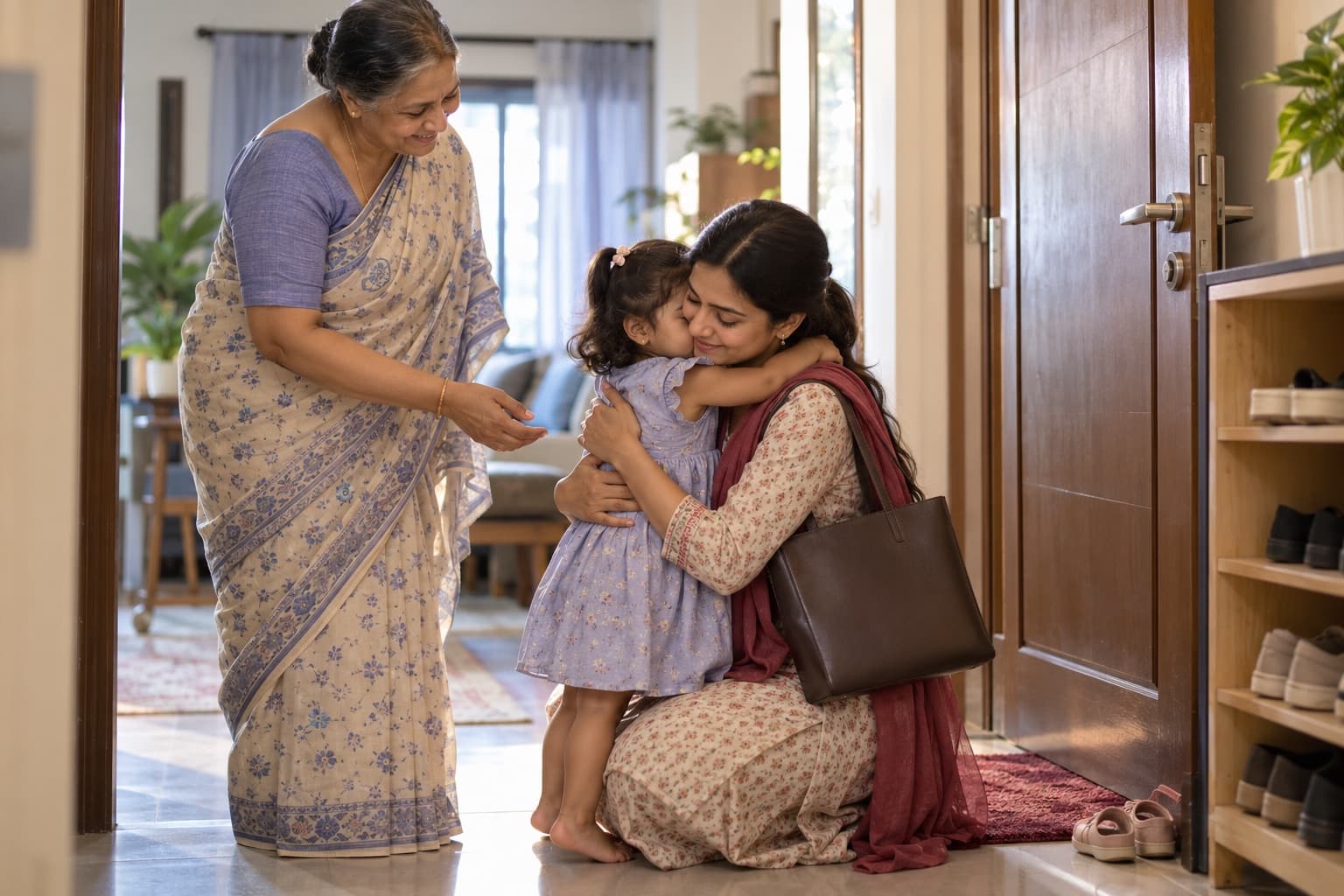
- Expect a warm-up. Young children may be shy, hide or cling to the other parent for a few days. Don't force hugs; play first.
- Join the routine rather than replacing it. Leave the rules with the parent who has kept them, and take over gradually.
- Keep the gifts small and the time big: one-to-one time with each child, the school drop-off, an ordinary Friday together. Quality time for working parents has easy daily rituals.
- Older children may test you or keep their distance. Stay patient; trust comes back through time together, not lectures.
When it's time to leave again
- Tell children ahead and count down together, so the leaving doesn't come as a shock.
- Keep the goodbye short and warm, and start the call routine the same week.
- Expect a dip for a few weeks: tears, tantrums, clinginess or bedwetting can come back for a while. Extra comfort and steady routines usually help.
A 7-day plan to feel closer across the distance
Pick one week. Each evening, note when you talked, what you did on the call, and how your child seemed afterwards.
- Day 1: Agree one fixed call time that suits both time zones, and tell your children.
- Day 2: Start a call box, and put a photo of the parent abroad at your child's eye level.
- Day 3: Do one ordinary thing on the call: a story, homework or a meal together.
- Day 4: Give each child a few minutes alone with the parent abroad.
- Day 5: Parents talk on their own: one decision to make together, and one hard thing to share honestly.
- Day 6: The parent at home takes one hour for themselves, while a relative they trust looks after the children.
- Day 7: Read your notes together on a call. Which calls went best? Keep that pattern next week.
When to get help for your child, or for yourself
Most children settle into the rhythm of calls, visits and goodbyes. Get help if you notice:
Get help if
- Your child seems low, withdrawn or very irritable most days for two weeks or more, or stops enjoying things they loved: talk to a doctor soon. For any talk of self-harm, stay calm and close, call 999 if they are in danger now, otherwise see a doctor the same day.
- Clinginess, bedwetting or sleep problems after a goodbye that are still getting worse after a few weeks, or refusing school for a week or more: talk to the school and your child's doctor.
- A teenager is skipping school, staying out late with new friends or money is going missing: talk calmly and contact the school this week. For signs of drugs, weapons or violence, get help the same day, and call 999 if your teen is in danger now.
- Any sign of abuse or a sudden change in behaviour, such as fear of one person, injuries nobody can explain, or a carer, relative or tutor who hits: believe your child, keep them away from that person, act the same day and report it at the local police station; call 999 if they are in danger now.
- You, the parent at home, feel low, hopeless or overwhelmed most days for two weeks or more: talk to a doctor soon. You deserve support too.
- You feel you might hurt your child: make sure the children are safe or with another adult, step away, and talk to a doctor the same day. If someone at home hurts or threatens you or the children, get to safety and act the same day; you can report it at the local police station. Call 999 if anyone is in danger now.
Distance is hard, but it doesn't decide how close a family feels. Steady calls, honest words and a supported parent at home can keep the bond between a parent abroad and their children strong. ParentMind helps you note what happens each day, see patterns and get guidance: see how ParentMind works.
Questions parents ask
Will my child forget their father while he works abroad?
Usually not, when contact is regular. Babies and toddlers may be shy on calls or for the first days after a homecoming, but they remember voices, faces and routines they meet often. Short daily calls, photos at eye level, recorded stories and the same bedtime rhyme from the parent abroad all help keep the bond alive.
How often should a parent abroad call their child?
Short calls on most days, at a time children can count on, usually work better than one long call a week. Five or ten minutes of real attention is plenty for a young child. Older children may prefer messages and a longer weekend call. What matters most is that calls are regular, and that promised calls happen.
How do I explain to my child why their father lives abroad?
Use simple, true words for your child's age: “Abbu works in Dubai so we can pay for school and home. He misses you and calls every night.” Say roughly how long, what stays the same, and that it isn't their fault. Answer as often as they ask; repetition is how young children make sense of it.
My child cries after every video call. Should we call less?
Usually not. Tears after a call often show love and missing, not harm. Keep calls regular, end them the same way each time, with a goodbye ritual such as a rhyme or “talk tomorrow”, and plan something comforting straight after: a cuddle, a story or a snack. If your child seems sad most days for two weeks or more, talk to a doctor soon.
Why is my child shy with their father when he comes home?
It is very common, especially under about 6. A parent on a screen feels different from a parent in the room, and young children need time to warm up. Don't force hugs or take it personally. Sit on the floor, play, feed them, join bedtime, and let them come to you. Many children warm up within a few days.
How can I raise my children alone while my husband works abroad?
Keep days simple and predictable, make big decisions together on calls, and ask family or neighbours you trust for practical help. Share the hard news with your husband, not only the good. Take small breaks for yourself, and talk to a doctor if you feel low or overwhelmed most days for two weeks or more.
Should children go to the airport to say goodbye?
It depends on the child. For many young children, a short, warm goodbye at home is easier than a long, crowded wait at the airport, while older children may want to come. Whatever you choose, say goodbye properly, never slip away while they sleep, and agree the first call time before you leave.
This article is general information, not medical advice. For health worries, talk to a doctor; if someone is in danger, contact your local emergency number.