Preteens and tweens: what to expect from 9 to 12, and how to stay close
Quick answer
Preteens, or tweens, are children aged about 9 to 12, between childhood and the teenage years. Many start puberty, want more privacy, care more about friends and can be moody. Stay close with short daily chats, explain body changes before they happen, agree phone rules, and get help if low mood lasts two weeks or more.
 By the ParentMind team12 min read
Listen to this article
16 min listen · Read by your device's voice
At a glance
- Who it is for
- Parents of girls and boys aged about 9 to 12, before and during early puberty
- Key takeaways
- Puberty often starts somewhere around 8 to 13 in girls and 9 to 14 in boys, so many changes begin in the preteen years.
- Talk about bodies, periods and wet dreams before they happen, calmly and in plain words, with daughters and with sons.
- Moods, eye-rolling and a closed door are common; short daily chats, side by side, often keep the door open.
- Get help for signs of puberty very early or very late, low mood lasting two weeks or more, bullying, or any talk of self-harm.
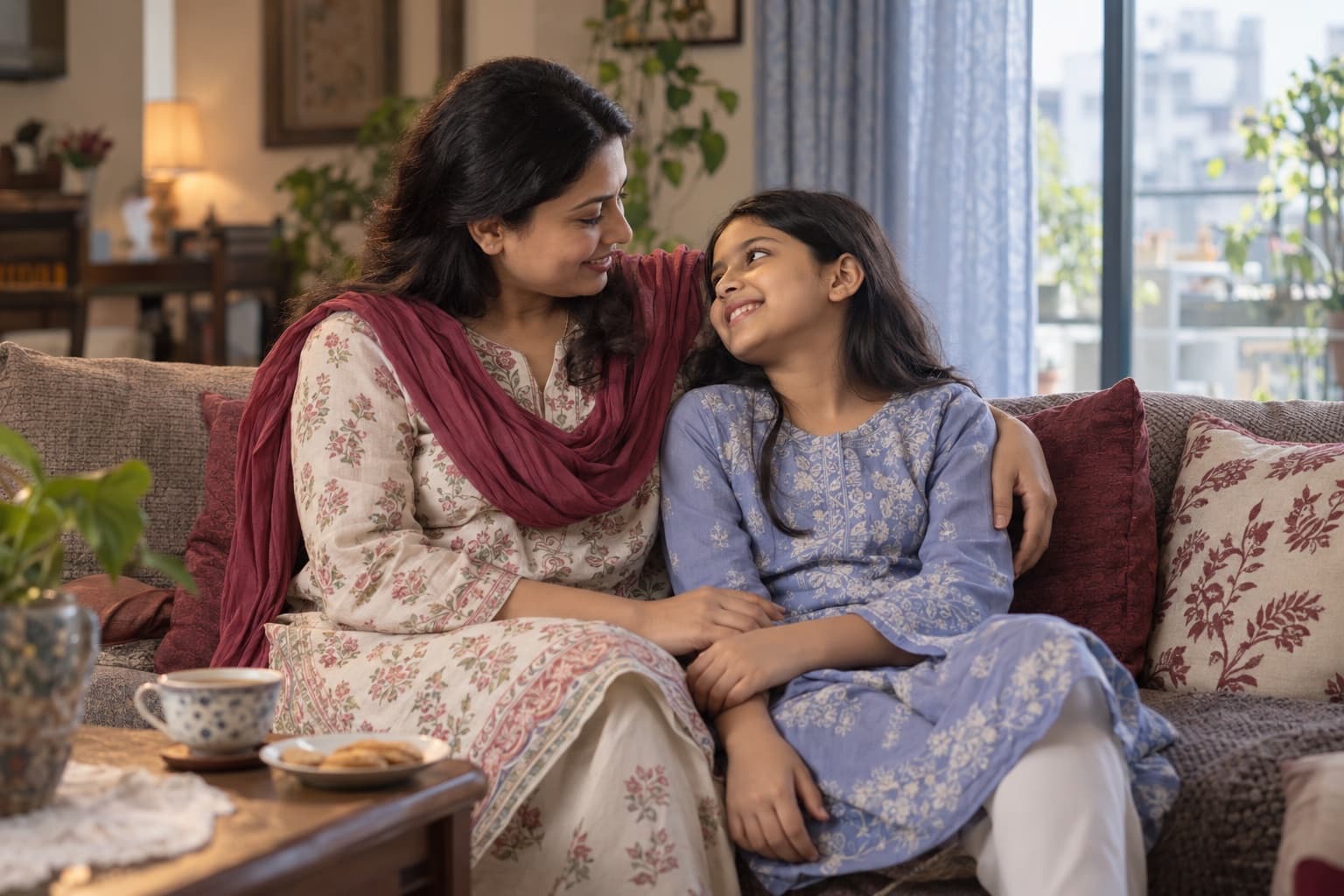
Preteens can change so fast it feels like living with a new person: the child who held your hand to cross the road now walks a few steps ahead, rolls their eyes at your jokes and wants the door shut. This is normal. It isn't a sign they love you less; it's the first stretch of growing up.
Children develop at different speeds, so this page is a guide, not a checklist. Below: what a preteen is, the body changes of puberty for girls and boys, how to prepare your child, moods and privacy, friends and phones, the talk many Bangladeshi families avoid, a 7-day plan and when to get help.
What is a preteen, and what changes between 9 and 12?
Preteens, also called tweens, are children roughly between 9 and 12: no longer little, not yet teenagers. These years are the step before adolescence, and a lot changes at once:
- Body: growth spurts, bigger appetites and, for many, the first signs of puberty.
- Thinking: arguing a point, spotting adults' contradictions, thinking about fairness, the future and the wider world.
- Friends: fitting in matters more, friendships get intense, and falling out can hurt badly.
- Feelings: quicker moods, more embarrassment and a strong wish for privacy.
- Independence: wanting more say, more freedom and, often, a phone.
Tween behaviour can look like pulling away, but most children this age still want their parents close, just on their own terms. For the stages before, see child development stages.
Puberty in preteens: what changes for girls and boys, and when?
Puberty is the body's change from child to adult. It often starts somewhere around 8 to 13 in girls and 9 to 14 in boys, and it unfolds over several years. Early or late within that range is usually normal, and the timing often runs in families.
Preteen girl changes
- Breasts start to develop, often first as a small, slightly tender bump under one or both nipples.
- Hair grows under the arms and in the genital area, and sweat starts to smell.
- A growth spurt, a changing body shape and sometimes pimples.
- A white or clear discharge in the underwear, which is normal and often appears some months before the first period.
- The first period often comes a couple of years after the breasts begin to develop.
Preteen boy changes
- The genitals start to grow first, usually before anyone notices other changes.
- Hair grows under the arms, in the genital area and later on the face, and sweat starts to smell.
- The voice cracks and deepens; the big growth spurt often comes later than in girls.
- Wet dreams, when semen comes out during sleep. This is a normal part of growing up, not an illness and not the boy's fault.
- Some boys have slight swelling or tenderness under the nipples for a while, which usually settles on its own.
Girls and boys often feel awkward, compare themselves with friends and worry that they're too early or too late. Hearing you say 'every body has its own timetable' helps.
How to prepare your child before puberty starts
Children usually cope best with changes they already know about. Many families start simple talks around 8 or 9, before the first signs, and keep them going in small pieces rather than one big talk.
Preparing your daughter for her first period
- Start before the first signs, in short, calm talks; a book written for girls her age can help.
- Use plain words. Explain that a period is a little blood from the vagina for a few days each month, and that it is a sign of a healthy, growing body.
- Show her pads: how to use and change them, and how to wrap and throw them away.
- Pack a small pouch for her school bag with a pad or two, spare underwear and a small bag.
- Agree who she can tell at school, such as a female teacher, and what to do about a stain.
- Tell her she can come to you, or to her father, any time, and that nothing about it is shameful.
Talking with sons too
Boys are often told nothing, or learn from friends and the internet. A father, uncle or mother can explain the voice, hair, growth and wet dreams in a few calm sentences, and add that new feelings, crushes and worries are normal too. 'Boys don't cry' doesn't help; 'you can talk to me about anything' does.
What you might say
- Your body will start changing soon. Can I tell you what to expect, so nothing takes you by surprise?
- Every body has its own timetable. Early or late, it's yours, and it's normal.
- You can ask me anything, even embarrassing things. I won't laugh or be angry.
- If your period starts at school, go to your teacher. It happens to every girl, and it's fine.
- Waking up with wet underwear after a dream happens to lots of boys. Just change it; there's nothing to be ashamed of.
Preteen attitude, moods and privacy: what's normal?
Preteen attitude often shows up as eye-rolling, sighs, 'whatever' and slammed doors. Part of it is hormones and tiredness; part is a growing brain that feels emotions strongly before it can manage them; part is practice at being their own person. It is usually normal, and it often eases sooner when parents stay calm.
How to talk to a preteen who snaps or shuts down
- Respond to the message, not the tone, the first time: 'Sounds like today was rough.'
- If it's rude, name the line calmly: 'You can be angry. You can't speak to me like that.'
- Wait until everyone is calm before talking it through; a heated moment is the hardest time to teach.
- Talk side by side: in a rickshaw, while cooking, on the way to coaching. Many preteens open up when they don't have to look at you.
- Listen more than you advise. Ask: 'Do you want help, or do you just want me to listen?'
- Repair after a fight. 'I shouted, and I'm sorry' teaches more than any lecture.
Privacy matters more each year. Knock before entering, don't read diaries, and make health and safety the only reasons you would step in. In a shared room, privacy can be a drawer of their own, a corner, or some time alone after school.
Parenting tweens is mostly staying close while letting go, a little at a time.
Tween friendships, group chats and phones
Tween friendships can be close and fierce. Being left out of a group, a best friend moving on or one hurtful message can feel huge. Listen without rushing to fix it, and help your child think through what they want to do next.
- Group chats often start around now, sometimes on a parent’s phone. Agree the rules early: which apps, who can be added, and what to do with a mean or scary message. More in group chats and online friends.
- Phones and sleep: children this age still need 9–12 hours of sleep. Keep phones out of the bedroom at night and screens off in the hour before bed; see phones at bedtime.
- Daily limits: from 6 there is no fixed number of hours, but consistent limits should protect sleep, at least 60 minutes of active play, homework and family time; see screen time by age.
- Online safety: tell your child that if anyone online asks for photos, secrets or a meeting, they should tell you, and that they won't be in trouble for telling.
In a Bangladeshi home: the talk many families avoid
For many parents, the hardest part of raising a preteen is the talk about puberty. In many Bangladeshi homes it is barely spoken about: a period is called 'being unwell', pads come home wrapped in newspaper, and boys hear nothing at all. Many parents were told nothing themselves. Silence doesn't stop a child wondering; it sends them to friends, rumours or the internet for answers.
How to start, kindly
- Choose the adult: often the mother with a daughter and the father with a son, but any trusted adult can start, such as a khala, phupu or older cousin.
- Use a hook: a TV advert, a cousin's sudden height, a question about a friend. 'Have you noticed...' is easier than 'We need to talk.'
- Keep it short and come back to it; ten calm minutes now and then often work better than one awkward hour.
- Many families talk about their values at the same time; facts about bodies and family values can sit side by side.
- Protect them from comments. When relatives remark on a girl's changing body, her weight or skin colour, or tease a boy's breaking voice, step in kindly: 'Let's not comment on their body; this age is hard enough.'
Coaching, exams and a full day
Many preteens have school, coaching and a tutor on the same day, with board exams already talked about at home. Leave room for sleep, play and friends, and watch for worry that builds before tests; exam stress in children has a plan.
A 7-day plan to stay close to your preteen
Pick one change, note what happens each day, and compare after a week.
- Day 1: Find 10 minutes of side-by-side time: a walk, cooking, or the ride to coaching.
- Day 2: Ask one open question and only listen: 'What was the best and the worst bit of today?'
- Day 3: Agree one phone rule together, such as phones charging outside the bedroom at night.
- Day 4: Start a short talk about body changes, using a hook from daily life.
- Day 5: Give one new piece of independence, like choosing their own clothes or managing pocket money.
- Day 6: Knock before you enter their room, and notice whether the mood changes.
- Day 7: Look back at the week: which moments felt closest? Keep those.
When to get help for your preteen
Most moodiness and body worries at this age are part of growing up. Get help if you notice:
Get help if
- Signs of puberty before about 8 in a girl or 9 in a boy, or no signs at all by about 13 in a girl or 14 in a boy: talk to a doctor.
- Periods so painful or heavy that your daughter regularly misses school: talk to a doctor.
- Strong worry about weight or food, skipping meals, or eating in secret: talk to a doctor soon.
- Bullying at school or online, or an adult or older child asking for secrets, photos or a meeting: believe your child and act the same day. Send nothing, keep the messages, block and report the account, and tell your local police station. Call 999 if your child has gone to meet them, can't be found, or is in danger now.
- A sudden change: an open child becomes withdrawn, stops seeing friends, or suddenly fears one person or place. Ask gently, believe what your child tells you, act the same day, and call 999 if they are in danger.
- Low mood most days for two weeks or more, or any talk of not wanting to live or of self-harm. For any such talk, stay calm and close: call 999 if your child is in danger now; otherwise speak to a doctor the same day.
As your child moves into the teenage years, teenage rebellion covers what often comes next. ParentMind helps you note moods, sleep and good moments each day, so you see patterns rather than single bad days; see how ParentMind works.
Questions parents ask
What age is a preteen?
A preteen is usually a child aged about 9 to 12, between middle childhood and the teenage years; some people say 10 to 12. 'Tween' means the same thing. It names a stage, not a strict age: some 9-year-olds already show early signs of puberty, while some 12-year-olds haven't started.
Is it normal for a preteen to be moody and rude?
Some moodiness, eye-rolling and wanting to be alone are normal at 9 to 12, as hormones, tiredness and a growing need for independence pile up. Respond to the message rather than the tone, set a calm limit on rudeness, and keep up small daily chats. Get help if low mood lasts two weeks or more.
When should I talk to my daughter about periods?
Before they start, ideally from around 8 or 9, because some girls get their first period at 10 or earlier. Keep it simple and calm: what a period is, that it's healthy, how to use pads and who to tell at school. Then keep the conversation going in small pieces as she grows.
How do I talk to my preteen son about puberty?
Start before the changes, in short, calm talks: the voice, hair, growth spurts and wet dreams, which are normal and nothing to be ashamed of. A father, uncle or mother can do it. Side-by-side moments, like a walk or a rickshaw ride, often feel easier for boys than a face-to-face talk.
How much privacy should a preteen have?
More each year, with clear reasons for when you would step in. Knock before entering, don’t read diaries, and give them a space of their own, even a drawer in a shared room. Keep safety rules clear: phones out of the bedroom at night, and they tell you if anyone online makes them uncomfortable.
How can I stay close to my tween?
Small, regular moments matter more than big talks: ten minutes side by side, a shared snack after school, laughing at the same show. Listen more than you advise, keep your promises about privacy, and repair after arguments. Most tweens still want their parents close, just on their own terms.
This article is general information, not medical advice. For health worries, talk to a doctor; if someone is in danger, contact your local emergency number.