YouTube for kids: what's okay, what to avoid and how to pick cartoons
Quick answer
YouTube for kids works best when you choose the videos, not the app. Under 18 months, avoid screens except family video calls; at 2–5, keep it to an hour a day or less of slow, good-quality shows, ideally watched together. Turn autoplay off, use a short playlist, warn before it ends, and offer something to do next.
 By the ParentMind team11 min read
Listen to this article
15 min listen · Read by your device's voice
At a glance
- Who it is for
- Parents of children aged 2–10 who watch cartoons and YouTube on a phone, tablet or TV
- Key takeaways
- What a child watches matters as much as how long: slow, gentle shows with a story are a better choice than fast, noisy clips.
- Autoplay and endless suggestions make stopping hard; a short playlist you chose, with autoplay off, makes the end clear.
- YouTube Kids has filters and parent settings, but filters can miss things, so watching together still matters.
- Crying when the cartoon ends is common. A warning, a calm voice and something to do next usually help more than giving the phone back.
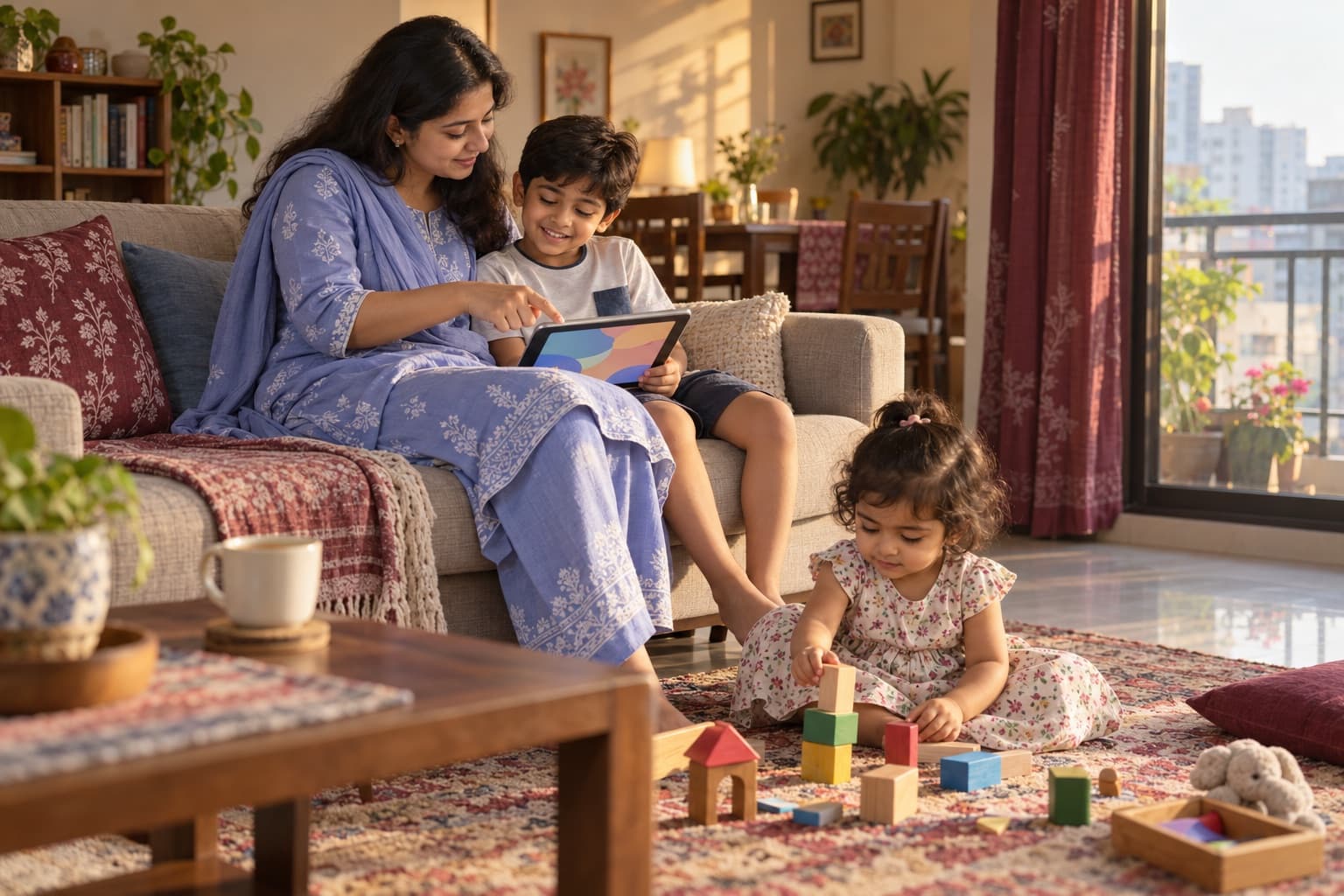
YouTube for kids can be a gift on a hot afternoon and a battle at bedtime. If your child cries the moment a cartoon ends, watches on a phone at every meal, or can't seem to get through a day without YouTube, you are far from alone, and it can change.
Cartoons and videos aren't all bad. Some are gentle, funny and full of songs and words. What matters is what your child watches, for how long, with whom, and how it ends. Below: how much is okay by age, YouTube and YouTube Kids, choosing shows, autoplay, tears at switch-off, copying, Bangladeshi homes and a 7-day plan.
How much YouTube and cartoons is okay at each age?
YouTube for kids, cartoons on TV and videos on a phone all count as screen time. Most child-health guidance uses the same simple limits by age:
| Age | Guidance |
|---|---|
| Under 18 months | None except video calls with family |
| 18–24 months | Only good-quality content, watched with an adult |
| 2–5 years | At most 1 hour a day of good-quality content, ideally together |
| 6 years and over | No fixed number. Consistent limits that protect sleep, at least 60 minutes of active play, homework and family time. No screens in the hour before bed, devices out of the bedroom at night |
Less than the limit is fine. At 3–4, children need at least 180 minutes of activity spread through the day, so long shows easily crowd out play, talk and books. For school-age children and teens, see screen time by age.
Is YouTube Kids safe? YouTube, YouTube Kids and TV compared
YouTube's own terms set 13 as the minimum age for using it on your own; younger children may use YouTube or YouTube Kids only when a parent enables it. YouTube Kids, where it is available, is a separate app made for children, with age-based content settings and parent controls. Its filters are automatic, though, so unsuitable videos can still slip through.
| Where they watch | What helps | Watch out for |
|---|---|---|
| The main YouTube app on a parent's phone | A huge choice, including Bangla rhymes and stories | Made for 13 and over; autoplay and suggestions lead quickly to unsuitable or endless videos, plus comments and ads |
| YouTube Kids | Made for children, with age settings and parent options | Filters can miss things, and watching can still run on without a time limit |
| TV or a downloaded episode | A clear start and end; easier to watch together on a bigger screen | A TV left on in the background all day still counts as screen time |
Whichever you use, the safest setup for YouTube for kids is the same: you choose the videos, the screen is in a shared room, and an adult is nearby. Step-by-step settings are in parental controls on phones and YouTube.
How to choose good cartoons for kids, in Bangla and English
Good cartoons for toddlers and educational videos for kids share a few signs. Before adding a show to your child's list, watch one episode yourself and check:
- A slow pace: longer scenes, not rapid cuts, flashing lights and noise every second.
- A real story with a beginning, middle and end, rather than endless short clips or toy-unboxing videos.
- Kind characters who share, solve problems and say sorry, with little hitting or rudeness played for laughs.
- Things to join in with: rhymes, counting, songs and stories your child can repeat away from the screen.
- Made for their age: a show that suits a 9-year-old can scare or confuse a 4-year-old.
- Bangla as well as English: Bangla cartoon channels, rhymes and folk tales help children hear the language of home. Check them the same way.
An 'educational' label doesn't always mean much for the youngest. Children under about 3 usually learn words far better from people talking and playing with them than from any video.
YouTube for kids without autoplay: how to stop one video becoming ten
Autoplay and endless suggestions are designed to keep everyone watching, and young children can't stop themselves. Short videos that scroll one after another are the hardest of all. A few changes make the end of screen time clear:
- Turn autoplay off in the app or device settings, so one video doesn't roll into the next.
- Agree the amount before it starts, in your child's terms: 'two episodes', not 'a little while'.
- Use a timer your child can see or hear, and give a warning before the last video.
- Watch on a TV or a screen in the living room, not a phone held close in bed or in a corner.
- Keep screens out of the hour before bed, and out of bedrooms at night.
Tantrums when the cartoon ends: what to do
Crying or shouting when a cartoon ends is very common, especially at 2 to 5. Stopping something fun is hard for a young brain, and a sudden switch-off can feel like a loss. These steps often make it easier within a week or two:
- Agree the plan before it starts: 'Two episodes, then bath.'
- Give a warning near the end: 'This is the last one.'
- Stop at the end of an episode, not in the middle of a scene, and let your child press stop if they want to.
- Stay close and calm if they cry. Name the feeling, and don't hand the phone back to stop the tears; that teaches that crying works.
- Move straight on to something next: a snack, a game, helping you cook, or a walk with you.
- Do it the same way most days. Endings your child can predict are easier than surprise ones.
What you might say when the cartoon ends
- One more, and then the phone goes to sleep.
- You're sad it's finished. I know. It was a good one.
- I won't turn it back on, but I'm right here with you.
- Come, let's build a tower. Show me what the bear did.
- We'll watch again tomorrow, after your nap.
If the screaming is daily and intense, or your child won't let go of the phone at all, see screen addiction in kids.
Child imitates cartoon characters: hitting, rude words and new accents
Children learn by copying, so it's no surprise when a 4-year-old kicks a cousin like a cartoon hero or repeats a rude catchphrase. Copying is normal; what they copy is something you can shape.
- Name it and set the rule: 'In the cartoon they kick. In our house, we don't kick people.'
- Watch an episode together and ask: 'Was that kind? What could he do instead?'
- Drop a show that keeps leading to hitting, rudeness or fear, and swap in a calmer one.
- Some children pick up words or a whole accent in another language, such as Hindi, from dubbed cartoons. It isn't harmful in itself; if you'd like more Bangla, add Bangla stories and rhymes, and talk with your child a lot.
In a Bangladeshi home: meals, grandparents and the phone as babysitter
In many Bangladeshi homes, the phone is how a busy household gets through the day: cartoons to get a toddler to eat, to keep a child quiet in traffic or at a dawat, or to give a tired grandmother an hour's rest. That is understandable, and it can change one routine at a time.
- Cartoon-only meals: many children eat only while watching. Changing it slowly, one meal at a time, often works better than a sudden ban; when your child won't eat without the phone has a gentle 14-day plan.
- Grandparents and house help: agree the same few rules for everyone who looks after your child, such as which shows, how many episodes and no screens at meals. Thank them first; they're often filling long hours.
- Small flats and hot afternoons: when outdoor play is hard, keep a box of screen-free things ready, such as blocks, crayons and old cartons. Screen-free activities for kids has ideas for small spaces and power cuts.
- Dawats and traffic: keep a small bag with stickers, a notebook and a snack, and save the phone for when nothing else works.
A 7-day plan to cut back cartoons and YouTube
Change one thing at a time, note how your child responds each day, and compare at the end of the week.
- Day 1: Notice. Write down when your child watches, for how long, on which screen, and what happens when it ends. Change nothing yet.
- Day 2: Turn autoplay off, and make a short playlist of shows you've checked.
- Day 3: Pick one or two fixed viewing times a day, and say the amount before you start: 'two episodes'.
- Day 4: Watch one episode together, and talk about it afterwards.
- Day 5: Make one meal screen-free, with you sitting and eating together.
- Day 6: Brief everyone who looks after your child on the same rules.
- Day 7: Compare with Day 1: minutes watched, tears at the end, how meals and sleep went. Keep what helped, and choose the next step.
When is it more than a cartoon habit? When to get help
Too many cartoons is usually a habit that eases with steady routines. Talk to a doctor if:
When to get help
- A toddler has very few words, rarely responds to their name, or rarely looks at you to share something. Ask for a development check, whatever their screen time.
- Your child loses words or skills they had, at any age. Get this checked promptly.
- Meltdowns when screens end happen most days and include hitting, throwing things or hurting themselves, even after a few weeks of calm, steady limits.
- Your child won't eat at all without a video and is losing weight, or isn't growing as expected at check-ups.
- Your child has seen frightening, violent or sexual videos and has new nightmares, fears or sexual behaviour beyond curiosity: get help the same day. If someone showed them on purpose, believe your child, keep them away from that person, report it at the local police station (thana), and call 999 if they are in danger now.
- Screens keep your child up late most nights, or they are too tired for school most mornings.
YouTube for kids doesn't have to be all or nothing: chosen shows, a clear end and you nearby go a long way. ParentMind helps you note what happens each day, such as how long cartoons ran and how the switch-off went, so you can see patterns over a week; see how ParentMind works.
Questions parents ask
Is YouTube Kids safe for my child?
Where it is available, it is usually safer than the main app, but not completely safe. YouTube Kids is made for children and has age settings and parent options, but its filters are automatic and can miss unsuitable videos. Choose what your child watches where you can, turn off search for young children if the app allows it, keep the screen in a shared room and stay nearby.
How long should a 3-year-old watch cartoons?
At 2 to 5 years, most child-health guidance says at most 1 hour a day of good-quality content, ideally watched together, and less is fine. Split it into one or two short sessions rather than one long one, keep it away from meals and the hour before bed, and leave plenty of time for active play.
My child watches YouTube all day. What should I do?
Cut back gradually rather than all at once. Note for a day how much and when your child watches, then set one or two fixed viewing times, turn autoplay off and use a short playlist. Fill the gaps with simple play and time with you, and agree the same rules with grandparents or house help. Many children adjust within a week or two.
Are cartoons good or bad for toddlers?
Neither, on their own: it depends on age, what they watch and how much. Under 18 months, screens aren't recommended except video calls with family. From 18 months, slow, gentle cartoons watched with an adult can be fine in small amounts. Fast, noisy clips and screens at meals or before sleep tend to cause the most trouble.
Can my child learn fighting from cartoons?
Children often copy what they see, including kicks, punches and rude words from cartoons, especially at 3 to 7. It rarely means a child is becoming aggressive, but it's worth acting on. Name the rule calmly, watch together and talk about kinder choices, and drop shows that keep leading to hitting.
Should I turn off autoplay for my child?
Yes, for most young children. Autoplay rolls one video into the next, so there is never a natural place to stop, and young children find stopping on their own very hard. Turn it off in the app or device settings, agree the number of videos beforehand, and give a warning before the last one.
This article is general information, not medical advice. For health worries, talk to a doctor; if someone is in danger, contact your local emergency number.