Tantrum in public? What to do in shops, weddings and relatives' homes
Quick answer
A tantrum in public needs the same calm response as one at home, with safety first. Move your child away from roads, stairs and crowds, stay close, say little, and don't hand over what the tantrum is about. Many onlookers have been there; focus on your child, not them. If it doesn't pass, leave calmly and try again another day.
 By the ParentMind team12 min read
Listen to this article
17 min listen · Read by your device's voice
At a glance
- Who it is for
- Parents of children aged 1–6, in shops and markets, at weddings and dawats, on the road and at relatives' homes
- Key takeaways
- Public tantrums are common from about 1 to 5: crowds, noise, waiting, hunger and late nights all make a meltdown more likely.
- Safety comes first: get your child away from roads, stairs, escalators and crowds, then stay calm, say little and hold the limit.
- One calm line is enough for a staring stranger or a commenting relative; your child needs your attention more than they do.
- Most of the work happens before you leave home: food, sleep, a short plan, a small bag and an agreed way out.
A tantrum in public can feel ten times harder than the same tantrum at home. Your child is on the supermarket floor, or screaming at a cousin's wedding, and you can feel every pair of eyes. If this happens to you, you are not a bad parent and your child is not a bad child. Children aged 1 to 5 have tantrums wherever they are, and busy places make them more likely.
Public tantrums tend to follow patterns, and many can be made shorter or rarer. Below: why they happen, what to do and say, handling the stares, planning outings, road and crowd safety, weddings and dawats, and a 7-day plan. For tantrums in general, see toddler tantrums.
Why do children have tantrums in public?
Tantrums in public happen for the same reasons as tantrums at home, with extra pressure added. Outside the house, a young child often meets several triggers at once:
- Too much at once: loud music, bright lights, crowds, and strangers pinching their cheeks.
- Waiting: queues, traffic jams, a long wait for food at a dawat.
- Hunger and tiredness: a skipped nap, a late dinner, a long day of shopping.
- Temptation at eye level: toys, chips and balloons placed exactly where a child can see them.
- Your attention is elsewhere: on the shopping list, the relatives or your phone.
- Your stress: children often sense when a parent feels watched, and it can make them more upset.
Some outbursts in crowded, noisy places are less about wanting something and more about being overwhelmed. A tantrum usually has a goal; an overwhelmed child needs a quieter space, few words and comfort.
What to do when your child has a tantrum in public
The goal is not to stop the tantrum fast for the audience, but to get your child through it safely, without teaching that screaming in public works.
- Make it safe first. Near roads, stairs, escalators, lifts or parked motorbikes, hold your child firmly or pick them up. Move breakable things out of reach.
- Move to a quieter spot if you can: a corner of the shop, outside the door, a side room or a bench. Carry your child calmly rather than dragging them.
- Calm your own body: one slow breath, a low voice, loose shoulders. Imagine it's just the two of you.
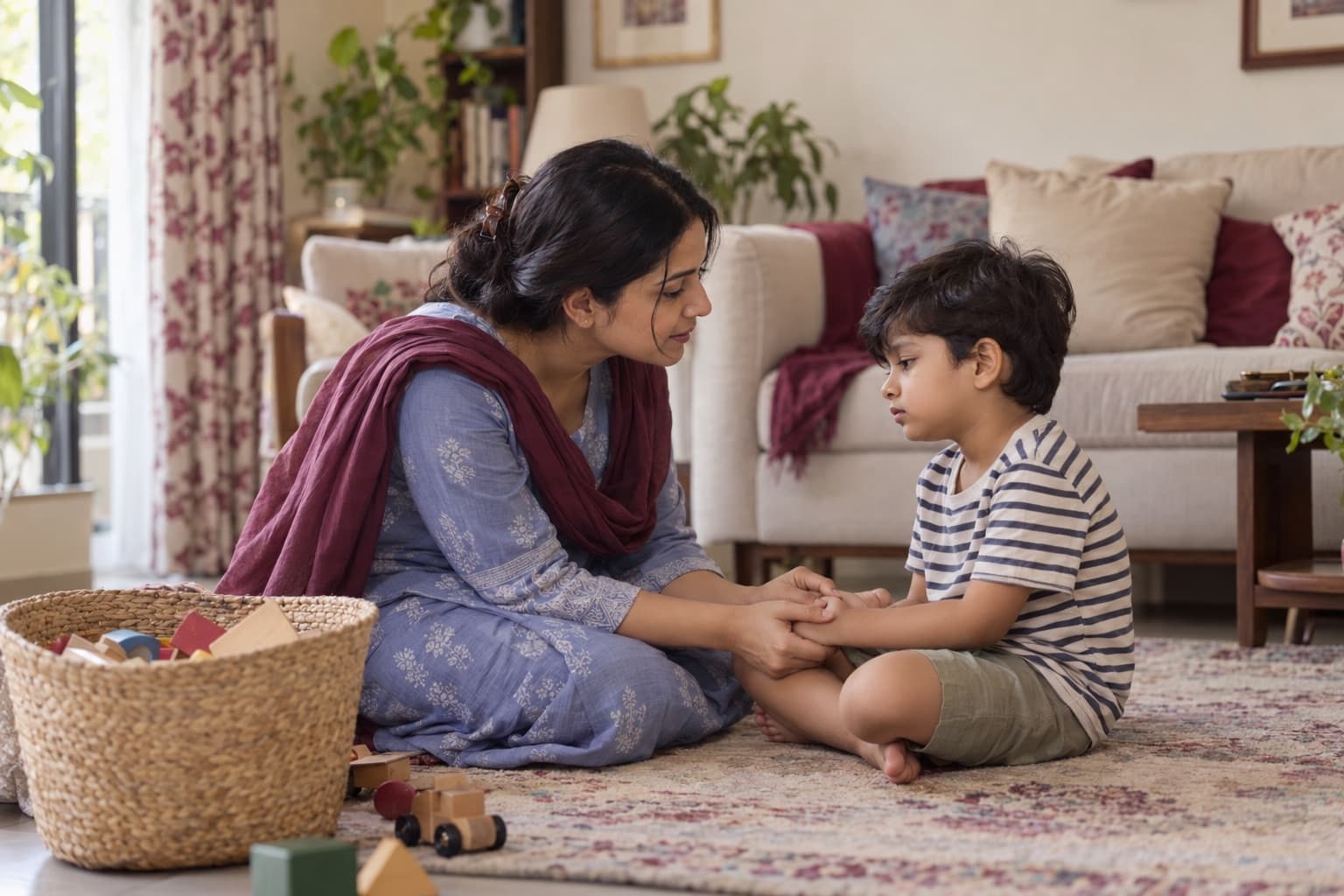
- Get down to their level, name the feeling in a few words, then stop talking.
- Hold the limit. If the tantrum is about a toy or a sweet, the answer stays no; buying it now teaches that the next public tantrum should be louder.
- If it doesn't ease within a few minutes, leave calmly. Leave the basket if you need to, or tell the hosts you're stepping out for a while. Leaving isn't a punishment; it's a reset.
- Reconnect when it passes: a hug, some water, and one kind sentence about what happened. Then finish the outing if you can, or go home.
What you might say to your child
- You really wanted the balloon. You're so cross.
- I'm right here. We'll stay here till you feel calmer.
- The answer is still no. I'm staying with you.
- It's too loud in there. Let's go outside for a bit.
- I'm carrying you to keep you safe from the cars.
- That was a big feeling, and you got through it. Some water?
What not to do in public
With others watching, it's tempting to shout, smack, threaten or strike a deal just to end the scene. Each of these tends to make the next public tantrum more likely. Drop two common threats completely: 'I'll leave you here' and 'That uncle will take you away.' They either mean nothing or truly frighten a child. Never leave a young child alone, even for a moment, to make a point. Positive discipline has calmer ways to stay in charge.
Embarrassed by your child's tantrum? Handling stares and comments
Feeling embarrassed by your child's tantrum is normal, and often the hardest part. The people watching usually fall into three groups: parents remembering their own hard days, people who are simply curious, and a few who judge. Only your child needs your attention right now.
Here the comments often come with advice: 'One slap and he'd be fine', 'Just give it to him, he's a child', 'Can't his mother control him?' You don't have to argue or explain. A short, polite line, then back to your child, is enough. If relatives comment again and again, see relatives' comments and unwanted advice.
What you might say to other adults
- Thank you, we're fine. He just needs a minute.
- I know you mean well. I'm handling it my way.
- Khala, we don't smack. I'll take her outside until she's calm.
- If we give it now, she'll cry louder next time. We're waiting it out.
- Could you hold my bag for a minute? That would really help.
How to plan an outing so a public tantrum is less likely
Most public tantrums are easier to prevent than to stop. Before an outing with a child under 6, run through this list:
- Time it well: after a nap and a meal, not at the end of a long day.
- Keep it short: one or two stops, not five. Big shopping trips usually go better without a toddler.
- Say the plan before you go: 'We're buying rice and eggs. No toys today. Then we'll look at the fish.'
- Give your child a job: holding the list, choosing the tomatoes, pressing the lift button.
- Pack a small bag: water, a snack, a picture book or a favourite toy, wipes and spare clothes.
- Agree the way out: who takes your child outside if a tantrum starts, and when you'll head home.
| Place | Why it's hard | What often helps |
|---|---|---|
| Shop, supermarket or bazar | Toys and sweets at eye level, queues | Say the plan first, give a job, finish fast or step outside |
| Wedding or holud | Loud music, late dinner, stiff new clothes | Feed before, quiet breaks, soft clothes, leave before exhaustion |
| Relative's home or dawat | Many adults, other children's toys, different rules | A quiet room, a familiar toy, one adult in charge of your child |
| Rickshaw, CNG, bus or traffic jam | Heat, waiting, being held still | Water, a snack, songs and 'I spy', a firm hold the whole way |
| Doctor's waiting room | Long waits, feeling unwell | A book, a snack, short walks in the corridor, a quieter time of day |
If most shop tantrums are about toys and sweets at the counter, how to say no to a child has the words that make a no easier to hold.
Keeping your child safe near roads and crowds
A child in the middle of a tantrum may run, throw themselves backwards or pull free. In busy places, safety comes before everything else, including teaching:
- Near roads, hold your child by the hand or wrist, or carry them. Never put a screaming child down on a pavement beside traffic or rickshaws.
- On a rickshaw or in a CNG, hold a young child firmly the whole ride; a child who throws themselves backwards can fall out.
- While your child is upset, keep away from escalators, stairs, balconies and open rooftops.
- At gatherings, name one adult to watch your child at all times, because in a crowd everyone tends to assume someone else is watching. At a village home with a pond or river nearby, a small child who runs off upset can reach the water within minutes.
- Before a crowded market, mela or big wedding, take a photo of your child in that day's clothes, and put a card with your phone number in their pocket.
- Teach a simple plan for getting lost: 'If you can't see me, stand still and tell a shopkeeper or a mother with children.'
- If you can't find your child, tell staff or security at once and call 999.
In a Bangladeshi family: weddings, dawats, Eid crowds and long journeys
Many of the biggest public tantrums here happen at family events: long, loud and late, with dozens of relatives watching. A few plans for each:
A tantrum at a wedding or holud
Wedding food often arrives late, the music is loud, and new clothes can itch. Feed your child before you leave, put something soft under the fancy outfit, and bring a light shawl for a nap on your lap. Find the quietest corner early, step out together every hour or so, and leave before your child is exhausted, even if dinner hasn't been served.
A tantrum at a relative's house or a dawat
At a relative's home, take your child to a quiet room for a tantrum rather than handling it in front of everyone, then come back together. Bring one familiar toy, and check with the hosts which rooms and things are off limits. If a grandparent or aunt steps in with whatever your child was crying for, thank them warmly and talk later, in private.
Eid shopping and melas
Eid markets and melas are crowded, hot and full of things to want. If you can, shop for Eid clothes without your youngest, or go early in the day. Agree beforehand what your child will choose, such as one toy at the mela, and stick to it.
Long journeys to the village
Bus, launch and train trips before Eid mean long waits and tight spaces. Pack water, snacks, spare clothes and a few new things, such as a picture book or a colouring pad, to bring out one at a time. On a launch, keep a young child in your arms or holding your hand, well away from the railings. Save the phone for when nothing else works, not as the first answer to every cry.
A 7-day plan for calmer outings
Pick one change, note what happens each day, and compare after a week.
- Day 1: Think back over the last few public tantrums: where, what time, how hungry or tired your child was, and what happened just before. Write it down.
- Day 2: Choose one regular outing to work on, such as the corner shop or the school pick-up.
- Day 3: Play 'shop' at home, practising waiting, hearing no and choosing one thing.
- Day 4: Make a short practice trip after a meal, with the plan said out loud and a job for your child.
- Day 5: Agree your way-out plan and your one line for onlookers with the other adults in the family.
- Day 6: Try a slightly longer outing, and say out loud what went well: 'You held my hand all the way.'
- Day 7: Compare with Day 1: how many tantrums, how long they lasted, how quickly your child calmed and how you felt. Keep what helped.
Your child isn't giving you a hard time. They are having a hard time, in front of everyone.
When to get help for public tantrums
Most public tantrums are a passing stage. Talk to your child's doctor or a child development specialist if:
Get help if
- Tantrums still happen most days after age 5, or regularly last longer than about 25 minutes.
- Noise, crowds or new places upset your child so much that you avoid going out, or they often cover their ears, hide or can't be comforted.
- Your child often runs off near roads or water, or hurts themselves or others during tantrums.
- Your child holds their breath until they turn pale or blue, or faints. Tell a doctor the first time this happens, and call 999 if they don't come round within about a minute.
- Tantrums come with other worries: speech well behind other children the same age, losing skills they had, or little interest in people.
- You feel you might hurt your child, or you can't cope. Make sure your child is safe, with another adult if possible, step away for a few minutes and get support. If anyone is in immediate danger, call 999.
A tantrum in public is one hard moment, not a verdict on your family. ParentMind helps you note what happens each day, such as where and when tantrums happen and what helped, so you can plan the next outing; see how ParentMind works.
Questions parents ask
Should I leave the shop when my child has a tantrum?
Often, yes, if it doesn't ease within a few minutes. Leaving calmly isn't giving in, as long as your child doesn't get what they were screaming for. Step outside or to a quiet corner, stay close until they calm down, then finish the shopping or go home. Leaving early a few times often makes later trips easier.
Should I ignore a tantrum in public?
Ignore the demand, not your child. Stay close and calm, keep your child safe and say very little, but don't walk away or pretend they aren't there. If the tantrum is about getting something, giving it little attention often helps. If your child is frightened, overwhelmed by noise or unwell, they need comfort and a quieter space.
What should I say when strangers stare or comment?
Very little. A short, polite line such as 'Thank you, we're fine, she just needs a minute' is enough; then turn back to your child. You don't owe anyone an explanation. If a relative insists on a smack or on giving in, say kindly that you handle it differently, and talk later in private.
Is it okay to give my child the phone to stop a public tantrum?
Now and then it happens, but it's better not to make it a habit: children quickly learn that a tantrum is how the phone appears. Water, a snack or a book usually work better for waiting. Child-health guidance suggests no screens under 18 months except video calls with family, only good-quality content watched with an adult at 18–24 months, and at most 1 hour a day of good-quality content from 2 to 5.
Why are tantrums worse in public than at home?
Public places pile up triggers: more noise, waiting and temptation, often less sleep, and a parent who feels watched, which children sense. Some children also save their biggest feelings for the parent they trust most. Shorter outings, food before leaving, a clear plan and a quiet way out usually help.
This article is general information, not medical advice. For health worries, talk to a doctor; if someone is in danger, contact your local emergency number.