Baby sleep schedule, 0–12 months: what's normal and a gentle routine
Quick answer
A baby sleep schedule changes fast in the first year. Newborns sleep about 14–17 hours in 24, in short stretches, waking to feed day and night. From 4 to 12 months, most sleep 12–16 hours in 24, with longer nights and two or three naps. For every sleep, lay your baby on their back on their own firm, flat surface.
 By the ParentMind team12 min read
Listen to this article
17 min listen · Read by your device's voice
At a glance
- Who it is for
- Parents of babies from birth to 12 months, including families who share a bed or a room
- Key takeaways
- Newborns sleep about 14–17 hours in 24, in short stretches; from 4 to 12 months, most sleep 12–16 hours, naps included.
- Waking at night to feed is normal, especially in the first months, and there is no fixed age for sleeping through the night.
- Every sleep, day and night: on the back, on the baby's own firm, flat surface, with nothing soft; never a sofa, chair or hanging cradle.
- Never give a medicine, syrup, gripe water or honey to make a baby sleep; a baby under 3 months with a fever needs a doctor straight away.
A baby sleep schedule is what many tired parents search for at 3 am, often with a newborn who sleeps all day and is wide awake at night. That is normal. Young babies don't yet know day from night, and they wake often because small tummies need feeding often.
Sleep settles into a pattern over the first year, and you can help it along gently. Below: sleep by month, night feeds, gentle settling, safe sleep (in a shared bed too), a 7-day plan and when to get help.
Baby sleep schedule by month: how much should a baby sleep?
A baby's sleep is counted over 24 hours, naps included, and each baby sits somewhere inside a range. The hours below match our sleep chart by age; the naps and awake times (often called wake windows) are rough guides, not targets.
| Age | Sleep in 24 hours | Naps and awake time | Nights |
|---|---|---|---|
| Birth to 3 months | About 14–17 hours, in short stretches | Sleeps on and off all day; often ready to sleep again within an hour of waking | Wakes to feed every few hours, day and night |
| 4–6 months | 12–16 hours | Several naps, often three; often awake about 1½–2½ hours at a time | A longer first stretch at night; many still wake to feed |
| 7–9 months | 12–16 hours | Two or three naps, moving to two; often awake about 2–3 hours | Many wake once or twice; some sleep a long stretch |
| 10–12 months | 12–16 hours | Usually two naps; often awake about 3–4 hours | Longer nights, though some still wake for a feed or comfort |
Use your baby, not the clock, as the guide: a baby who wakes content, feeds well and is alert while awake is usually getting enough sleep, even if the hours differ a little from the table.
Newborns often breathe unevenly in sleep: a few quick breaths, then a short pause of a few seconds. On its own, this is usually normal, and so are twitches, grunts and little noises. A long pause, blue or grey lips, or struggling to breathe is different: call 999 straight away.
When do babies sleep through the night?
There is no fixed age for sleeping through the night. The longest stretch slowly grows, and many babies manage several hours in one go somewhere between about 3 and 6 months. Many still wake once or twice a night until their first birthday or beyond, and that is normal too.
Night feeds are part of a young baby's sleep: small tummies need milk at night as well as by day. Don't cut them because someone says your baby should be ‘trained’ by now; a doctor or nurse can tell you when they are no longer needed.
Some babies wake more for a while around a big change: learning to roll or sit, a new tooth, a cold, or a trip to the grandparents' village. These patches often pass within a week or two once the routine is back.
Baby sleeps in the day and wakes at night: what helps?
Many newborns sleep long in the day and are wide awake at night, because their body clock isn't set yet. It usually sorts itself out over the first few months, and a few small habits help it along:
- By day: open the curtains, keep the usual household sounds, and talk and play during feeds.
- By night: keep the lights dim and voices low, and feed and change your baby without play.
- A little morning daylight by a bright window can help set the body clock.
- Don't keep your baby awake in the day to make them sleep at night: an overtired baby often sleeps worse, not better.
How to settle a baby to sleep, gently
Gentle settling means helping your baby to sleep with your voice, your touch and a calm routine, and answering their cries. There is no need for harsh methods, and comforting a young baby doesn't spoil them; more in can you spoil a child with love.
- Watch for sleepy cues: yawning, rubbing eyes, looking away, fussing or a faraway stare. Start settling then, before your baby is overtired.
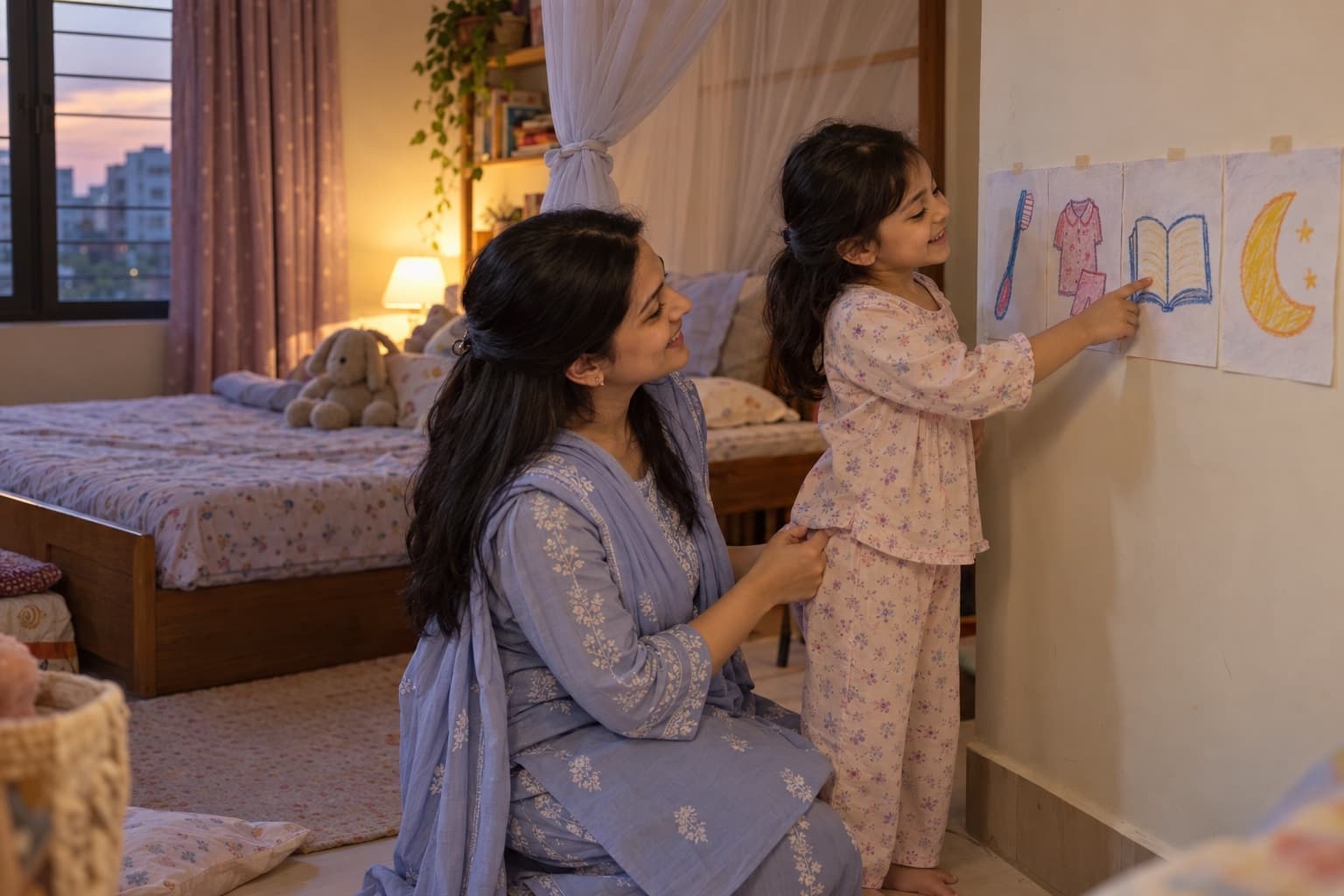
- Keep the same short routine each evening from a few weeks old: a fresh nappy, a feed, a wash, a song or a short dua if that is part of your family's evening, then lights low.
- Lay your baby on their back in their own cot, sometimes while drowsy but still awake, so they get used to falling asleep there. It's fine if many sleeps still start in your arms.
- Soothe before you pick up: a hand resting on the tummy, gentle patting, a soft ‘shh-shh’, or the steady hum of the fan.
- If the crying builds, pick your baby up, calm them, then try again. Never leave a young baby to cry alone for a long time, and never shake a baby.
- At night, feed and change in dim light with few words, then lay your baby straight back down on their back.
From about 6 months, if you wish, give a little less help over a few weeks: pat a little less, then sit a little further from the cot. Go at your baby's pace; there is no deadline.
What you might say, to your baby and to family
- Shh, shh. Ammu's here. Time to sleep now, my love.
- Amma, babies sleep safest without a pillow. Let's keep her bed flat.
- Let's rock him in our arms, not the dolna, and lay him in his cot once he's asleep.
- Please don't give her gripe water or a syrup for sleep. If we're worried, we'll ask the doctor.
- Could you hold him for an hour while I nap? I'll do the night feeds.
Safe sleep for babies: on the back, flat, and nothing soft
For babies, where they sleep matters as much as how long. A baby sleeps safest on their back, on their own firm, flat surface, such as a cot beside your bed, with nothing soft or loose in it: no pillow, bolster, quilt or soft toy. Do this for every sleep, day and night.
- On the back for every sleep, day and night, including naps.
- Keep the cot beside your bed, in your room, for at least the first 6 months.
- No pillow of any kind, not even a small or mustard-seed pillow: a baby's head needs nothing under it.
- Dress your baby for the weather instead of covering them with a quilt or kantha, and keep the head and face uncovered.
- A hanging cradle (dolna) is not a safe sleep place. If your baby falls asleep in a cradle, a sling, a car seat or your arms, move them onto their back in their own cot.
- No smoking near your baby, and a mosquito net over the cot instead of a coil in the room.
- Never leave a baby alone on an adult bed or a sofa, even for a minute: babies can roll off.
Many Bangladeshi families share a bed with their baby. If your baby sleeps in your bed, these steps make it safer:
- Lay your baby on their back on a firm mattress, away from pillows, quilts, bolsters and any gap where they could slip down or get stuck.
- Keep your baby beside one parent, not between two adults and not next to older children.
- Never fall asleep with your baby on a sofa or in a chair.
- Do not share a bed with your baby if you or your partner smoke, have taken alcohol or a medicine that makes you drowsy, or are so tired you could sleep very deeply, or if your baby was born early or very small.
Baby sleep in a Bangladeshi home: family beds, heat and advice
Babies in Bangladesh often sleep surrounded by family: a grandmother humming, cousins nearby, a fan turning overhead. That closeness is a strength. A few habits need a small change to keep sleep safe:
- Mustard-seed pillow (sorishar balish): many families use one out of love, hoping for a nicely rounded head. Any pillow in a baby's sleep space can press against the face and make breathing harder, so please don't use one for sleep. For a flat spot on the head, give tummy time while your baby is awake and watched, and change which way they face in the cot.
- Bolsters as walls: many families build a wall of bolsters or pillows around the baby so they can't roll off the bed. These can fall onto the face, or a baby can roll against them and get stuck, so keep them out of the baby's space. Their own cot beside your bed is the safer way to prevent a fall.
- Wrapping: if you wrap a newborn, use one thin cotton cloth, no higher than the shoulders and loose at the hips so the legs can bend up and out, and always lay your baby on their back. Stop as soon as your baby starts trying to roll, and never let a wrapped baby get too hot: on hot nights, a light cotton layer instead of a wrap is often safer.
- Heat: a fan in the room that isn't blowing straight at the baby, one light cotton layer and no cap indoors. If the back of the neck feels hot or sweaty, take a layer off; more in sleep in hot weather.
- Mosquito nets: tuck the net under the mattress all round, so it can't sag onto your baby's face. Keep a rechargeable light for load-shedding, never a candle near the bed or the net.
- Older brothers and sisters: a young child can't keep a sleeping baby safe. Never leave a young child alone with a baby, even while the baby sleeps.
A 7-day plan for a calmer baby sleep schedule
Pick one change at a time, and jot down a line each day: when your baby slept, woke and fed. After a week you'll see patterns that one hard night hides.
- Day 1: Change nothing. Note every sleep, waking and feed for 24 hours, and check the sleep space: on the back, flat, nothing soft.
- Day 2: Make day and night different: daylight, chat and play by day; dim and quiet at night.
- Day 3: Choose a short bedtime routine (nappy, feed, wash, a song or dua, lights low) and do it in the same order tonight.
- Day 4: Watch for sleepy cues, and start settling at the first yawn or eye rub.
- Day 5: For one sleep today, lay your baby down drowsy but awake, and soothe with a hand on the tummy.
- Day 6: Keep night feeds quiet and dim, with no play and few words.
- Day 7: Compare your notes with Day 1: how long settling took, the longest stretch of sleep, your baby's mood. Keep what helped and choose the next small change.
Sleep changes again after the first birthday. For night waking then, see toddler waking at night; for rolling, sitting and what comes next, see child development by age.
When to get help with your baby's sleep
Most babies' sleep troubles ease with time, feeds and a steady routine. Some signs need a doctor, and a few need 999:
See a doctor, or call 999, if
- Your baby is under 3 months and has a fever (a temperature of 38°C, or 100.4°F, or more): see a doctor straight away, even if your baby otherwise seems well.
- Your baby is unusually drowsy, hard to wake for feeds, or feeding much less than usual: see a doctor the same day.
- Your baby snores loudly most nights, or often breathes through the mouth or snorts in sleep: talk to a doctor.
- You feel low or exhausted most days: tell a doctor. Support is for parents too.
- You ever feel you might hurt your baby: lay them on their back in their cot, step into another room for a few minutes, and get help the same day; call 999 if anyone is in danger now.
- Call 999 straight away if your baby has a long pause in breathing, struggles to breathe, has blue or grey lips, or is floppy, very hard to wake or can't be woken.
A baby sleep schedule is easier to read over a week of notes than at 3 am. ParentMind helps you note what happens each day, see patterns and get guidance: how ParentMind works.
Questions parents ask
How many hours should a newborn sleep?
Newborns sleep about 14–17 hours in 24, in short stretches, waking to feed every few hours, day and night. Some sleep a little more or less. A newborn who is very hard to wake for feeds, or is feeding much less than usual, needs a doctor the same day.
Is it normal for a 9-month-old to wake up at night?
Yes. Many babies still wake once or twice a night at 9 months, for a feed, for comfort, or around a new skill such as crawling or standing. If your baby settles back fairly quickly and is content by day, it's usually fine. A steady bedtime routine and quiet, dim night feeds help many babies sleep longer stretches.
How many naps does a 6-month-old need?
Most 6-month-olds take two or three naps a day, often short, as part of 12–16 hours of sleep in 24. Many are ready to sleep again after about 2 hours awake. Watch for yawns and eye rubbing rather than the clock, and expect naps to settle into two over the next few months.
Should I let my baby cry it out?
You don't need to. Young babies cry to tell you they need something, and comforting them doesn't spoil them. From about 6 months, gentle steps can help if you want them: give a little less help over a few weeks while staying close. Never leave a baby to cry alone for long, and never shake a baby.
Can my baby sleep on their tummy or side?
No. Lay your baby on their back for every sleep in the first year: it is the safest position. Once your baby can roll both ways by themselves, you can leave them in the position they choose, but always start on the back. Tummy time is for when your baby is awake and watched.
Is it safe to sleep with my baby in my bed?
The safest place is your baby's own cot beside your bed. If your baby sleeps in your bed, lay them on their back on a firm mattress, beside one parent, with no pillows, quilts or bolsters nearby. Don't bed-share after smoking, alcohol or a drowsy-making medicine, when exhausted, or with a baby born early or small, and never sleep with a baby on a sofa or chair.
Can I give my baby gripe water or a syrup to help them sleep?
No, not unless a doctor prescribes it after checking your baby. A healthy baby doesn't need sleep medicine, gripe water, syrups or home remedies, and honey must not be given at all before the first birthday. If your baby's sleep worries you, a doctor can check for a cause.
This article is general information, not medical advice. For health worries, talk to a doctor; if someone is in danger, contact your local emergency number.