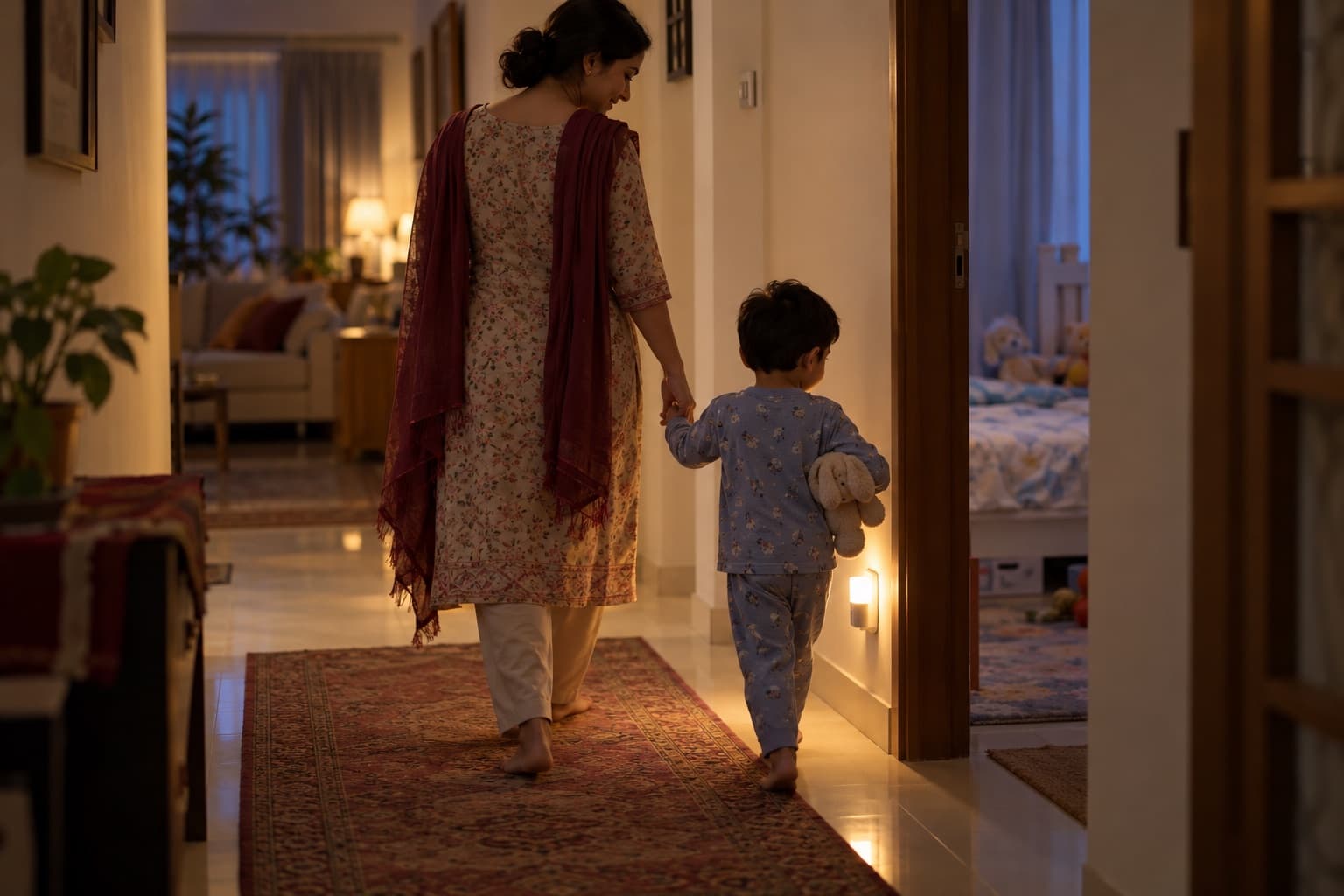
Toddler waking at night: why it happens and how to settle them back
Quick answer
A toddler waking at night is common between 1 and 5. All children surface between sleep cycles; those who fell asleep being fed, rocked or held often call for the same help again. Illness, teething, fears or a new sibling can add wakings. Settle them the same quiet way each time; see a doctor for loud snoring with pauses.
 By the ParentMind team13 min read
Listen to this article
18 min listen · Read by your device's voice
At a glance
- Who it is for
- Parents of children aged about 1 to 5 who wake in the night to cry, call out or climb into their parents' bed
- Key takeaways
- Brief waking between sleep cycles is normal; a toddler calls out when they cannot drift off again the way they first fell asleep.
- Settle your child the same calm, boring way every time: low light, few words, no screens, a little less help each night.
- Night milk, a shared bed or a run of colds can keep wakings going; change one thing at a time, starting at bedtime.
- See a doctor for loud snoring with breathing pauses, pain or fever at night, or waking that lasts a month or more despite a steady routine.
A toddler waking at night can leave the whole house exhausted: a cry at 1 am, again at 3, small feet at your door before the Fajr azan. If your child slept well as a baby and has started waking again, or has never really slept through, you are far from alone.
Most night waking at this age has ordinary causes, and it often eases when the response at night is calm and the same every time. Below: why it happens, settling back without new habits, night milk, shared beds, a 7-day plan and when to see a doctor. If the battle is getting into bed at all, see a toddler who won't sleep.
Toddler waking at night: why does it happen?
Everyone sleeps in cycles and comes close to waking several times a night; adults turn over without noticing. A child who fell asleep being fed, rocked, held or with a parent lying beside them often wakes fully at those moments and wants the same help again. That is the most common reason for a toddler waking at night, but not the only one:
| Reason | What you might notice | What often helps |
|---|---|---|
| How they fall asleep | Wakes at similar times; settles only with a feed, rocking or you lying down | Let them drift off in bed at bedtime; step back slowly |
| Hunger or night milk | Wakes for milk and falls asleep feeding; small or early dinner | A filling dinner; milk earlier in the routine; fewer night feeds, slowly |
| Illness, teeth or discomfort | Blocked nose, cough, fever, tooth pain, itching; heat; mosquitoes; a wet nappy | Comfort first; a fan, cotton clothes, a mosquito net; a doctor for pain or fever |
| Fears and dreams | Wakes scared and clings to you; from about 2, may tell you a dream | Comfort, a dim night light, and talk about fears in the day |
| A big change | A new baby, a new play school, a move, a parent away, a trip to the village | Extra closeness in the day; the same night-time response |
| Daytime sleep | A long or late nap, a nap at sunset, or overtired after a skipped nap | End naps by mid-afternoon; a steady wake-up time |
Toddlers aged 1–2 need 11–14 hours of sleep in 24 hours, and 3–5-year-olds 10–13 hours, naps included. A child who naps long and late may simply have slept enough by 3 am; how much sleep children need has the full chart.
If your child screams and thrashes in the first hours of sleep but doesn't seem awake or know you, that is different; see night terrors in toddlers. For bad dreams and fear of the dark, see children's fears and the dark.
What to do when your toddler wakes up crying at night
When a toddler wakes up crying at night, keep everything quiet and dull, so night stays night:
- Wait a moment before you go in. Many toddlers grumble, call once and drift off again.
- If the crying builds, go in calmly and check the basics: a wet nappy or the toilet, heat, a mosquito, a blocked nose, a fever.
- Keep the room dim and your voice low and boring: no bright light, no phone screen, no play.
- Settle them where they sleep, with the least help that works: a hand on the back, a soft shh, the same short sentence.
- Once they are calm and drowsy, sit still or step back, before they are fully asleep when you can.
- Do the same thing every time, and agree it with every adult who settles your child at night.
- If your child is frightened, comfort them first. Settling can come after.
What you might say at night
- It's still night-time. Time to sleep.
- You're safe. I'm right here.
- Shh. Lie down, eyes closed.
- Milk is for the morning. You can have a sip of water.
- When the sun comes up, it's morning. Then we'll play.
How to stop night waking gently: a little less help each night
If your child needs a feed, rocking or you lying beside them to fall asleep, the kindest change is a slow one that starts at bedtime: the way a child falls asleep at 9 pm is often how they want to fall asleep again at 2 am. Nothing needs to change if it works for your family; these steps are for when the wakings are too many.
- At bedtime, finish the feed or cuddle while your child is drowsy but still a little awake, so they drift off in bed.
- For the first few nights, stay close: a hand on their back, then just sitting beside the bed.
- Every two or three nights, move a little further away: the edge of the bed, a stool, then the doorway.
- At night wakings, give the same small help as at bedtime: a pat and a sentence rather than picking them up.
- If they come out of bed, walk them back calmly with the same words, as often as it takes.
- From about the age of one, a small soft toy or a favourite cotton cloth can help them feel you are near.
Expect a few harder nights at first; many toddlers protest a change before they accept it. Keep going for one to two weeks before you judge it, and change one thing at a time.
Night milk: does an older toddler still need a feed at night?
Many toddlers still wake for milk, from the breast or a feeder bottle, and for many families it is a warm, easy way back to sleep. Many toddlers who eat well in the day no longer need it for hunger; the feed has become part of falling asleep. If you breastfeed and are happy with the night feeds, there is no rush to stop. If you're unsure how much milk your toddler needs, a doctor can advise. For fewer night feeds:
- Give a filling dinner, and if needed a small snack in the routine, such as a banana or a piece of roti.
- Give the last milk earlier in the routine, before teeth are brushed, so your child does not fall asleep feeding.
- Cut back one night feed at a time over a week or two, and comfort in other ways: a cuddle, a pat, a sip of water.
- If your child wakes mainly for the breast, the father or a grandmother can settle them for a few nights.
- No feeder bottle left in bed: falling asleep with milk in the mouth can harm teeth. Brush teeth after the last milk, and add no sugar to it.
Shared beds and rooms: night waking when the family sleeps together
In many Bangladeshi homes, toddlers share a bed or a room with parents, a grandparent or siblings. That is a loving, normal way to sleep, and a toddler waking at night in a shared bed can settle with the same calm approach.
- A toddler in your bed: keep the same steps. Lying still with your eyes closed tells them it is still night.
- Siblings in one room: settle the waking child quickly and quietly; a fan's steady hum covers small noises.
- A grandparent who sleeps with your child: agree the same response, with no frightening stories or phone videos at night.
If a baby shares the bed too
A toddler often wakes more after a new baby arrives, and a baby under one in the same bed needs extra care. A baby sleeps safest on their back, on their own firm, flat surface, such as a cot beside your bed, with nothing soft or loose in it: no pillow, bolster, quilt or soft toy. If your baby sleeps in your bed, these steps make it safer:
- Lay your baby on their back on a firm mattress, away from pillows, quilts, bolsters and any gap where they could slip down or get stuck.
- Keep your baby beside one parent, not between two adults and not next to older children, including your toddler.
- Never fall asleep with your baby on a sofa or in a chair.
- Do not share a bed with your baby if you or your partner smoke, have taken alcohol or a medicine that makes you drowsy, or are so tired you could sleep very deeply, or if your baby was born early or very small.
Never leave a young child alone with a baby, even when both are asleep in the same bed. Extra closeness in the day often helps an older sibling most; see an older child and a new baby.
Night waking in a Bangladeshi home: heat, load-shedding, late evenings
- Heat and mosquitoes: a fan, loose cotton night clothes, a tucked-in mosquito net and a cool wash before bed all help. Keep a rechargeable fan or light ready for load-shedding, and never a candle near the bed or the net.
- Late evenings: TV, guests and a 10 pm dinner can make sleep later and lighter. Feed your child earlier and dim the lights at their bedtime.
- Sleep syrups: relatives sometimes suggest one. Never give any medicine or syrup to make your child sleep unless a doctor prescribes it after checking your child.
- Scary words: 'the ghost will come' or 'the chhele-dhora will take you' may quiet a child for a minute and bring more night waking later.
- A dua or a familiar song: if a bedtime dua is part of your family's evening, a softly whispered dua or the same lullaby can be a calm step at night too.
- Ramadan: sehri lights and voices can wake a toddler. Keep their room dark and quiet at sehri, and settle them back the usual way.
- One parent doing every waking: in many homes it is the mother. Taking turns, even one night a week, helps; a father or grandparent can settle a toddler just as well.
A 7-day plan for fewer night wakings
A toddler waking at night often follows a pattern you only see on paper. Each morning, note how your child fell asleep, each waking and what settled it, and when they woke for the day.
- Day 1: Notice. Change nothing yet; just write it down.
- Day 2: Check total sleep for their age, the nap and dinner time. Fix one thing, such as ending the nap earlier.
- Day 3: Choose your night response: the same words, low light, no screens. Agree it with everyone who settles your child.
- Day 4: At bedtime, finish the feed or cuddle before your child is fully asleep.
- Day 5: At wakings, give a little less help: a pat instead of picking up, sitting instead of lying down.
- Day 6: Make the room easier: dark, cool, the mosquito net in place, the toilet or a fresh nappy just before bed.
- Day 7: Compare with Day 1: how many wakings, and how long to settle? Keep what helped and give it another week.
Broken nights are hard on parents too. Ask family to take some nights, rest when your child naps if you can, and tell a doctor if you feel low or exhausted most days. If you ever feel you might hurt your child, make sure they are safe in their bed or with another adult, step into another room for a few minutes and get support the same day; call 999 if anyone is in danger now.
When to see a doctor about night waking
A toddler waking at night now and then is normal, and most wakings ease with time and a steady routine. Talk to your child's doctor if:
Talk to a doctor if
- Your child snores loudly most nights, especially with pauses in breathing, gasping or choking sounds, or is very sleepy in the day.
- Night waking has gone on most nights for a month or more despite a steady routine, especially with daytime trouble: very sleepy, cranky or struggling at play school.
- Pain, itching, coughing or a blocked nose wakes your child most nights for a week or more. If they pull at an ear and have a fever, see a doctor the same day.
- Your child wakes very thirsty and wees much more than usual, or starts wetting again after months of being dry along with thirst, tiredness or weight loss: see a doctor the same day.
- Fear of sleep starts suddenly, after a frightening event or around one person or place: ask gently, believe what your child tells you and act the same day; call 999 if they are in danger now.
- If your child is struggling to breathe, turns blue or cannot be woken, call 999 straight away.
A toddler waking at night is easier to understand over a week of notes than at 3 am. ParentMind helps you note what happens each day, see patterns and get guidance. See how ParentMind works.
Questions parents ask
Is it normal for a 2 year old to wake up at night?
Yes. Many 2-year-olds still wake once or twice a night, and a run of extra wakings around a big change or a new skill such as talking is common. Talk to a doctor if waking lasts a month or more despite a steady routine, or comes with loud snoring, pain or daytime sleepiness.
Why does my toddler wake up crying at night?
Usually because they surfaced between sleep cycles and could not drift off again the way they first fell asleep, such as being fed or rocked. Teething, a cold, heat, mosquitoes, a bad dream or a change such as a new sibling can also bring crying at night. Check for discomfort first, then settle calmly.
Should I give my toddler milk when they wake at night?
It depends on your family and your child. Many toddlers who eat well in the day wake for milk out of habit, not hunger. For fewer night feeds, give the last milk earlier in the routine, brush teeth afterwards and cut back one feed at a time. If you're unsure how much milk your toddler needs, a doctor can advise.
What is a toddler sleep regression?
It is what many parents call a sudden run of night waking or bedtime battles in a child who was sleeping well, often around 18 months or 2 years. It tends to come with new skills, such as walking or talking, or stronger feelings about being apart from you. Keep the same calm response; most runs settle within a few weeks.
Why does my toddler wake at 3 am and want to play?
Often because they have slept enough for now: a long or late nap, a very early bedtime or a nap at sunset can leave a toddler wide awake in the small hours. Keep the room dark and dull, with no play or screens, shorten the nap or move it earlier, and keep the morning wake-up time the same.
Is it OK for my toddler to sleep in my bed?
Yes, if it suits your family; many Bangladeshi families share a bed. Toddlers can wake just as often in a shared bed, so the same calm response helps. If a baby under one shares the bed too, keep the baby on their back beside one parent, not next to your toddler, on a firm mattress away from pillows and quilts.
This article is general information, not medical advice. For health worries, talk to a doctor; if someone is in danger, contact your local emergency number.