Age appropriate chores for kids: what children can do at home, 4–15
Quick answer
Age appropriate chores for kids grow with them: at 4–5, putting toys away and carrying their plate; at 6–8, making the bed and setting the table; at 9–12, folding clothes and sweeping; at 13–15, simple cooking with an adult home. Teach each job together, start with one or two, and keep young children away from stoves, sharp knives and chemicals.
 By the ParentMind team12 min read
Listen to this article
17 min listen · Read by your device's voice
At a glance
- Who it is for
- Parents of children aged 4–15 who want them to help at home, including homes with house help or heavy study schedules
- Key takeaways
- Chores help children feel capable and part of the family, and small daily jobs often matter more than big weekend ones.
- Teach a job by doing it together a few times, then let your child do it while you watch, and accept “good enough”.
- Boys and girls can learn every household job, and children in homes with house help still look after their own things.
- Keep young children away from stoves, sharp knives, cleaning chemicals and balcony rails, and never leave a young child alone, or alone with a baby.
If your child leaves plates on the table, clothes on the floor and the school bag wherever it lands, you may be wondering which age appropriate chores for kids are fair to ask for, and how to get them done without a daily fight.
Most children can do more than adults expect, and many enjoy it when the job is real and their help is noticed. Chores are less about a spotless home and more about a child learning “I can do things” and “I belong to this family.”
Below: why chores matter, a chores-by-age table from 4 to 15, how to get kids to help without nagging, praise and pocket money, boys and girls, homes with house help, safety, a 7-day plan and when to get help.
Why should children do chores?
Teaching responsibility to children starts at home, with real jobs that matter to the family. Children who help regularly often:
- feel capable, because they can see what they did: a made bed, a set table;
- feel part of the team, rather than guests in their own home;
- learn skills for life, from folding clothes to cooking rice;
- practise planning and finishing a task, the same habits homework needs;
- learn to notice other people's work, and to say thank you for it.
For children under 4, chores are mostly play: dropping a toy in a basket or handing you a peg. For that stage, see how to teach a child independence.
Age appropriate chores for kids: a list from 4 to 15
Treat these age appropriate chores for kids as rough guides, because every child is different. With a little teaching, most children can do the jobs in their row, and many can do some from the next. Each age includes the jobs before it.
| Age | Looking after themselves | Helping the family | In the kitchen |
|---|---|---|---|
| 4–5 years | Put toys in a basket, dirty clothes in the laundry basket and shoes by the door; carry their plate to the sink | Water plants with a small cup, match socks, wipe up their own spills, hand pegs to an adult hanging laundry | Wash fruit in a bowl, tear coriander leaves, put spoons on the table; no stove, sharp knives or cleaning products |
| 6–8 years | Make the bed roughly, get dressed, pack the school bag from a checklist, put clean clothes away | Set and clear the table, fold towels, put light shopping away, feed a pet | Spread butter or jam with a table knife, measure and stir away from the stove; still no stove or sharp knives |
| 9–12 years | Keep their room and desk tidy, pack bag and uniform the night before, fold and put away their own clothes | Sweep or mop a room, wash their own plate and glass, tie up the rubbish bag, help a younger sibling while an adult is at home | Peel and cut soft food with a small knife while an adult watches, make a simple nashta; the stove only with an adult right beside them |
| 13–15 years | Wash some of their own clothes, iron the school uniform, manage their own alarm and timetable | Clean the bathroom basin, buy a few things from a nearby shop, help cook family meals, help younger siblings with homework while an adult is home | Cook simple dishes such as rice, eggs or dal with an adult at home; use a sharp knife carefully; cleaning products with gloves, never mixed |
How to get kids to do chores without nagging
Most chore battles come from jobs that were never really taught, or that depend on a parent remembering to ask. These steps often help:
- Start with one or two jobs, not ten. Add a new one only when the first ones happen with few reminders.
- Teach it in four steps: you do it while they watch, you do it together, they do it while you watch, then they do it alone.
- Tie each job to something that already happens: plate to the sink when they get up from dinner, bag packed before brushing teeth.
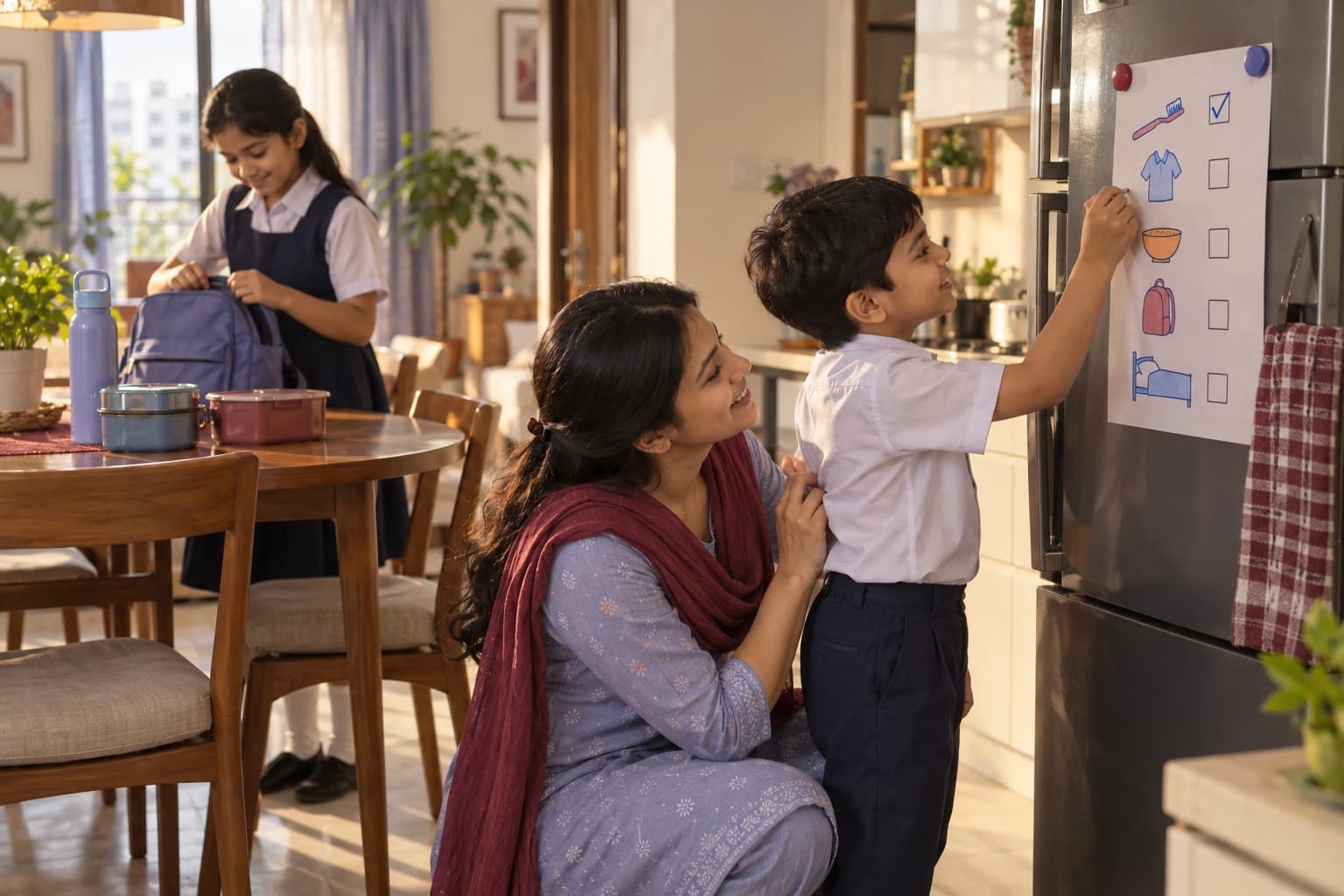
- Make it visible with a simple chore chart: pictures for children who can't read yet, a short list on the fridge for older ones.
- Accept “good enough”. A lumpy bed your child made is worth more than a smooth one you remade behind them.
- Use “when, then” instead of nagging: “When your plate is in the sink, then we can start the cartoon.”
What you might say
- You're old enough to pack your own bag now. Let's do it together this week.
- In our family, everyone helps. Tonight your job is the spoons and glasses.
- When your clothes are in the basket, then it's story time.
- You folded all the towels by yourself. That really helped me.
- It doesn't have to be perfect. You did it, and that's what counts.
Should kids get paid for chores? Praise and pocket money
Families differ on this, and there is no single right answer. Many families find it works best to keep everyday family jobs unpaid, because everyone in a home helps, and to handle money separately.
- Praise first: thank your child for the specific job, such as “You cleared the whole table,” rather than a general “good boy” or “good girl”. More ideas in how to praise a child.
- Pocket money as a learning tool: if you give it, many families start a small, regular amount around the time a child can count money, kept separate from chores, so they learn to save and choose.
- Extra jobs can earn extra: washing the car, sorting the bookshelf or helping before Eid guests arrive can be paid, if you like, because they go beyond the everyday.
- Skip bribes and fines for every job. Paying for each plate cleared, or docking money for each slip, tends to turn helping into a deal.
- Never use chores as a punishment. Extra housework for misbehaving can make helping feel like a penalty.
Should boys and girls do the same chores?
Yes. In many homes, daughters are called to the kitchen while sons are told to study or go and play. Both need the same skills, because every adult needs to cook a simple meal, wash their clothes and keep a room clean. The right chores for each age are the same for sons and daughters.
- Give sons and daughters the same jobs at the same age, and rotate them so no one is stuck with one job.
- Watch the words: “help your mother” makes housework sound like her job. Try “let's get dinner ready”.
- Children copy what they see. When fathers cook, wash up and fold clothes, sons and daughters both learn that home is everyone's. See a father's role in parenting.
- Keep the same safety rules for both: an 8-year-old girl is no more ready for the stove than an 8-year-old boy.
Chores in a Bangladeshi home: house help, grandparents and studies
Many families in Bangladesh have house help, grandparents close by and a heavy study schedule, and all three can mean a child does nothing at home. Age appropriate chores for kids still matter here, in small ways that fit your home.
- With house help: your child still looks after their own things, such as their plate, bed, school bag and clothes, because these are the skills they are learning.
- Respect for the people who work in your home: children ask politely, say thank you, clean up their own mess and never order adults around. More in house help and childcare at home.
- When grandparents say “He is too little, let him be”: thank them for the love, and explain that small jobs help their grandchild grow. Ask them to teach a job they are proud of, such as folding a sari or picking stones from rice.
- When study is “the only job”: a two-minute job, such as clearing a plate, takes nothing from study time. In exam season, cut back to one job rather than none.
- Family occasions: setting the iftar table in Ramadan, serving shemai to Eid guests or arranging chairs before a family dawat are jobs children often love.
- Fit chores into the day: a simple after-school and bedtime routine often turns jobs into habits.
Which chores are not safe for young children?
Some household jobs carry real risks for young children. Keep these for adults, or for older children with an adult right beside them:
- The stove, gas burner, matches and hot oil: none for young children, and at 9–12 only with an adult right beside them.
- Sharp knives, the bonti (floor blade), graters and blenders: keep them out of young children's reach and give them a blunt table knife instead; a small knife at 9–12 while an adult watches.
- Cleaning chemicals: bleach, toilet and floor cleaners, insect spray and kerosene stay locked up high, in their own bottles and never in water or drink bottles. Children under about 12 use only water, a cloth and a little soap.
- Balconies and roofs: young children never climb by the railing to hang clothes or water plants, and go to the roof only with an adult.
- Water and electricity: no full buckets of water near toddlers, no ironing for young children, and no plugs or switches with wet hands.
- Younger siblings: helping is lovely, but never leave a young child alone, or alone with a baby.
A 7-day plan to start chores at home
Note one line each evening: the job, whether it got done, how many reminders it took and how your child seemed.
- Day 1: change nothing. Notice what your child already does at home, and what you do for them that they could do themselves.
- Day 2: choose one or two jobs from your child's row in the table, and tell them warmly: “From today, this is your job.”
- Day 3: do the job together, showing each step slowly.
- Day 4: let your child do it while you watch, and hold back any correction that is not about safety.
- Day 5: tie the job to a routine moment, such as after dinner, and put a picture or list where your child can see it.
- Day 6: step back. Give one calm reminder at most, then thank your child for the specific job.
- Day 7: read your notes. Did the reminders drop? Keep what worked, and add a new job only when the first ones are steady.
When is it more than a chores problem?
Most chore struggles are ordinary and ease with routine. Talk to your child's doctor or teacher if you notice any of these, and act at once on the safety signs:
Get help if
- Your child is well behind most children their age with self-care, such as dressing, washing hands or using the toilet, or has lost skills they had. See child development by age.
- Even simple one- or two-step instructions are hard to follow most days, at home and at school, for months.
- Being asked to help leads to outbursts most days, with hitting, throwing or breaking things.
- Your child carries adult-sized jobs, such as cooking alone or caring for a sick relative or siblings, and is missing school or play. Share the load and ask the school for support.
- Your child swallows a cleaning product, medicine or other chemical: don't try to make them vomit. Take the bottle and go to hospital straight away, and call 999 if your child has trouble breathing or is drowsy.
- A burn or cut: cool a burn under cool running water for about 20 minutes, with no toothpaste, oil or ice. Get medical help the same day for a burn bigger than your child's palm, one that blisters or is on the face or hands, or a cut that is deep or keeps bleeding after firm pressure. Call 999 if your child is badly hurt.
Chores usually become habits slowly, one reminder fewer at a time. ParentMind helps you note what happens each day, see patterns and get guidance: how ParentMind works.
Questions parents ask
At what age should a child start doing chores?
Earlier than many parents think. Toddlers of 2–3 can put toys in a basket or hand you pegs, and by 4–5 most children can manage one or two small daily jobs, such as carrying their plate to the sink. Start with jobs that take a minute, and let them grow with your child.
What chores can a 10-year-old do?
Quite a lot. Most 10-year-olds can make their bed, keep their room tidy, pack their own bag and uniform, fold and put away clothes, sweep or mop a room, wash their own plate and make a simple snack. With an adult right beside them, they can start learning to use the stove safely.
Should I pay my child for doing chores?
It is your choice, and families differ. Many families keep everyday jobs unpaid, because everyone helps at home, and give pocket money separately so children learn to save and spend. Some pay for extra jobs, such as washing the car. Paying for every small job can turn helping into a deal.
My child never helps at home. What can I do?
Start small and teach rather than demand. Pick one daily job, show it a few times, then do it together until your child can manage alone. Tie it to a routine moment, use “when, then” instead of nagging, and thank them for the specific job. Most children need a few weeks before a job becomes a habit.
Should my child do chores if we have house help?
Yes, in a smaller way. House help can do the heavy work, but your child still needs to learn to look after their own things: their plate, bed, bag and clothes. These are life skills, not just household jobs, and helping also teaches respect for the people who work in your home.
Do chore charts really work?
Often, yes, especially for children aged 4–10. A simple chart with three to five jobs, pictures for younger children and a tick when each is done helps children see what is expected without you repeating it. Review it together each week. If the chart turns into a fight, keep the routine and drop the chart.
This article is general information, not medical advice. For health worries, talk to a doctor; if someone is in danger, contact your local emergency number.