Your 7-year-old: development, behaviour, sleep, play and what's normal
Quick answer
A 7-year-old is usually more thoughtful and independent: most read simple books, write sentences, ride a bicycle, keep close friends and follow rules. Moodiness, worries and harsh self-talk ('I'm stupid') are common. Most need 9–12 hours of sleep in 24 hours and at least 60 minutes of active play a day. Talk to a doctor if your child loses skills.
 By the ParentMind team13 min read
Listen to this article
18 min listen · Read by your device's voice
At a glance
- Who it is for
- Parents of 7-year-olds, usually in class one or class two
- Key takeaways
- Most 7-year-olds read simple books, write sentences, ride a bicycle, tell the time on the hour and keep close friends, but reading in particular varies a lot.
- Moodiness, worries, sulking and harsh self-talk like 'I'm stupid' are common at 7, as children start comparing themselves with others.
- Most 7-year-olds need 9–12 hours of sleep in 24 hours, at least 60 minutes of active play a day, and screen limits that protect both.
- Praise effort and progress rather than marks, and talk to the teacher and a doctor early if reading, hearing, sight or friendships stand out as a struggle.
Life with a 7 year old can feel calm one week and puzzling the next: your child reads you a whole page, then tears up a drawing because it isn't perfect. Seven is often a quieter, more thoughtful year. Children start looking inward, comparing themselves with friends and caring deeply about getting things right.
Use this page as a guide, not a test. It covers what to expect from a 7 year old: what most can do, which behaviour is normal, school and homework, sleep and screens, play ideas for a small flat, life in a Bangladeshi home, a school-day routine, a 7-day plan and when to talk to a doctor.
What can a 7 year old do? Development at seven
Seven is a year of steady growth rather than big leaps: skills learned at five and six get smoother, faster and more independent. These are rough descriptions of what most children do around seven; being ahead in one area and behind in another is common.
| Area | What most 7-year-olds do | How you can help |
|---|---|---|
| Body | Rides a bicycle, often without stabilisers; skips rope; throws and catches more accurately; handwriting gets neater; many have a gap where front baby teeth have fallen out | Cycling, skipping and ball games with rules; at least 60 minutes of active play a day |
| Reading and writing | Many read simple books alone, in Bangla, English or both; writes a few sentences, spelling many words by sound | Read together daily and let them read to you; ask about the story, not just the words |
| Thinking | Tells the time on the hour and half hour; knows the days of the week and the months; adds and takes away small numbers; loves riddles, jokes and collecting things | Use a real clock, a calendar and small sums of money; play riddles and card games |
| Friends | Has close friends, often of the same sex; plays in groups with rules; cares a lot about fitting in; may leave others out, or be left out | Listen to friendship troubles; coach kind words for joining in and for including others |
| Feelings | More thoughtful and private; often self-critical and hurt by teasing; worries about school, friends or news they overhear; may sulk rather than have a tantrum | Notice effort out loud; give quiet time to talk; explain news simply and calmly |
| Doing things alone | Washes, dresses and packs a school bag with a few reminders; ties laces; wants privacy when changing; manages small chores and a little money | A morning checklist; one real daily job; knock before entering while they change |
Reading varies widely at 7, especially for children learning two scripts at once: some read chapter books, others still sound out words, and both can be fine. Losing skills they had, at any age, needs a prompt check. See child development stages from 0 to 12 for the bigger picture, your 6-year-old for the year before and your 8-year-old for the year ahead.
7 year old behaviour: moods, worries and 'I'm stupid'
Many parents notice that seven is quieter than six, and more serious. These are common, and usually nothing to fear:
- Moodiness and sulking: going quiet, retreating to a corner, or saying 'Nobody likes me' after a hard day.
- Harsh self-talk and perfectionism: rubbing out work again and again, tearing up a drawing, or saying 'I'm stupid' after one mistake.
- New worries about tests, friends, a parent's health or frightening news, often raised at bedtime.
- Arguing about rules and fairness, or digging in with 'You can't make me'; strong-willed children shows calmer ways through power struggles.
- Lies to avoid trouble that are more convincing than at five; why children lie has age-by-age help.
- 'Not hearing' you when absorbed in a game, a book or a screen; see how to get kids to listen.
When your 7-year-old is hard on themselves
- Don't rush to argue ('You're not stupid!'). First name the feeling: 'You're really disappointed with that page.'
- Get specific about what went wrong: one sum, one word, one shot at goal.
- Add 'yet': 'You can't do joined-up writing yet.'
- Point to past progress: 'Last month that word was hard. Look at it now.'
- Praise effort and strategy, not cleverness or marks.
- Watch what you say about yourself and others; 7-year-olds copy it.
What you might say
- You sound really disappointed. Mistakes mean you're learning.
- You can't do it yet. Shall we try one more together?
- I noticed how long you kept trying with that sum.
- Sounds like a hard day with your friends. Do you want to tell me, or just sit together?
- That news sounded scary. Here's what's true, and here's how we stay safe.
- I'm not angry. I just want the real story, so we can fix it.
School at 7: class two, homework and learning by heart
Depending on when they started and the school's rules, a 7-year-old in Bangladesh is usually in class one or class two. Many schools hold regular class tests, homework comes most evenings, and there is a lot to learn by heart, from poems to spellings in two languages.
- Understanding first, then memorising: ask your child to explain an answer in their own words before learning it by heart.
- Short, steady homework at the same time and place each day, after food and active play, with the TV off.
- Let the work be theirs, mistakes included; sit nearby rather than over them.
- Handwriting and dictation (shrutilipi) improve with a little daily practice, not with punishment for messy pages.
- Talk to the teacher if homework regularly takes far longer than expected or ends in tears most nights; see how to help kids with homework.
What should a 7-year-old be learning beyond the syllabus? Telling the time, handling a little money, making a simple snack like muri makha, owning up to mistakes and asking for help when stuck.
How much sleep, food and screen time does a 7-year-old need?
- Sleep: most 7-year-olds need 9–12 hours in 24 hours. With a school that starts around 8, that usually means lights out around 8:30 to 9. Tiredness at this age often shows up as irritability and tears rather than yawning; see how much sleep children need.
- Screens: from 6 there's no fixed number of hours. Child-health guidance suggests consistent limits that protect sleep, at least 60 minutes of active play, homework and family time, with no screens in the hour before bed and devices out of the bedroom at night. Many 7-year-olds play games on a parent's phone; agree when, where and for how long, and keep it in a shared room.
- Food: three meals and one or two snacks, with a tiffin that lasts through school; many children are hungriest straight after school, so have a snack ready.
7 year old activities for a small flat
Seven-year-olds need at least 60 minutes of moderate-to-vigorous activity a day, the kind that makes them puff, plus time for quieter skills. Ideas that fit a Dhaka flat:
- Cricket or football with a soft ball on the roof, always with an adult there.
- Skipping rope, kutkut and borof-pani (freeze tag) with cousins or neighbours.
- Dancing or an indoor obstacle course on rainy days.
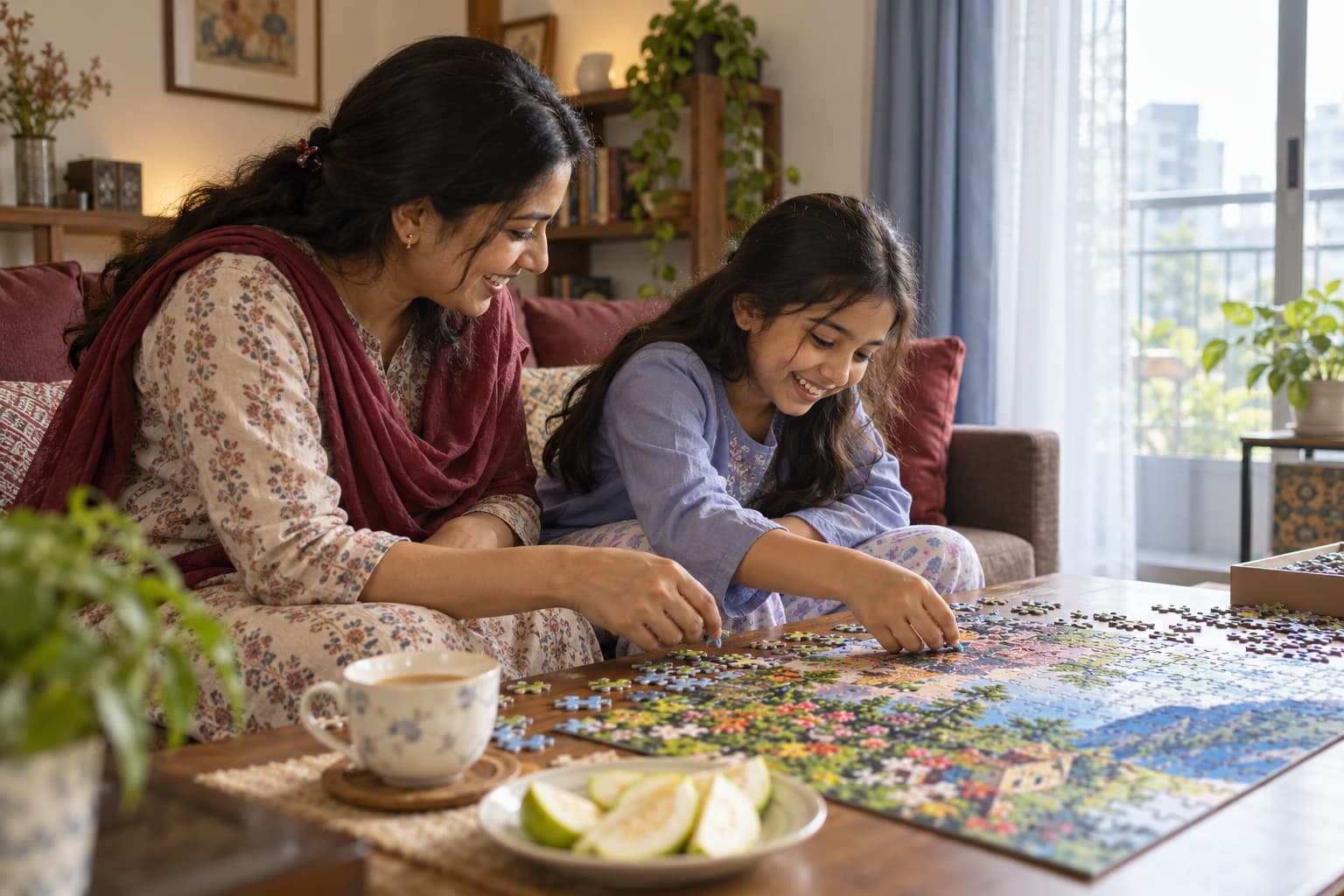
- Carrom, Ludo, cards and dominoes for counting, strategy and losing well.
- Collections and projects: stickers, stones, a leaf album, a cardboard model.
- Kitchen jobs: washing rice, mixing muri makha, measuring dal.
In a Bangladeshi home: privacy, Eid salami and a crowded timetable
Privacy in a shared room
Many 7-year-olds share a room, or a bed, with siblings or grandparents, and many now want privacy when bathing or changing. That's a healthy sign. Give them a corner or a turn in the bathroom, knock before entering, and keep teaching that their body is their own; it fits naturally with body-safety talks.
Eid salami and first lessons with money
Eid salami from relatives is often a 7-year-old's first real money. Instead of taking it all for safekeeping, try a simple split: some to spend, some to save in a box and some to give. Let them buy something small from the corner shop with you watching, and count the change together; it practises maths and self-control at once.
School, a tutor and Arabic lessons: count the hours
By seven, many children have school, a home tutor and, in many families, Arabic lessons with a hujur or a parent. Add up the hours once: if there's no room left for an hour of active play, some free time and 9–12 hours of sleep, something may need to move. Grandparents' stories and Friday family time count too.
A 7 year old routine for a school day
This example is for a child whose school runs from about 8 to 1. Move the times to fit your school, and keep the order steady.
| Time | What happens |
|---|---|
| 6:30 | Wake up, wash, dress and check the bag against the morning list |
| 7:00 | Breakfast together: paratha or roti with egg or dal |
| 8:00–1:00 | School, with a filling tiffin and a water bottle |
| 1:30 | Lunch, then rest, reading or quiet play |
| 4:00 | Snack and at least an hour of active play, outside or on the roof with an adult |
| 5:30 | Homework in short chunks, or a tutor session |
| 7:00 | Free time, with any screen time here, then a family job like setting the table |
| 7:45 | Dinner with the family, then a wash and the bag packed for tomorrow |
| 8:45 | Reading in bed or a chat about the day, then lights out |
A 7-day plan for calmer days with your 7-year-old
Pick one change, note what happens each day, and compare after a week.
- Day 1: Note the hard moments: when your child sulks, argues or says 'I can't', and what came just before.
- Day 2: Protect one hour of active play and a bedtime that allows 9–12 hours of sleep.
- Day 3: Swap one correction for a question: 'What do you think went wrong?'
- Day 4: Praise one specific effort out loud, not a mark or a talent.
- Day 5: Give 10 minutes of one-to-one time, with your phone away, and let your child choose what you do.
- Day 6: Hand over one real responsibility, like packing the school bag or feeding the fish, and let small mistakes happen.
- Day 7: Compare with Day 1, keep what helped, and share it with everyone who looks after your child.
When to talk to a doctor or teacher about your 7-year-old
Most 7-year-olds who are slower in one area catch up with steady support. Talk to your child's doctor, and the teacher where it fits, if:
Talk to a doctor or teacher if
- Your child loses skills they had, such as speech, reading or using the toilet. Get this checked promptly.
- Your child isn't doing several things most 7-year-olds do, or still finds letters and reading very hard after several months of steady help while managing well in other ways; ask for an eye and hearing check too.
- Hearing or sight worries: your child often mishears, can't see the board, squints, holds books very close or gets headaches after reading.
- Worries, stomach aches or tears on most school mornings for a few weeks, refusing school for more than a week or two, or no friends at all for a long stretch.
- Bullying, a sudden change in behaviour, or a teacher or tutor hitting or humiliating your child: believe your child, act the same day, and call 999 if your child is in danger now.
- Low mood most days for two weeks or more, harsh self-talk that does not ease, or any talk of not wanting to live or of self-harm. For any such talk, stay calm and close: call 999 if your child is in danger now; otherwise speak to a doctor the same day.
ParentMind helps you note moods, sleep and school days, so you can see what makes the hard days harder; see how ParentMind works.
Questions parents ask
What should a 7 year old be able to do?
Most 7-year-olds can ride a bicycle, skip, read simple books, write a few sentences, tell the time on the hour, add and take away small numbers, and keep close friends. Many dress, wash and pack their school bag with a few reminders. Reading varies a lot at this age, so being early or later is usually fine.
Is it normal for a 7 year old to be so moody?
Yes, for many children. Seven is often a more inward year: children notice more, compare themselves with others and feel criticism sharply, so sulking, tears and 'nobody likes me' are common. Tiredness and hunger make it worse. Offer quiet time and a listening ear, and talk to a doctor if low mood lasts most days for two weeks or more.
Is it normal for a 7 year old to say 'I'm stupid'?
It is common, especially after a mistake, because 7-year-olds start judging themselves against others. Don't argue it away; name the feeling, get specific about what was hard, and add 'yet'. Praise effort rather than cleverness. If the self-criticism is constant, grows into 'I hate myself', or comes with low mood for weeks, talk to a doctor.
Is it normal for a 7 year old not to read well yet?
Often, yes. Reading develops at very different speeds, and children learning Bangla and English at once may take longer in one script. Read together daily, let them read easy books they enjoy, and keep it calm. Talk to the teacher and a doctor if letters and sounds are still very hard after several months of steady help, and ask for an eye and hearing check.
Why does my 7 year old argue about everything?
Because they now think more logically and care about fairness, so they test your reasons; arguing is also a way to feel some control. Keep a few firm rules, explain them once, offer choices within them and avoid long debates. Notice when they cooperate. If arguments become constant defiance at school and at home for months, talk to a doctor.
What is a good daily routine for a 7 year old?
A good school-day routine keeps the same order: wake, breakfast, school, lunch and rest, an hour of active play, short homework, free time, dinner with the family, then reading or a chat and lights out. Aim for 9–12 hours of sleep in 24 hours, and keep weekend bedtimes close to school nights.
This article is general information, not medical advice. For health worries, talk to a doctor; if someone is in danger, contact your local emergency number.